Gulf states today face a security dilemma that is less about their advanced arsenals or the foreign military bases on their soil than about the authority to make security-related decisions.
Who holds the power to decide when to wage war, when interests diverge and external guarantees are subject to the calculations of major powers? For decades, this issue was sidelined and obscured by financial abundance, military alliances and massive arms deals. Today it has returned to the heart of strategic debate, as wars, crises and regional shifts expose the limitations of traditional security concepts and force a re-examination of the interplay between power, sovereignty and diplomacy.
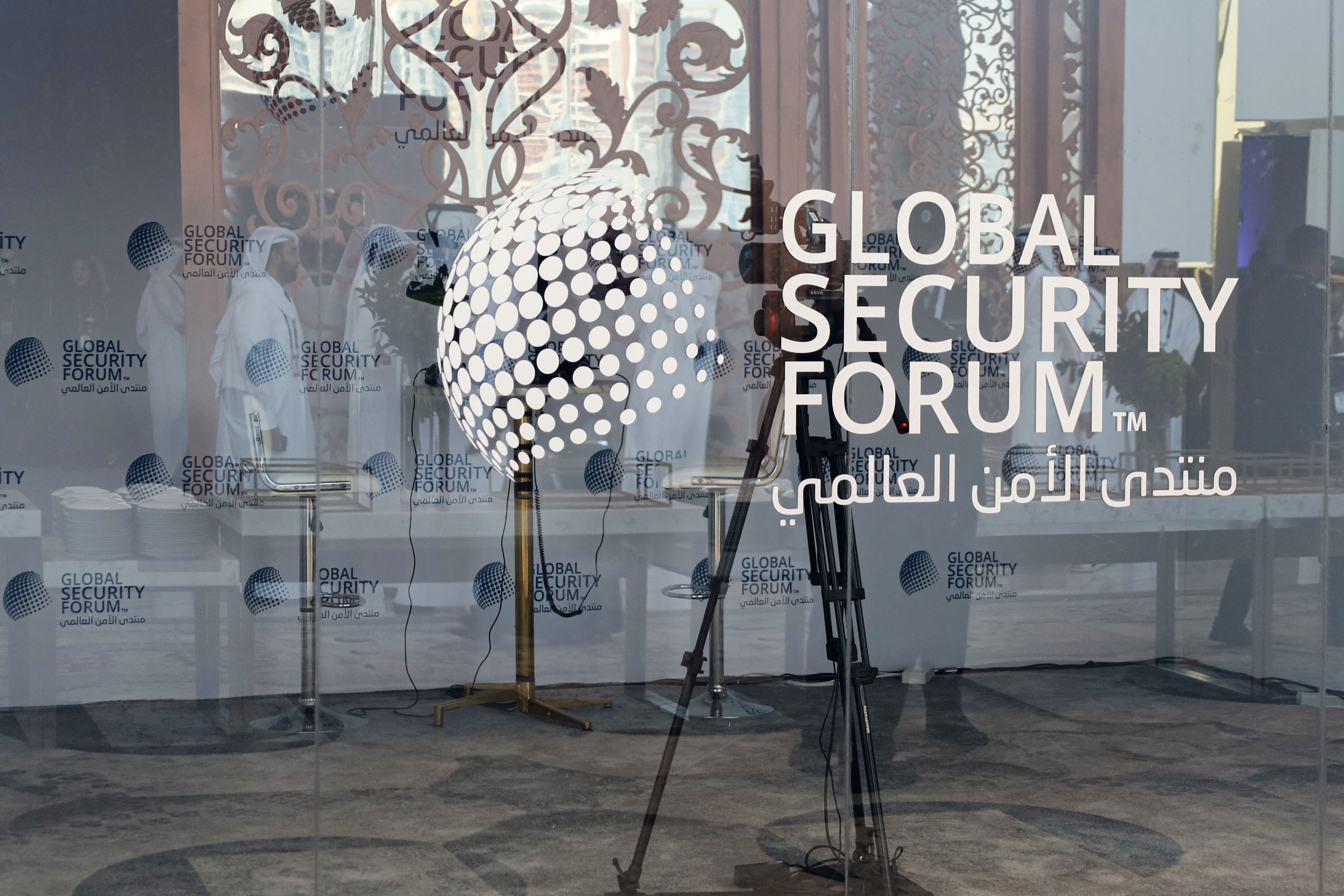
That imbued this year’s Global Security Forum—held in Qatar and attended by government officials, diplomats and parliamentarians, alongside security and strategic experts—with renewed importance.
The region is navigating shifting deterrence equations and evolving alliances, as the line between national security and regional conflicts is increasingly blurred. Gulf states are confronting challenges that necessitate a radical reassessment of the security philosophy that has guided their policies for decades.
The announcement of an initiative to establish a defense industries hub in Qatar adds a practical dimension to these discussions, leading to deeper questions over the future of national defense capabilities, the limits of reliance on international partners, and the potential for a gradual transition—from imported arms and security guarantees toward knowledge and technology transfer for domestic production and development.
A New Gulf Security Equation
For decades, the Gulf security equation was built on a core premise: that strategic partnerships with the U.S., bolstered by Western military superiority, would provide a sufficient deterrent to protect the Gulf states from external threats. This was reinforced by an extensive network of military bases, defense agreements and arms deals, a foreign military presence that became integral to the regional security architecture.
However, recent developments have exposed a fundamental problem here: the conflation between maintaining a military alliance with a major power and receiving an absolute security guarantee from it. Defense agreements do not negate the independent political interests of their signatories, nor do they necessarily imply that an ally will intervene militarily in every crisis or bear the costs of confrontation when doing so conflicts with its own strategic calculations.
Despite spending hundreds of billions of dollars on arms over recent decades, the Gulf states continue to face challenges over the integration of their defense systems, the autonomy of their supply chains, and their ability to sustain military operations throughout prolonged crises. This is not due to insufficient financial resources, but is the result of a security model that has prioritized procuring of off-the-shelf capabilities over the development of an industrial and technological base able to produce and sustain such assets.
The U.S. will certainly remain a key Gulf security partner for the foreseeable future. However, it is important to examine the nature of this relationship, ensuring it is not viewed as a substitute for indigenous defense capabilities.
States that rely on outside actors for weaponry and intelligence may procure advanced military capabilities, but they will not necessarily enjoy full strategic autonomy.
Building National Capabilities
Speaking on the sidelines of the forum, Qatar’s Deputy Prime Minister and Minister of State for Defense Affairs, H.E. Sheikh Saoud bin Abdulrahman Al Thani, announced the establishment of a defense industries hub as part of a strategy to bolster Qatar’s national capabilities. This has far-reaching strategic implications, reflecting a shift from a model centered on the procurement of arms toward one focused on building national defense capabilities and localizing military knowledge and technology.
Security today cannot be measured solely by the size of a nation’s arsenal or the sophistication of its weaponry, but also by its ability to produce, maintain and develop its own defense needs, while ensuring operational readiness during crises. Qatar’s shift also reflects an understanding that strategic autonomy cannot be achieved merely by procuring weapons, but by mastering the ability to produce them—thereby strengthening national sovereignty and reducing dependence on external guarantees and supplies.
The strategic value of any defense facility is not determined by the scale of its infrastructure or the investments allocated to it, but rather by the functions it performs, and by its capacity for technology transfer, the localization of defense industries and the development of local expertise. There is a profound difference between establishing a facility for assembling imported equipment and building a national base with the technical and engineering know-how required for development, production and long-term sustainability.
It is also important to define the modalities of cooperation with the U.S., the UK and France—nations with advanced expertise in defense manufacturing—while simultaneously expanding collaboration with regional partners having varying degrees of experience in military manufacturing and defense technology. Yet the success of such partnerships hinges on their evolution beyond the traditional relationship between buyer and seller, into industrial and technological alliances encompassing research, development, training and knowledge exchange.
This does not imply that Qatar should strive for absolute military self-sufficiency—an elusive goal even for major industrialized nations. Rather, the objective is to identify specific strategic areas where the development of indigenous national capabilities is vital. More importantly, the localization of defense industries must not be reduced to an economic slogan or a symbolic project, but should be integrated into a long-term national strategy integrating military institutions, universities, research centers and the industrial sector. Technology should not simply be bought; what is required is a scientific and institutional environment capable of absorbing and developing that technology, while generating new knowledge by building upon it.
Diplomacy Alongside Strength
The development of Qatar’s defense capabilities raises further questions over the relationship between military power and the diplomatic role Doha has played over the past few decades—notably through mediation, containing conflict and opening channels for dialogue between belligerents.
At first glance, strengthening Qatar’s military capabilities could appear to conflict with the state’s diplomatic identity. However, this fails fully to understand the relationship between power and politics. Diplomacy does not operate in a strategic vacuum, nor can it remain independent if the state practicing it is unable to protect its own sovereignty and core interests.
Qatar has successfully established a diplomatic standing characterized by an ability to engage with opposing sides and keep channels of dialogue open during moments of political deadlock. This derives its significance not from its military might, but from political trust, diplomatic flexibility and an ability to manage complex relationships.
However, for this role to endure, it must be bolstered with national defensive capabilities—especially within a regional environment characterized by a complex interplay of direct and indirect conflicts, in which strife is increasingly likely to spill over into the states attempting to contain it.
As such, a distinction must be made between the possession of power and its application, and between building deterrence and militarizing policy. The objective is not for Qatar to become a military participant in regional conflicts, but rather that it possesses the capabilities necessary to safeguard its national security, while preserving the independence of its decision-making and its credibility as a diplomatic mediator.
Diplomacy underpinned by a credible defensive capability is no less inclined toward peace. Rather, it is better equipped to achieve it, free from pressure or blackmail. The goal is not to replace Western alliances with others, nor to shift from reliance on one major power to dependence on its rival, but to construct a security policy rooted in diverse partnerships, developed national capabilities, enhanced regional cooperation, and the preservation of independent political decision-making.
Furthermore, Gulf security cannot be reduced to the military dimension alone. The sources of regional instability are also linked to political conflicts, regional rivalries, economic crises and societal divisions. Consequently, the development of an advanced defensive system must be accompanied by proactive diplomacy aimed at de-escalating tensions and addressing the root causes of conflicts, rather than merely managing their consequences.
From this perspective, Qatar’s move toward developing its national defense infrastructure offers an opportunity to rethink the relationship between power and diplomacy, between external alliances and indigenous capability, and between national security and regional stability.
The most significant strategic lesson to be drawn from the region’s recent crises is that external guarantees—no matter how robust—are ultimately contingent upon the interests of the states that provide them. In contrast, a nation’s own capacity to safeguard its sovereignty remains the cornerstone for building long-term security.
It is time for the Gulf states to shift their focus from the question of who can protect them when war breaks out to a more critical inquiry: How can they cultivate the strength, knowledge, and cooperation necessary to ensure their security is less dependent on the decisions of others? The core dilemma lies not in a lack of allies or weaponry, but rather in the tendency to treat an alliance as a substitute for indigenous capability, and in the gap between possessing arms and having the autonomy to make one’s own strategic decisions.
This article was originally written in Arabic. This English version is an adapted translation of the original text.
The opinions expressed in this article are those of the author and do not necessarily reflect the views of the Middle East Council on Global Affairs.