

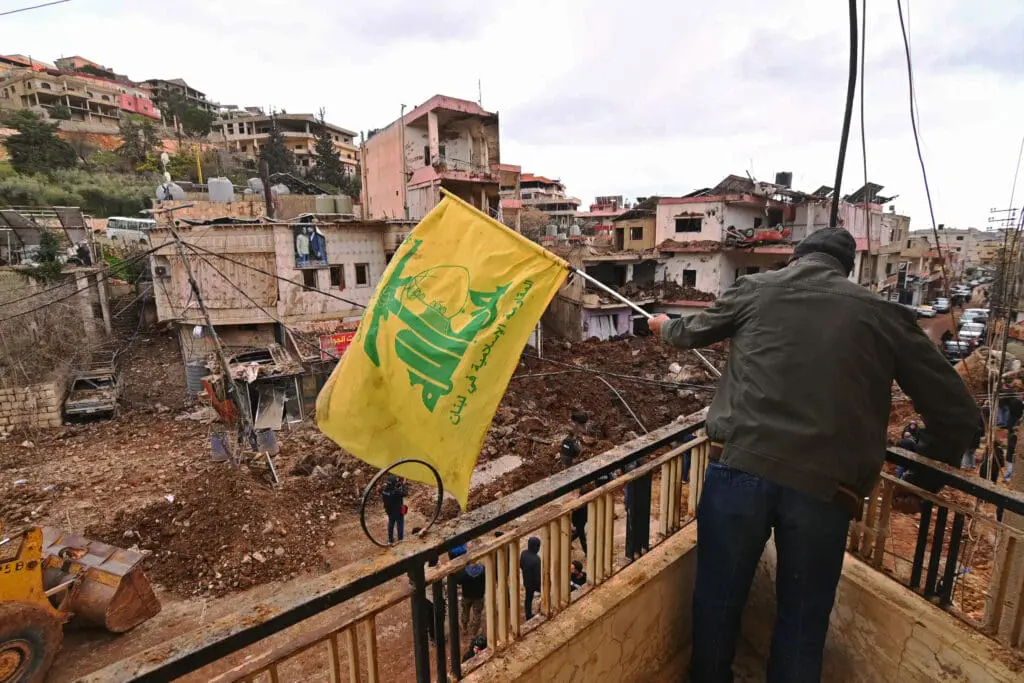
Israel’s war on Lebanon is rapidly escalating, with military operations penetrating deep into Lebanese territory: in the south, the Bekaa Valley, and key areas of Beirut—especially its southern suburb of Dahiya. The conflict is no longer confined to the border region between the two states. It has metastasized into an all-out war, imposing new military and security realities across the country. Diplomatic efforts have been ineffective in halting or even curbing the escalation, including an intervention by French President Emmanuel Macron.
Beyond its military scope, the war has also triggered a profound domestic political crisis in Lebanon. The latest round of confrontation comes less than 18 months after the end of Hezbollah’s “war of support” for Gaza, during which the group sustained major losses to both its military structure and leadership. Hezbollah lost two successive secretaries-general, while its senior leadership and security apparatus were crippled by a series of Israeli assassinations and targeted strikes.
That war ostensibly ended with the signing of a “cessation of hostilities” agreement under American and French auspices, which came into effect on November 27, 2024. Yet the hollow deal did not actually bring an end to Israel’s attacks on Lebanese territory, which continued in the south and the Bekaa. Hezbollah, for its part, withdrew from these areas in order to regroup, seeking to restore its military and political equilibrium.
Now, as war between the United States, Israel and Iran engulfs the region, Lebanon has once again become a battlefield. This time, however, the conflict is unfolding within a markedly different domestic political context. As a result of the weakening of Hezbollah and under pressure from the U.S. and Israel, the Lebanese state has adopted a more confrontational posture and is seeking the group’s disarmament.
On March 2, after Hezbollah fired missiles into Israel in response to the killing of Iranian Supreme Leader Ayatollah Ali Khamenei, the government of President Joseph Aoun announced that Hezbollah’s military activities were outlawed and that it must confine its role to the political sphere. Lebanon now faces a dilemma unlike any it has experienced in recent decades: a fierce, open military confrontation with Israel alongside an internal crisis of legitimacy surrounding Hezbollah’s arsenal and its role as an armed force.
A Second War in a Broader Regional Context
Hezbollah’s decision-making amid the U.S.-Israeli war on Iran has quickly turned Lebanese territory into a major theater of the broader regional conflict. Israel has responded with predictably extreme force, exceeding even the scale and scope of the heavy bombardment during the previous confrontation.
Israel has also launched ground incursions into southern Lebanon and has signaled the possibility of a major invasion. The entire population of the south has been ordered to evacuate, displacing roughly 700,000 people.
Hezbollah has clearly entered this war in a different state than in previous rounds of combat. The war it fought in 2023–2024 inflicted significant losses on its leadership and military structure. In response, Tehran dispatched more officers and advisors from the Islamic Revolutionary Guard Corps (IRGC)—particularly its extraterritorial branch, the Quds Force—to assist in restructuring the Lebanese movement.
This has given rise to a more complex command structure for directing military operations and a more prominent role for the Quds Force in providing operational, logistical and technical support—including direct coordination with Iran’s own operations against Israel. The Lebanese government has responded by banning the IRGC’s activities inside Lebanon.
Nevertheless, this coordination has been evident in joint operations, with Iran and Hezbollah launching simultaneous attacks on Israeli targets in an attempt to overwhelm Israeli air defense systems. This military interdependence helps explain why Israel has targeted Iranian figures inside Lebanon, in a bid to sever operational coordination between Tehran and Hezbollah.
An Unprecedented Crisis Within Lebanon
Despite the gravity of these military developments, the most sensitive aspect of the current war lies in its repercussions within Lebanon itself. The government’s decision to deem Hezbollah’s military and security activities illegal represents a significant shift in the Lebanese state’s approach to the group’s weapons. Since the ceasefire agreement, Beirut has treated the issue as a complex political matter requiring long-term domestic arrangements.
Today, as the bombs fall, official discourse has become unprecedentedly blunt, pitting Hezbollah’s arsenal in direct confrontation with the state’s legal authority. One statement from the president asserted that Hezbollah’s attack was intended to set a “trap” that would either force the Lebanese military to futilely confront Israel, or back down and prove that Hezbollah is the only armed force capable of defending the country, thereby justifying its armament.
As a result, Lebanon appears to be proceeding along two paths simultaneously. The first is the military path tread by Hezbollah in its confrontation with Israel—a trajectory of open-ended escalation that could lead to broader operations in the coming phase. The second path is political—an effort by the Lebanese government to pursue direct negotiations with Israel as a way of ending the war.
In recent days, President Joseph Aoun and Prime Minister Nawaf Salam have publicly spoken of Lebanon’s readiness to engage in formal negotiations under international auspices. This reflects a growing awareness within state institutions that if the war continues, outside powers could impose new security arrangements on Lebanon.
The relationship between these two tracks is highly complex. While the state speaks of direct negotiations with Israel and asserts its monopoly over the use of force, Hezbollah continues to wage its military confrontation on the ground, framing the conflict as an existential battle and part of a broader historical struggle with Israel.
This divergence reflects a deeper crisis over the nature of decision-making in Lebanon. The current war is not only between Israel and Hezbollah. Rather, it reveals the limits of the Lebanese state’s ability to control the course of events within its own territory or to implement its decisions amid the ongoing war and the collapse of already fragile domestic power balances—pressures compounded by the massive displacement crisis generated by the war.
Whatever comes next, the conflict underway marks a pivotal moment in Lebanon’s history. It threatens not only the country’s security and stability but also opens up an intense domestic debate over the nature of the state and the limits of its authority. In the absence of a clear prospect for ending the confrontation, events in Lebanon are likely to unfold along one of three principal scenarios.
The first scenario would see international and Arab diplomatic efforts succeed in imposing a prompt ceasefire—most likely through a return to the November 2024 ceasefire framework. Such an outcome could freeze the military situation and reduce immediate humanitarian and security pressures. However, it would do little to address the underlying structural crisis related to Hezbollah’s weapons and the unresolved question of who ultimately controls decisions of war and peace in Lebanon.
The second scenario would involve a prolonged war marked by escalating Israeli operations aimed at significantly weakening, or even destroying, Hezbollah’s military capabilities. Such a campaign could profoundly reshape Lebanon’s domestic balance of power. Yet it would also carry enormous risks, including widespread destruction, deeper humanitarian crises, and the potential collapse of already fragile state institutions.
The third, and most controversial, scenario would see the war conclude with external security and political arrangements imposed on Lebanon. These could take the form of a buffer zone in the south or new political constraints on the Lebanese state.
In all three cases, the central issue remains the same: the relationship between the Lebanese state and Hezbollah’s military power. Whether through diplomacy, prolonged conflict, or externally imposed arrangements, the war is likely to reopen fundamental questions about sovereignty, authority, and the structure of political power in Lebanon.
It is clear that Lebanon is facing a situation unprecedented since the end of the civil war in 1990. Today, the conflict is no longer limited to domestic rivalries or internal balances of power. Instead, it has become inseparable from the broader reshaping of the regional order.