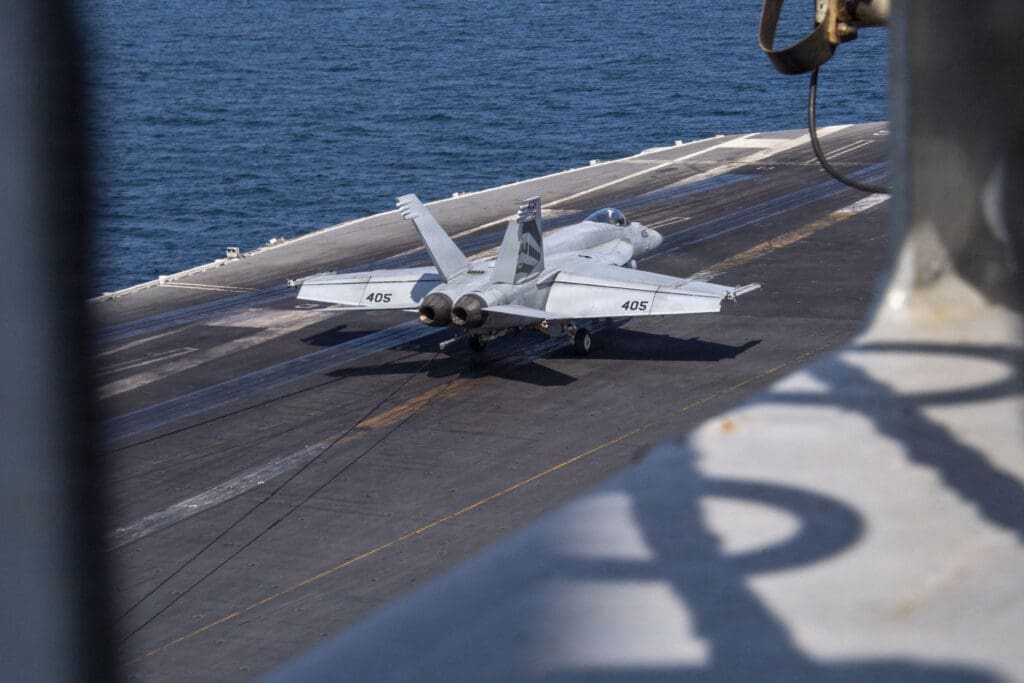
Various levers of pressure are still at play in the U.S.-Israeli war with Iran, notably Tehran’s ability to disrupt traffic through the Strait of Hormuz or to strike American bases and critical infrastructure throughout the region. While Washington may be able to deliver a decisive military blow against Iran, what is less certain is whether it can translate this into a strategic outcome that ends the conflict, rather than perpetuating and deepening it.
The premise of a decisive military outcome rests on a simple logic: if Washington’s capabilities vastly exceed those of Tehran, then a devastating strike on Iranian nuclear facilities, air defenses, missile sites and command centers could weaken Tehran to the point where it either accepts American terms or ceases its escalation.
This logic is not entirely unfounded. The U.S. air and naval forces are capable of executing precise operations at short notice, and U.S. Central Command (CENTCOM) has already completed preparations for another military strike. Prior to the U.S. midterm elections, President Donald Trump had considered a large-scale strike targeting Iranian infrastructure and nuclear facilities after the vote.
The problem is that the crisis cannot simply be resolved by destroying a single facility. It involves a regional political and security apparatus built upon a system of government that views the conflict as existential. It relies on distributed missile and drone capabilities, a network of allies and proxies across Iraq, Lebanon, Yemen and elsewhere, and the strategic geography of the Strait of Hormuz, which grants Tehran global leverage.
Therefore, even if hundreds of targets are destroyed, Iran could potentially still retaliate and transform the conflict into a protracted war of attrition. Israel’s Institute for National Security Studies (INSS) has noted that despite sustaining damage, Iran remains resilient and able to disrupt maritime navigation, strike pipelines and target critical infrastructure.
Furthermore, the 40-Day War from February to April demonstrated that military strikes do not automatically bring about political capitulation. The confrontation began with Israeli and American strikes on Iranian targets, then evolved into a multidimensional regional conflict involving Iranian missile and drone barrages, attacks on shipping and threats against Gulf military bases and infrastructure. Moreover, the April ceasefire and the June memorandum of understanding collapsed within weeks, underscoring that temporary agreements can only yield a strategic solution if they address the root causes of the conflict.
Evolving Capabilities and Doctrine
Iran does not rely solely on a conventional army or ballistic missiles, but also on a hybrid arsenal comprising ballistic and cruise missiles, drones, asymmetric naval capabilities and air defense systems. This makes it harder to counter, and ensures a multifaceted and distributed response to any American strike. Reports indicate that Iranian attacks on U.S. bases have prioritized early-warning systems and aircraft hangars, before targeting warehouses, facilities and personnel. This suggests that Iran is not merely waiting for a strike, but actively seeking to disrupt layers of American defense before targeting higher-value assets.
Iran’s ability to impose asymmetric costs, by leveraging the Strait of Hormuz and by forcing adversaries to intercept cheap drones with expensive missiles, feeds into a new doctrine of deterrence. Rather than seeking military victory, it aims to impose prohibitive political, economic and military costs on its adversaries. This involves striking U.S. bases in the region, energy and export infrastructure in Gulf states and maritime navigation in the straits of Hormuz and Bab el-Mandeb, while leveraging allies and proxy groups to diversify battlefronts, and maintaining its nuclear program as a tool for political pressure and deterrence.
The conflict has thus devolved into a war of attrition: while Iran faces economic constraints and limited capabilities, the U.S. and its allies face limits to the military, economic, and political costs they are willing to bear.
Conversely, Washington often uses swift, decisive strikes with limited objectives—disrupting Iran’s nuclear program, destroying specific capabilities or deterring Tehran. However, this doctrine has a fundamental weakness: while it may achieve military objectives, the broader political goal—neutralizing the Iranian threat or altering Tehran’s behavior—remains elusive. Past strikes have failed to resolve the conflict, typically leading instead to a temporary truce which collapses into limited skirmishes. That said, while Trump has not ruled out future military action, the sweeping Republican defeat in the U.S. midterm elections has reduced the likelihood of a new round of escalation.
Military vs. Political Victory
While military victory entails destroying or weakening an adversary’s capabilities, political victory signifies achieving a stable objective—namely, altering an adversary’s behavior, compelling them to reach an agreement, neutralizing the threat they pose or reshaping the regional order. It is vital to distinguish between these objectives; Washington could destroy dozens of targets, yet find itself facing an even more hardline adversary, a less stable region, and allies who have lost faith in American protection. As the 40-day war showed, strikes could weaken Iran but fail to eliminate its capacity to cause disruption or force it to capitulate.
Translating U.S. military dominance into political victory would require several preconditions: a clear political objective, the ability to prevent the escalation from spiraling into a full-scale war, and coordination between the U.S. and its allies: Israel, the Gulf states and Europe. It also requires a plan for filling the resulting power vacuum and preventing Iranian retaliation, plus a political settlement and an economic strategy that accounts for oil prices and defense costs—all while considering American public opinion. Absent these conditions, any military victory will remain tactical, not strategic.
The Republicans’ lackluster performance in the U.S. midterm elections directly influences these calculations. Some analysts believe Trump may resort to a military strike to reassert his strength. Conversely, he may become more cautious. While the transitional period before the new Congress assumes office might provide a window of opportunity, it offers no political solution.
The war has raised the cost of living for American voters; by mid-October, rising energy prices and knock-on impacts had cost the average American household approximately $2,000. This exerts pressure on decision-makers, making a protracted war less appealing, regardless of the military options available. Washington may therefore favor a limited strike it could present as an “achievement,” rather than embarking on an open-ended conflict. Yet rather than resolving the underlying problem, such a strike could trigger a new cycle of escalation.
The Gulf as a Battlefield
The Gulf states will sit at the heart of any renewed confrontation, whether through attacks on critical infrastructure and civilian targets, renewed energy supply disruptions, or the hit to long-term investor confidence. The war thus compels the Gulf states to re-evaluate their security strategies. Relying exclusively on American protection is no longer sufficient, as the U.S. could launch strikes serving its own priorities without adequate coordination with its allies.
While some in the Gulf might welcome American pressure on Iran, nobody wants another war. Consequently, the Gulf states will likely focus on strengthening their own capabilities, particularly in air defense and counter-drone systems; diversifying international partnerships (including with Europe, China and other Asian nations); developing alternative transit routes and pipelines to reduce reliance on the Strait of Hormuz, and maintaining diplomatic channels with Tehran to prevent a total conflagration.
A swift military victory may be tactically feasible, but would fall short as a strategic solution. U.S. strikes might destroy key targets and set back Iran’s capabilities, but cannot alter geography, dismantle Iran’s regional network, diminish its political will or negate the costs of war for the U.S. and its allies. Moreover, the evolution of both its offensive and defensive capabilities, from missiles and drones to advanced air defense and naval assets, has rendered the war far more complex and less susceptible to a quick resolution. True victory demands that Washington protect its allies, maintain domestic and international political legitimacy, and translate battlefield outcomes into a stable order.
Yet a genuine political victory would remain far harder to achieve than a military one, as it requires not only winning a single round, but ending the cycle of escalation. For the Gulf states, the priority is to minimize the risk that their territories, waters and energy infrastructure become a theater for a war that does not serve their interests. Consequently, building stronger self-defense capabilities, diversifying energy transit routes and sustaining regional diplomacy are not strategic luxuries, but security and economic imperatives.