

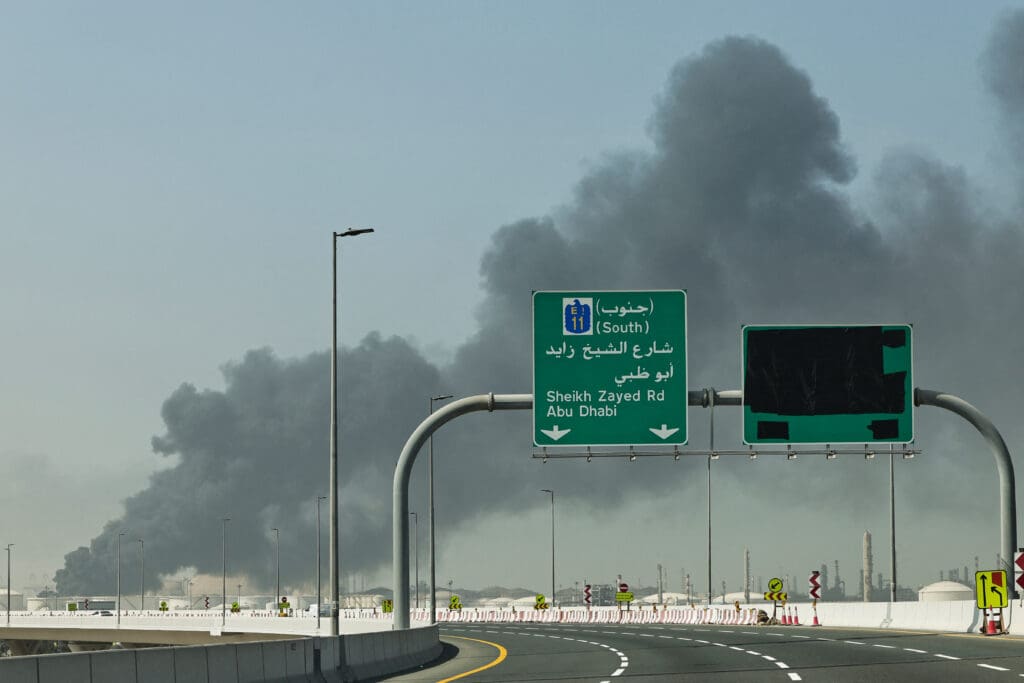
When the United States and Israel launched their war on Iran in late February, Tehran responded, in large part, by attacking military installations and civilian infrastructure in the Gulf states. The Islamic Republic’s strategy was to immediately raise and disperse the cost of the war by destabilizing the global economy and pressuring the Gulf states over their security ties with Washington—all while projecting resilience in a war of survival.
Iran has justified its attacks by alleging that U.S. and Israeli forces used Gulf bases and airspace to carry out Operation Epic Fury on February 28. Gulf officials have uniformly denied this, and Tehran has offered no evidence. For many in the region, the more salient reality is that Washington proceeded with the war despite explicit Gulf opposition—fueling Gulf resentment of an American policy seen as indifferent to the security of its closest Arab partners.
More than a month into the conflict, the Gulf states are operating in a fundamentally altered security landscape. GCC members now face a difficult balancing act: They want to avoid further escalation of a war they sought to prevent, yet they must find a way to deter Iran from additional aggression against them. Officials fear that failure on either front will result in the Gulf becoming a permanent arena for Iranian retaliation whenever tensions escalate with Washington.
For now, the Iranian missile and drone attacks against high-value economic and energy targets in the GCC have shored up a sense of Gulf Arab unity. However, not all GCC members are responding to Tehran’s aggression in the same manner.
Diverging Strategies
Responses to the war from the six Gulf Arab states exist along a spectrum. On one end—although also divergent in their own right—are Saudi Arabia and the United Arab Emirates (UAE), which have been the most willing to align with Trump against Iran. Both view deterrence—potentially through cooperation with U.S. military efforts—as necessary to prevent sustained Iranian strikes on their countries and the other GCC members.
The UAE’s ambassador to the United States, Yousef Al Otaiba, wrote in The Wall Street Journal on March 25, “A simple cease-fire isn’t enough. We need a conclusive outcome that addresses Iran’s full range of threats: nuclear capabilities, missiles, drones, terror proxies and blockades of international sea lanes.” He added, “Iran’s nuclear capabilities have been degraded. Its proxies have been weakened. More needs to be done to remove the missile and drone threats. And we are ready to join an international initiative to reopen the [Strait of Hormuz] and keep it open.”
Notably, since February 28, Iran has targeted the UAE—by volume—more aggressively than any other country in the region, including Israel. Tehran’s strikes on military and civilian sites in the UAE appear linked to Abu Dhabi’s participation in the Abraham Accords and its alleged role in assisting the U.S. with attacks on Iranian civilian targets, as well as calibrated to exploit Dubai’s position as a major hub in the global economy. Escalatory rhetoric has accompanied these attacks, including warnings tied to long-standing territorial disputes over the islands of Abu Musa and Greater and Lesser Tunbs—amid fears that the Trump administration might order a ground invasion. In this context, the Iranian security analyst Morteza Simiari warned on national television that Iran is prepared to capture the coastlines of the UAE and Bahrain.
Saudi Arabia, meanwhile, has reportedly opened King Fahd Air Base in Taif to U.S. forces. The move enhances operational depth for Washington while reflecting a shift away from the Saudi-Iranian détente that was consolidating before the war. Riyadh’s calculus appears to be driven by the assessment that it cannot allow Iran to target the Saudi kingdom without repercussion.
Bahrain tends to align with the UAE and Saudi Arabia during major regional crises, and the current war is no different. Bahrain has been a major target of Iranian strikes, likely due to hosting the U.S. Navy’s Fifth Fleet, and for normalizing relations with Israel in 2020—Israel’s embassy in the Financial Harbour Towers has been targeted. Bahrain has also spearheaded the diplomatic effort for the GCC at the United Nations due to its position on the Security Council. But Manama could also find itself involved militarily if Abu Dhabi and Riyadh join the fray.
Kuwait is second only to the UAE in being hardest hit by Iran, underscoring how much this conflict, like the Iran-Iraq War in the 1980s, has spilled into its own territory. Kuwaiti Foreign Minister Sheikh Jarrah Jaber Al Sabah has accused Iran of a “systematic pattern of undermining regional stability” while “exploiting chaos and terrorism as tools of influence.”
True to form, Kuwait has approached this security crisis within the framework of tight Gulf Arab unity. In line with its traditional stance, Kuwait’s position is that GCC and Arab League cohesion and collective action are the best way to counter aggression by Iran or any other external actor.
On the other end of the spectrum are Oman and Qatar. Oman has suffered the fewest attacks among GCC states and remains the most committed to maintaining normalized relations with Iran, despite being hit by Iranian drones several times since March 1 (although the new Iranian supreme leader, Mojtaba Khamenei, has denied Tehran’s involvement and blamed the attacks on Israel).
By generally refraining from attributing significant blame to Tehran for attacks on GCC territories, including its own, Muscat has prioritized de-escalation and keeping diplomatic channels open with Iran, the U.S., and other countries involved in the conflict.
On March 18, Omani Foreign Minister Sayid Badr Albusaidi wrote in The Economist that while Iran’s strikes on “American targets” in GCC states were “unacceptable” and “deeply regrettable,” he also said such retaliation on Tehran’s part was “inevitable” and “probably the only rational option available to the Iranian leadership.” Albusaidi also articulated his view that Israel persuaded Trump to unnecessarily wage what he said was “not America’s war.”
Qatar has gone further than Oman in taking diplomatic actions against Iran, as evidenced by the foreign ministry’s use of strong language to call out Iran by name and expelling Iran’s military and security attaches from Doha in the aftermath of Tehran’s strike on Qatar’s most important LNG facility, Ras Laffan. Nonetheless, as foreign ministry spokesperson Majed al-Ansari articulated, the Qatari leadership holds that only through diplomatic means can this war be resolved. Al-Ansari stated that Doha would back “all formal and informal” diplomatic channels, and he emphasized that his country and Iran must “find a way to live next to each other,” adding that “total annihilation of Iran” is not a viable option.
Balancing Diplomacy and Deterrence
One month into the war it is clear that the Gulf’s security dynamics have drastically shifted, forcing all six GCC members to make difficult decisions when navigating threats posed by an increasingly radicalized Iran and the realities of Trump’s ever-erratic foreign policy in his second term.
The spectrum of responses—from Saudi Arabia and the UAE’s alignment with U.S. military efforts to Oman and Qatar’s de-escalatory diplomacy—highlights varied GCC approaches to Iran’s strikes, even as the Gulf is more united than before the war began. Looking ahead, the Gulf states will need to balance their interests in thwarting further escalation with deterring continued, intolerable attacks on their infrastructure. The calculation is further complicated by the prospect of an abrupt U.S. exit from the war that leaves the GCC completely on its own while Tehran continues a low-intensity campaign against targets in the Gulf.
Whether GCC members can swiftly develop strategies that achieve this delicate balance while adapting to a rapidly shifting security environment remains uncertain. As Israel and Iran pursue increasingly rogue foreign policies, and the U.S. president appears indifferent to their security concerns, the coming months will test the resilience of these six Gulf states in ways not seen at least since Iraq’s invasion of Kuwait in 1990.