

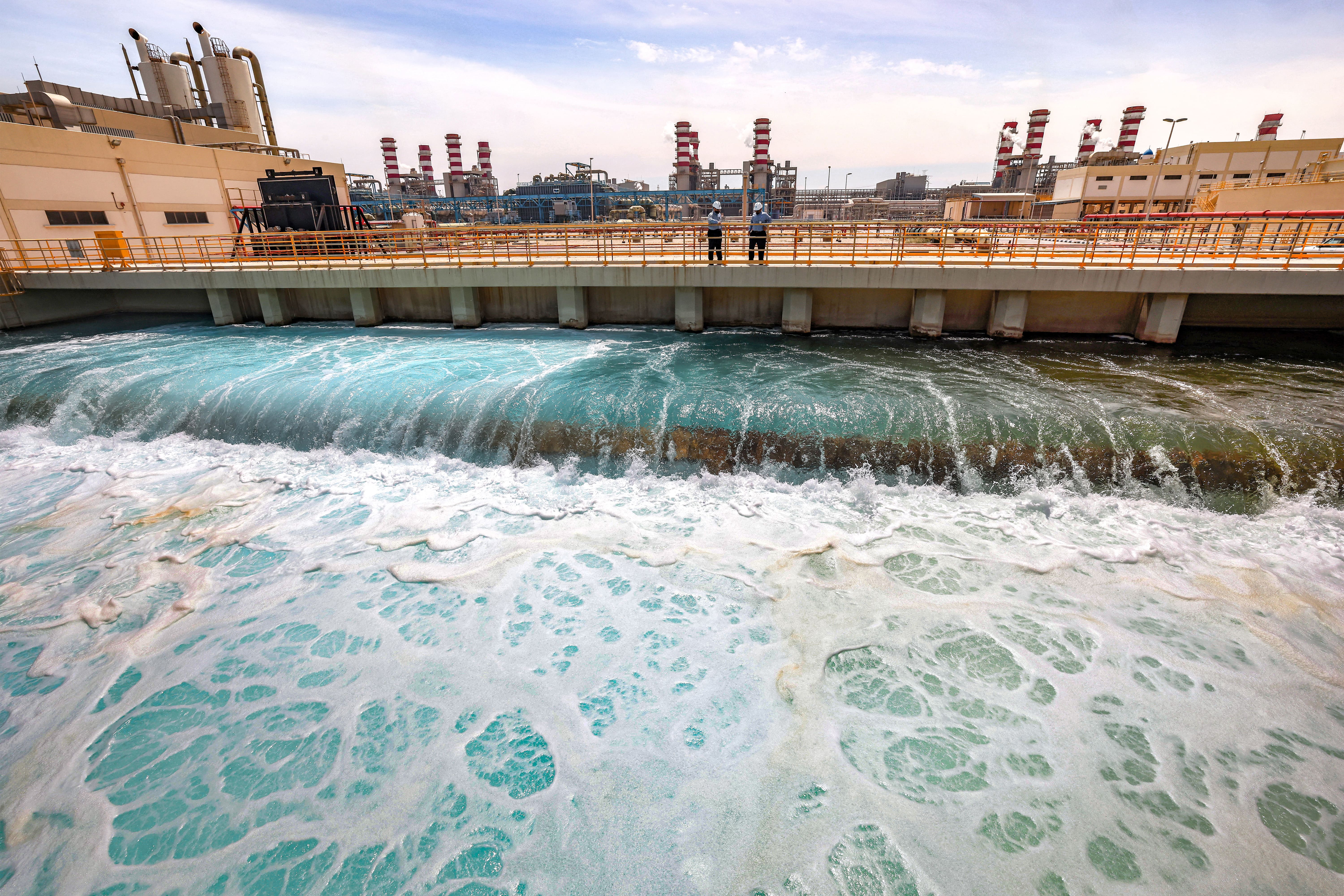
In the arid lands of the Arab Gulf, water is often said to be more precious than oil. Over the past half-century, oil revenues have driven rapid population expansion and the construction of modern metropolises. However, freshwater resources are limited, requiring Gulf states to increasingly rely on desalination to survive and thrive. The primacy and scarcity of water have produced an implicit taboo against the targeting of desalination plants. Much like nuclear reactors, attacking these facilities was assumed to cross a dangerous threshold with severe humanitarian consequences far beyond the battlefield.
Recent events, however, suggest that this taboo may be eroding. Reports emerged in the first week of the U.S.-Israeli war on Iran that U.S. forces had struck a desalination plant on Iran’s Qeshm island. Iran responded by targeting a desalination plant in Bahrain, setting off alarm bells in the region. These developments were compounded by reports of Israeli attacks on Tehran’s energy and water infrastructure, which produced toxic clouds and “rivers of fire” that threatened the livelihoods of the capital’s ten million residents.
If desalination plants become targets in regional warfare, the consequences would be profound. Water infrastructure sustains everyday life. Disrupting it—even briefly—could trigger humanitarian crises across the Gulf within days. To avoid such a scenario, Gulf countries should make it clear to all parties that the region’s vital water infrastructure is completely out of bounds and that any violation will be met with a powerful, unified Gulf response. At the same time, they should continue hardening and decentralizing existing water infrastructure to make it more resilient in the event that deterrence fails.
Water Infrastructure under International Law
The Gulf region is among the most water-stressed in the world. Many Gulf countries source close to 90 percent of their drinking water from desalination, supporting not only their citizens but also the more than 30 million foreign nationals who live and work there.
Drinking water infrastructure, including desalination plants, is protected under international law as being critical to the survival of civilian populations. Article 54 of the First Additional Protocol to the 1949 Geneva Conventions explicitly prohibits attacks against objects indispensable to the survival of the civilian population, including drinking water installations and supplies.
As of June 2025, 175 states had ratified Additional Protocol I (API). Notable exceptions, however, include the three counties involved in the current war: the United States, Israel, and Iran. All three have recently targeted critical water infrastructure.
The erosion of this norm did not begin with the current conflict. A brief look at events over the past decade reveals that the taboo against attacking water infrastructure, including desalination facilities, has repeatedly been broken. In January 2025, Israel destroyed the northern Gaza desalination plant—the only one operated by the Palestinian Water Authority—demolishing its supply wells, intake pipeline, and power generators. In early March 2026, Israeli authorities disconnected Gaza’s South Sea desalination plant from the Israeli electric grid, putting the lives of hundreds of thousands of Palestinians in jeopardy.
The Gulf has also not been immune. The Yemen-based Houthis struck desalination facilities at Al Shuqaiq in Saudi Arabia at least twice, once in 2019 and again in 2022. Earlier still, Kuwait faced a catastrophic water crisis immediately following the 1990-1991 Gulf war, when the destruction of desalination infrastructure, along with Iraq’s decision to deliberately release oil onto Kuwait’s shores, rendered the seawater unfit for desalination. Kuwait was forced to rely on imported water from Saudi Arabia for years.
Gulf States are Increasing their Resilience
Gulf states have taken steps to increase their resilience to attack. One approach has been to decentralize their water networks and expand emergency storage reserves. Abu Dhabi, for example, is working to store fresh desalinated water in a large underground aquifer, creating a strategic water reserve that could supply the country with freshwater for up to 90 days. Doha is also experimenting with aquifer recharge.
Additionally, Qatar’s new water law, passed in October 2025, introduced new protections for the country’s scarce fresh groundwater resources, banning their use for irrigation and agriculture without a special license. Farmers are now expected to utilize treated brackish groundwater. Indeed, natural aquifers provide a far cheaper and more secure method of water storage than large above-ground reservoirs. Because they lie deep below the surface, they are also largely immune to missile and drone strikes. Some Gulf countries have also constructed small, highly resilient desalination plants deep underground to protect them from missile attacks and natural disasters. While they cannot replace the large surface-level facilities, they are still an important backstop against system collapse.
Saudi Arabia has pursued a different strategy: incentivizing the development of smaller, privately-owned and operated desalination facilities throughout the country. These small plants supply the Saudi water grid with nearly 4.5 million cubic meters (MCM) per day, roughly 37 percent of the country’s total desalination output. Losing a few of these facilities would be disruptive but not catastrophic. Furthermore, their small size and geographic dispersion make them less attractive military targets. Still, Saudi Arabia must continue to protect its largest state-owned facilities at Ras Al-Khair and Jubail, which are the most vulnerable nodes in its network.
The smaller Gulf states still rely more heavily on centralized facilities, although the situation has improved from just a decade ago. Even so, desalination plants are not easy targets. Large facilities can cover areas equivalent to 150 football fields, with production divided across many parallel lines. Damage to one line does not necessarily disable the others. Moreover, advances in reverse osmosis technology have made desalination plants more modular and easier to repair, reducing the number of single points of failure.
Nonetheless, diligence in required. A determined adversary with sufficient missiles can overwhelm even a decentralized network. The Gulf should concentrate air defense coverage over its largest desalination plants. Additional emergency measures to consider include stockpiling spare parts and securing emergency portable desalination systems that can be activated if needed.
Gulf States Must Elevate the Diplomatic Agenda
As infrastructure resilience alone cannot eliminate the threat, enhanced protection must be accompanied by a diplomatic effort to reinforce regional and international norms against targeting civilian water systems. The Gulf states must get on the diplomatic offensive by first establishing a normative regional foundation for diplomatic engagement—perhaps through a joint declaration—then pushing for a renewed international framework explicitly recognizing desalination plants as protected infrastructure during armed conflict.
One option would be for the Gulf Cooperation Council (GCC) and its member states to sponsor a United Nations resolution reaffirming the protection of desalination infrastructure under international humanitarian law, building on the aforementioned Article 54 of the 1977 Additional Protocol I. Gulf states could also assemble a coalition of water-stressed nations across the Middle East, Africa, and beyond—states that share a common interest in protecting civilian water infrastructure from being targeted during war.
At the same time, Gulf states should make clear to all parties that attacks on civilian water systems will not be without strategic cost. Indeed, continued strikes on Iranian civilian water infrastructure, including those carried out by Israel, will generate domestic political pressures that Gulf governments will be unable to ignore.
Leaders of the GCC states have already shown a willingness to distance themselves from Washington when their national interests demand it. A major regional water crisis—or even the credible threat of one—will accelerate that trend. Gulf states that have normalized relations with Israel will find those ties increasingly difficult to sustain if civilian water systems remain targets. Washington should recognize that its long-term position in the Gulf rests not only on defense agreements and arms sales, but on being seen as a power that upholds the basic conditions of civilian life.
Ultimately, the objective is simple: ensuring that the roughly 60 million people—citizens and expatriates alike—living along the Gulf’s shores, who have limited sources of fresh water, never wake up to find their taps dry because of decisions made in distant war rooms.