

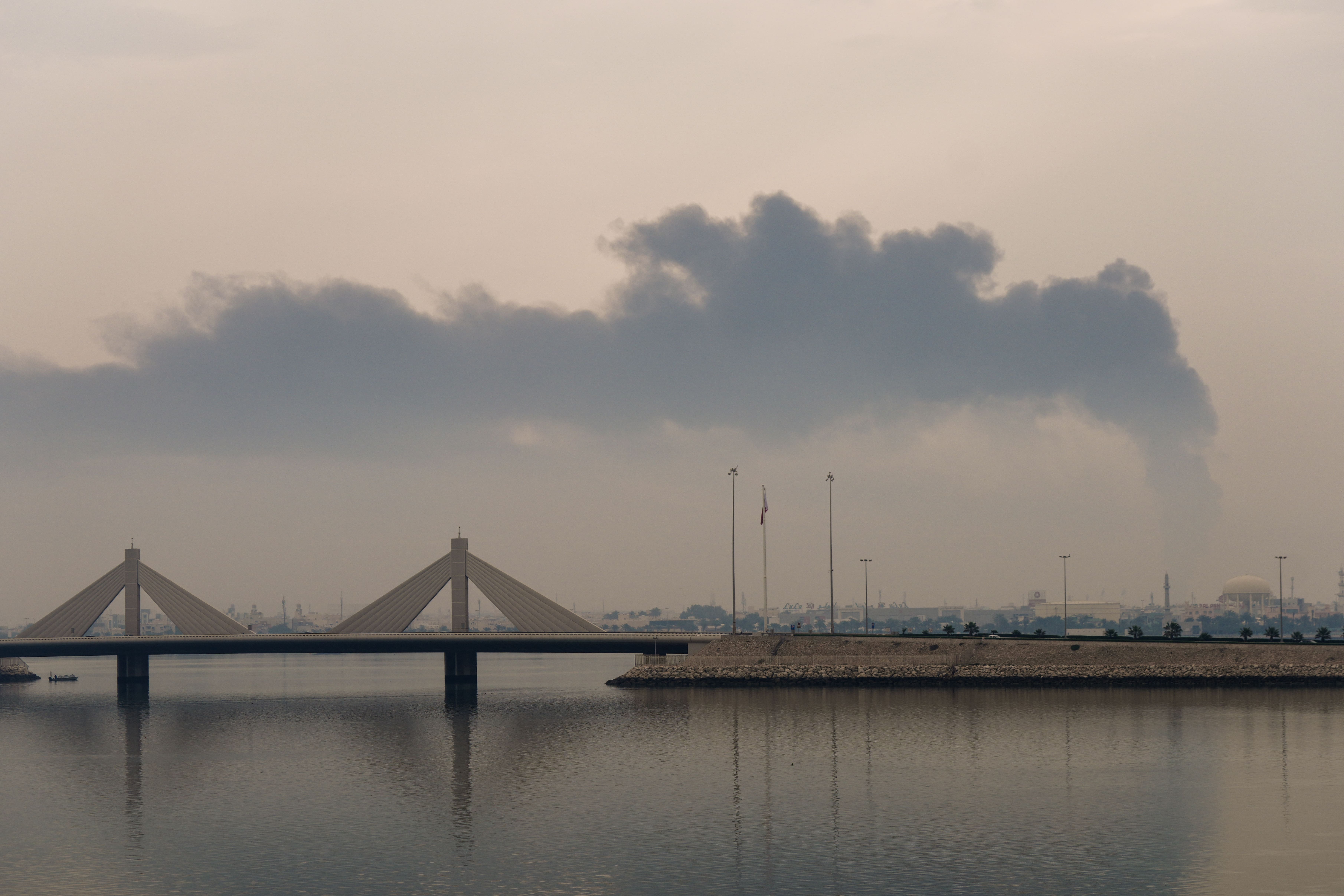
The gravity of war in the Middle East cannot be measured by the depth of depleted arsenals or the number of sorties that streak across its skies, but by the structural imbalances it exposes and the truths it lays bare—truths that have long been hidden behind facades of alliances, agreements, and hollow slogans.
The open confrontation unfolding today between the United States and Israel on one side, and Iran on the other, is not merely a transient military escalation. It marks a potential inflection point that may well redefine the contours of the regional order for years to come.
At the center of this transformation sits the Arab Gulf. Not by choice, but by force of geography, history, and hydrocarbon wealth, the region has become an unavoidable factor that no regional or international rivalry can circumvent. The Gulf is more than a geographic space; it is a global energy artery, a critical trade corridor, and one of the world’s most concentrated zones of economic power. Consequently, every major conflict in the region, sooner or later, reaches its shores.
The Expanding War
The confrontation began with U.S. and Israeli strikes on Iranian military and strategic infrastructure, aimed at degrading Tehran’s capabilities and constraining its regional reach. Iran’s response, however, was not confined to a single front; it was directed across multiple theaters targeting Israel and U.S. bases in the region, with repercussions extending beyond military installations in the Gulf.
As the pace of attacks and counterattacks escalated, the conflict gradually—but unmistakably—transformed into a multi-front regional war of attrition, the costs of which are borne by all, albeit to varying degrees.
The most consequential dimension of this confrontation is not the sheer scale of military strikes, but their spillover into the energy sector. When strikes began targeting Iranian oil and gas facilities—particularly fields and infrastructure linked to energy exports, disrupting nearly 12 percent of Iran’s gas production—it was not an isolated tactical maneuver, but a clear signal that the war had moved into the economic domain.
Iran’s response took the form of threats and attacks on energy infrastructure across the Gulf—a region producing about 17 percent of global oil and hosting roughly 32 percent of proven reserves worldwide—revealing the most dangerous equation the region could face: oil against oil, infrastructure against infrastructure. This is no longer a conventional military conflict—it is one with the potential to destabilize the global economy and disrupt international energy flows.
Entrapping the Gulf
A careful reading of the situation yields a troubling conclusion: targeting energy infrastructure was not merely an escalatory choice but a strategic one—part of a broader, more dangerous objective of entangling the Gulf states in the war.
The logic is straightforward: when political pressure fails to compel alignment, material vulnerability can force it. As such, Israeli strikes against Iranian facilities forced a response in kind against the Gulf, creating conditions in which neutrality was increasingly difficult to sustain.
Even more concerning, perhaps, is the attempt by U.S. and Israeli policy-makers and media to frame the Gulf states as aligned with Israeli strategic objectives and ideological interests. In reality, Gulf states have consistently pursued a distinct set of priorities centered on stability, economic continuity, and risk avoidance—not ideological alignment.
So far, they have also demonstrated a high degree of strategic maturity and discipline, refusing to be drawn into a conflict that does not serve their interests.
The Gulf Cooperation Council: Success Under Extreme Tests
Against this backdrop, the Gulf Cooperation Council (GCC) states have adopted a deliberate, calibrated approach of avoiding direct involvement while upholding core strategic priorities—internal stability, economic resilience, energy flows, and preventing the Gulf from becoming an open battlefield.
This stance represents one of the most significant achievements of the GCC system in recent decades—an achievement whose importance should be recognized. The real danger has never been a missile landing here or there, but the Gulf turning into a permanent stage for others’ wars.
One of the clearest lessons from this crisis is that old regional security equations have exhausted their validity. The United States—despite its military might—has been unable to prevent attacks on its regional bases or provide comprehensive protection to its allies. Israel—despite its presumed military superiority—can no longer wage one-sided wars without consequences for its home front. Iran—despite its regional support network—is absorbing tremendous material and economic costs within its borders.
The Arab Gulf, meanwhile, has regained awareness of an unavoidable historical truth: security cannot be imported; it must be built from within. Those unable to protect themselves cannot extend protection to others.
A Strategic Crossroads
In light of this harsh experience, the Gulf now faces a defining choice. It can continue to operate as a cluster of neighboring states dealing with the world individually, or evolve into a cohesive political, economic, and military bloc capable of safeguarding its interests in a world that recognizes only the logic of power.
This crisis has underscored the limits of relying on external protection. Such arrangements can mitigate risk, but cannot eliminate it—and at times may introduce new vulnerabilities.
This crisis has shown that reliance on external protection may mitigate risks but cannot avert them, and, crucially, is susceptible to being upended by externally-driven agendas. Military misadventures concocted in Washington and aligned with radical Israeli interests have destabilized the entire region and squandered its wealth.
History’s verdict is clear: regions aware of their true weight become centers of power, while those awaiting protection from others are destined to become arenas of conflict.
The Gulf states, therefore, must choose: either establish a united regional framework—a genuine confederation that combines their economic and strategic weight—or remain mere spectators on their own land, unsure where the winds of struggle and survival will carry them, as external parties shape the Gulf security environment.
In a moment where regional balances are shifting at an accelerating speed, the space for hesitation is narrowing. The direction chosen now will help determine wither the Gulf acts with greater strategic coherence—or continues to navigate crises largely on terms set by others.
The opinions expressed in this article are those of the author and do not necessarily reflect the views of the Middle East Council on Global Affairs.