

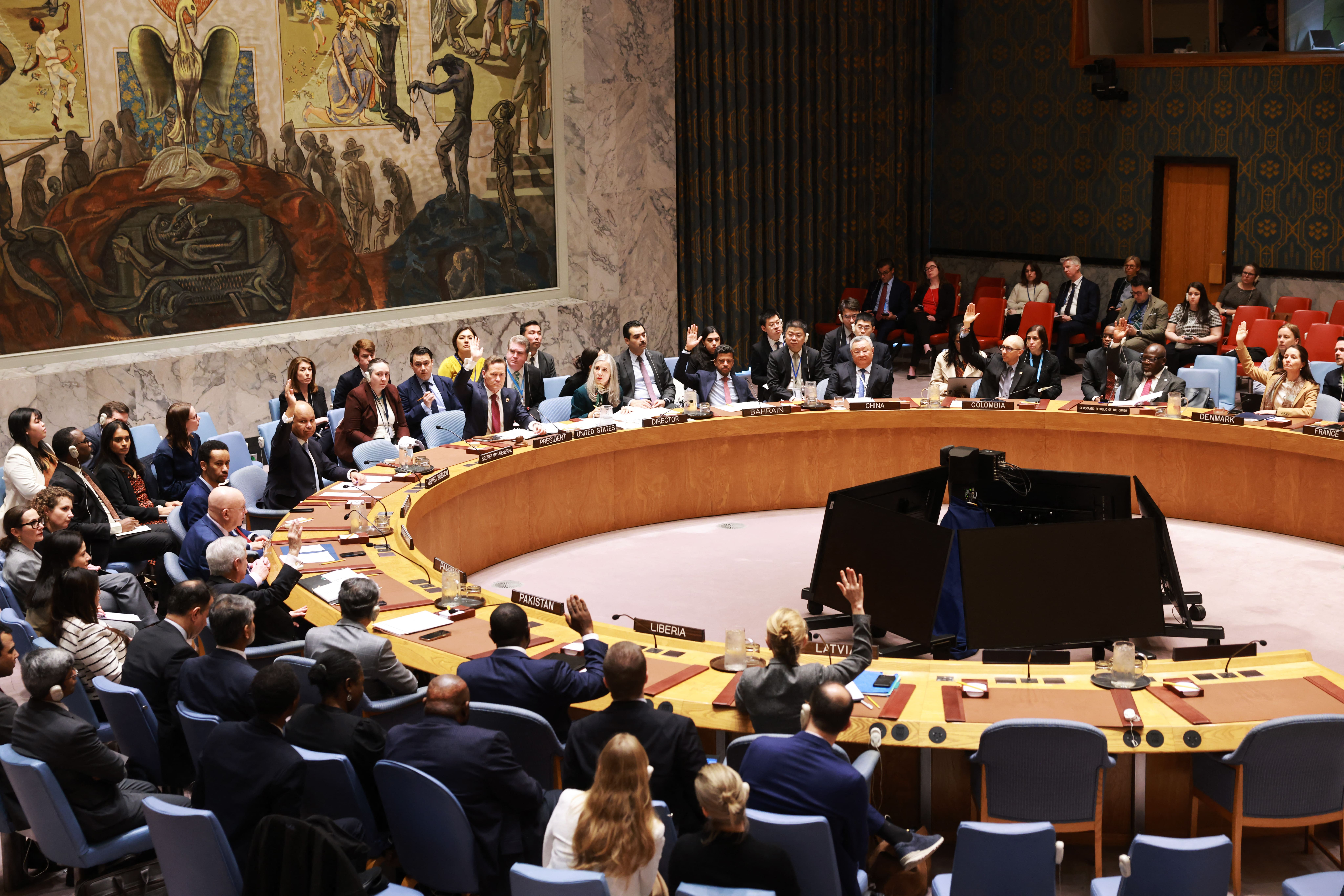
There are no silver linings for the Gulf in the current war, where the human toll and economic disruption are front and center. Yet on the global diplomatic front, the Gulf states leveraged their investments and influence at the United Nations to deliver an historic outcome in support of their security. Bahrain presented Security Council resolution 2817 on behalf of the Gulf Cooperation Council (GCC) and Jordan, adopted on March 11 with 135 co-sponsors—the highest number of supporters ever achieved for a Security Council resolution.
The resolution condemns Iran’s attacks against the Gulf states and determines that these attacks constitute a breach of international law. It provided legitimacy to the Gulf’s unified strategy and demonstrated that Iran lacks support for its actions against the region. Russia and China abstained, while the rest of the Security Council voted in favor. The historic cross-regional coalition behind the text, combined with full GCC unity, made it politically untenable for Russia or China to veto.
With its adoption, the resolution goes beyond simply expressing the position of the multilateral body. It also establishes legal obligations and a pathway toward enforcement action. The resolution alone may not induce an immediate change in behavior from Iran’s Islamic Revolutionary Guard Corps, which perceives itself in an existential fight and is likely ready to accept international isolation as the price of survival. Nevertheless, the resolution establishes an unambiguous global rejection of Iran’s rationale for attacking its Gulf neighbors and sets out the conditions under which relations with the region could be restored.
With resolution 2817 now mandating and guiding the UN system’s response to the war, the Security Council may take follow-up actions such as investigations and reporting on violations of 2817’s measures, sanctions against violators, or even authorizing the use of force—including steps to protect commercial vessels.
What the Resolution Says
The two-page resolution states that Iran deliberately targeted “airports, energy installations, objects necessary for food production and distribution, and critical civilian infrastructure” in the Gulf states and Jordan. It recognizes that this has occurred despite the Gulf states’ “strenuous efforts” to mediate between Iran and the international community.
Resolution 2817’s operational provisions include determining that Iran’s attacks constitute a breach of international law (operative paragraph, OP 2) and demanding their immediate cessation. The text specifies that “any attempt to impede lawful transit passage or freedom of navigation” through the Strait of Hormuz threatens international peace and security (OP8). Further, it presents the Gulf’s vision of regional peace and stability as one where Iran ceases “any provocation or threats to neighboring States, including the use of proxies” (OP5).
Notably, Bahrain and the full GCC presented a focused text, identifying Iran’s immediate threats to their civilian infrastructure and the global economy. The resolution deliberately avoids the broader debates over Iran’s nuclear program or the U.S. and Israeli strikes. This approach reflects the Gulf states’ consistent position that the war is not one of their choosing and that the priority should be de-escalation.
The resolution’s recognition that Iran’s attacks breach international law is particularly significant. The Security Council rarely makes such clear legal determinations about specific attacks. More commonly, it demands that states comply with their obligations under international law, or recalls that attacks against civilians are violations, or further specifies condemnation of violations such as attacks on children in conflict. Resolution 2817, by contrast, explicitly affirms the Gulf’s position that Iran’s attacks against them are strictly illegal and unjustified.
Parallel diplomatic efforts have reinforced this legal framing. Bahrain submitted a letter to the Security Council on behalf of the GCC on February 28 asserting that Iran’s attacks were criminal and contravened international law. As of March 13, Qatar had submitted eight letters to the Council documenting Iran’s missile and drone attacks, including the number of projectiles launched, their locations, and the resulting damage. The objectives of the letters include invoking the right to self-defense through formal notification, clarifying Qatar’s position and response to being attacked, and requesting international action. In other words, the Gulf states have doubled down on maintaining steady diplomatic leverage and legitimacy even in the midst of a crisis.
What the Votes Reveal
The 135 co-sponsors represents the highest level of support ever recorded for a Security Council resolution, surpassing the previous record of 134 co-sponsors for a resolution addressing the Ebola crisis of 2014. The scale of backing reflects the diplomatic capital the Gulf states have built over time, as well as the political weight of GCC unity at the UN.
The cross-regional coalition in support of resolution 2817 underscores the desire of many states to maintain good relations with the Gulf. Long-cultivated diplomatic relationships proved their value at a moment of acute crisis.
Notably, states such as Pakistan and India joined as co-sponsors despite their preference to maintain balanced relations with Iran. At the same time, China and Russia—both of which have deepened their partnerships with Gulf states in recent years—signaled their interest in maintaining ties. This was reflected in high-level diplomatic engagements, including calls between Russian President Vladimir Putin and Gulf leaders, as well as meetings between Chinese Foreign Minister Wang Yi, China’s Middle East Envoy Zhai, and Gulf counterparts.
Russia and China ultimately faced the political difficulty of vetoing a resolution backed by an historic amount of support and full regional unity from the GCC and the Arab League. Earlier this year, Russia articulated a similar rationale when it abstained from a resolution extending UN reporting on Houthi attacks in the Red Sea, stating: “solely due to the requests from regional players, we are not going to block it.”
The coalition supporting Resolution 2817 was also motivated by the broader principle that states not involved in hostilities should be protected from becoming targets. Bahrain’s permanent representative described the resolution as a rejection of Iran’s “unjust, hostile acts,” while the text itself repeatedly condemns Iran’s deliberate targeting of civilians in the Gulf and Jordan. The 135 co-sponsors drew on their self-interest to reject the precedent set by Iran’s strategy of drawing neighboring states into the conflict.
Finally, the breadth of support reflected global concern over the economic implications of disruptions to the Strait of Hormuz. Resolution 2817 identifies two situations that constitute specific threats to international peace and security: Iran’s attacks on the Gulf and Jordan, and any attempt to impede lawful transit through the strait. That determination is significant because it sets the precondition for the Security Council to act under chapter VII of the UN Charter, which allows for authorizing the use of force.
By identifying these threats, the resolution provides a basis for the Council to potentially follow up with further enforcement actions, such as investigations, sanctions against responsible actors, or the creation of a maritime security mission.
In a moment when war has exposed the Gulf to unprecedented risks, Resolution 2817 demonstrates that the region retains significant diplomatic leverage. Indeed, the region is proving its diplomacy is not merely surviving under fire, it is taking up its mantle as a leading bloc to mobilize UN action. By acting collectively and mobilizing global support, the Gulf states have translated their political and economic weight into a powerful statement of international legitimacy—and a potential framework for further action.