
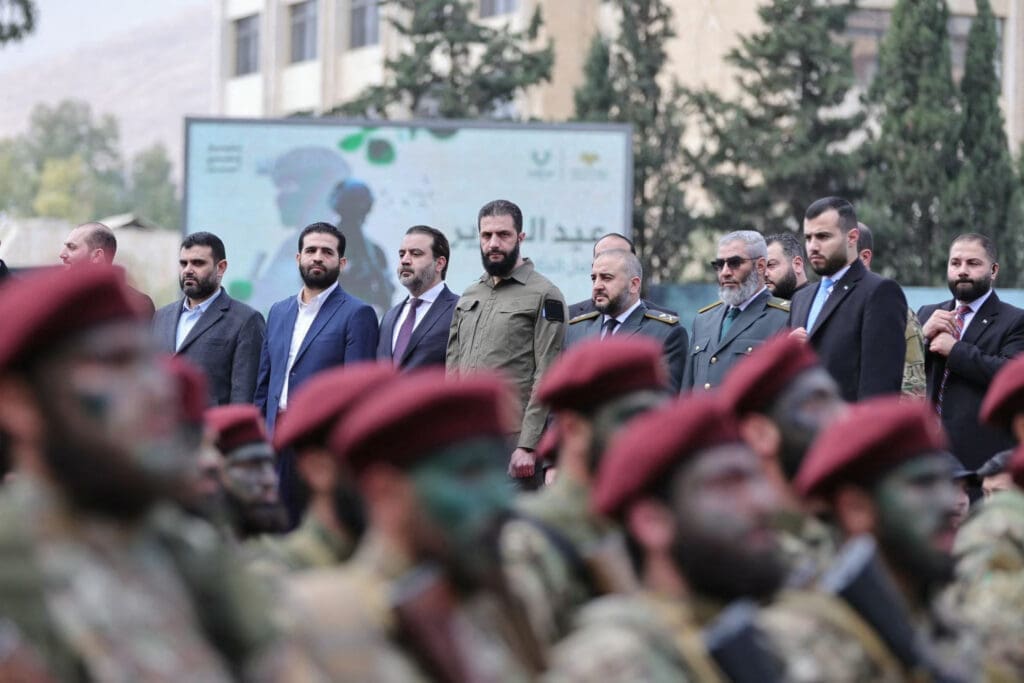
The first-year anniversary of the fall of Syria’s Assad regime is a moment that invites celebration: The end of 54 years of Baathist rule and the conclusion of a 14-year civil war that took thousands of lives, displaced more than half the population, and shattered the country’s physical and social foundations. Syrians have much to be thankful for. For the first time in decades, they have a genuine opportunity to rebuild their country and imagine a future on their own terms and shaped by their own efforts and aspirations.
The anniversary also provides an opportunity for reflection. The past twelve months have brought impressive achievements, as well as occasional missteps. The challenges ahead are not small, and no one should pretend otherwise. Yet it is important to remember just how deep a hole Syria found itself in its moment of liberation. Under Assad, the country did not simply hit rock bottom—it kept digging. Facing this reality, the transitional government has done a commendable job of slowly, steadily climbing upward. Its pragmatic approach has served the country well, even when the path forward was difficult and uneven.
The Assad Regime Leaves Behind a Massive Hole
Syria’s transitional government inherited a broken country and a bankrupt economy. On the eve of liberation, regime forces controlled less than 70 percent of the territory, and even that grip was tenuous and depended on foreign military support. State institutions had withered under starvation-level wages, systemic corruption and moral exhaustion. The regime had weaponized sectarian identities, eroding trust among communities that had long lived side by side.
The economy was also in shambles. Syria’s private sector had been cannibalized, factories gutted and farmland neglected or destroyed. One million homes were damaged or lost, while half the country’s hospitals and schools were unusable. The Syrian currency had collapsed, wiping out over 99 percent of its value. Per-capita income fell from $2,500 in 2010 to just $830 in 2024, well below the global low-income threshold and pushing around 80 percent of Syrians into poverty.
Internationally, the country had become more isolated. The regime’s brutal response to protests triggered sanctions from the United Nations, the European Union, and the United States. In November 2011, Syria’s membership in the Arab League was suspended. Seven million people were displaced internally; another six million became refugees abroad. The scale of destruction—physical, institutional, social, environmental and human—was immense. The cost of physical damage alone has been estimated at $108 billion.
After the fighting ebbed in 2017, Western countries signaled a readiness to re-engage. However, the regime chose intransigence over reconciliation. At home, repression and cronyism increased. To generate income, the regime turned to narcotics, producing and exporting around 80 percent of the global supply of Captagon. Internationally, Syria became even more isolated, as the United States’ Caesar Syria Civilian Protection Act of 2019 effectively blocked global financial support for government-led reconstruction efforts.
Crawling Slowly Out of the Hole
By 2024, the world was, once again, ready to find a way forward with the Assad government. The Arab League had reinstated Syria’s membership, and international actors began to discuss support for reconstruction. Despite distaste for the regime, even among its allies, engagement was viewed as a better alternative to its collapse, which would risk another wave of violent power struggles, physical destruction, and mass displacement. Yet, once again, the regime’s intransigence in the face of reconciliation efforts proved fatal, providing rebel groups, led by Hay’at Tahrir al-Sham, with an opening to move against it. The regime’s collapse was quick and sudden. State institutions, including the military, had been so hollowed out that they crumbled in the face of advancing forces.
The transition has been just as remarkable and unexpected. Critically, the new caretaker government has managed to avoid the direst predicted outcomes. The climb out of the hole has been slow, but deliberate. Security was largely maintained after the fall and has steadily improved. Basic services have been restored in many regions. Investments in electricity and infrastructure have gained momentum. State institutions, especially those hollowed out over the years, have begun to function again, even if imperfectly.
Internationally, the country has made remarkable progress in rehabilitating its image and rebuilding relations. Embassies have reopened across the world. In September 2025, President Ahmed al-Sharaa became the first Syrian leader in six decades to address the UN General Assembly. On November 10, he became the first Syrian President ever to visit the White House—a milestone few, if any, would have imagined a year earlier.
Institutionally, the government has embraced a more market-friendly direction, moving beyond the failed socialist policies of the past. It has begun scaling back an oversized public sector and, critically, raised public wages from around $25 to roughly $100 per month. While still remarkably low, this increase has allowed the government to credibly demand an end to corruption and abuse in public institutions.
Economically, Syria has gained international support for easing sanctions—something most analysts believed would take years. It has secured multibillion-dollar investments in infrastructure and energy projects, while restoring links with global financial systems and reengaging with major multilateral organizations. The progress has been uneven and incomplete, but it is real and is slowly gaining momentum.
Challenges Remain
Syria has not yet emerged from the deep hole it inherited. Reconciliation efforts have been delayed, with the government prioritizing security and economic recovery. The country remains divided—though less so than a year ago. Negotiations continue with Kurdish forces in the east and the Druze militia in the south. There is optimism that agreements will eventually be reached, paving the way for national reunification under a decentralized structure and opening the door to a more inclusive democratic transition.
The country continues to face a humanitarian crisis. There is widespread food insecurity, exacerbated by low rainfall and rising prices. The cost of reconstruction is projected to be $216 billion, but could reach as high as $345 billion. Millions of refugees and internally displaced populations are looking to return to their communities. To do so, however, they need basic levels of security, infrastructure support, public services, and employment opportunities.
Still, sanctions remain only partially lifted. This has kept an air of uncertainty around investment decisions, especially for Western firms. President al-Sharaa’s recent visit to Washington is expected to help shift political sentiment and build momentum toward fully lifting the remaining measures. Only then can Syria truly unlock its economic potential.
The most stubborn challenge remains economic policy. Foreign investments have been announced, but implementation has been slow, and the anticipated job opportunities have yet to materialize. At the same time, the cost of living continues to rise, placing pressure on households and testing public patience. The government is working on a revised economic plan—one that prioritizes livelihoods, small-business recovery, and targeted social support—to help Syria turn early stabilization into tangible improvements in daily life.
Rising With Determination
One year on, Syria is still at the beginning of a long journey—but it is one underpinned by genuine optimism and hope. The past twelve months have shown that, even in the face of extraordinary challenges, progress is possible. Syrians have demonstrated resilience, discipline, and an unwavering desire for a better future. With continued pragmatism, hard work and international support, Syria can turn its fragile recovery into a lasting renewal. The country is rising—slowly, steadily— and building a new future on its own terms.