

At first glance, readers might wonder about the meaning of this title and its implications. However, the answer will become clear in the lines that follow, which aim to provide an interpretation that clarifies the title’s significance.
As the US–Israeli war against Iran passes its sixteenth day, and despite the uncertainty around its end, it is clear that each side is promoting its own narrative regarding victory and defeat in accordance with its own interpretation of events. The US narrative is based on the claim that a strategic objective has been achieved, namely the destruction of a substantial portion of Iran’s military capabilities, the weakening of its deterrence infrastructure, and the obliteration of its nuclear program. This position was expressed by President Donald Trump, who stated that the United States had destroyed “100 percent” of those capabilities and that a significant part of the mission had been accomplished ahead of schedule.
On the other hand, the Israeli narrative emphasizes the achievement of an unprecedented security accomplishment, namely the removal of the immediate Iranian threat and the reshaping of the regional deterrence equation in a way that curtails Iran’s capacity to threaten Israel once and for all.
Conversely, the narrative advanced by the Iranian regime centers on resilience in the face of the strikes, framing the war as an existential confrontation with an “external coalition”, while underscoring that Iran, particularly the regime, still retains its capacity for retaliation and political maneuvering. Aspects of this position were reflected in statements by the Iranian Foreign Minister, Abbas Araghchi, who outlined conditions for negotiations and a ceasefire.
Regardless of the multiplicity of narratives, and the justifications and arguments they advance, what concerns us today is not determining who has won and who has lost according to each side’s perception, but rather, reading the post-war landscape – the ‘day after’. This, however, does not necessarily imply the emergence of fundamental solutions capable of ensuring stability and constructive cooperation in the region. Statements from both the US and Israeli sides suggest that the current confrontation must lead to a decisive outcome, rather than a situation in which military action has to be repeated every two years. Therefore, if the Iranian regime continues on its current trajectory, the region remains susceptible to another round, or potentially several rounds, of escalation. This prospect is further compounded by another critical factor; the persistence of the Palestinian issue in its unresolved form, continued Israeli practices and a reluctance to reach a comprehensive settlement based on the two-state solution. This intransigence allows the Palestinian issue to continue fueling terrorist organizations, serving as a tool for actors seeking to interfere in the region’s affairs.
Whether the stability we seek materializes or indicators of escalation persist, the Gulf region and its Arab states cannot afford to wait for the reactions and outcomes of others before adjusting their course. Instead, the GCC position regarding the future of its states must be reassessed—not as a transient political choice, but as a strategic necessity in preparation for a regional phase that may prove far more complex than those before. Such a reassessment is essential in light of the profound transformations unfolding across the region, particularly in the balance of power, the dynamics of deterrence, and amid a clear restructuring of the region’s interests in relation to the outside world.
Realism, free from emotional impulses and decisions detached from solid foundations, must form the basis of our forward-looking vision for the GCC states. In this context, it is useful to distinguish between fundamental pillars that underpin this vision and the factors that reinforce those pillars.
From a realistic perspective, the GCC states share deep and genuine commonalities—geographic proximity, shared customs and traditions, a common history, and extensive networks of family and kinship ties. All of these are undeniably important. Yet in an increasingly complex and rapidly changing world marked by polarization and shifting alliances, the shared destiny of the GCC states must remain the central foundation of their relations. After all, any threat to the stability of the governing systems in one of these six states—or to the social contract between ruler and ruled—would inevitably reverberate across the others.
In full recognition of this shared destiny, we must collectively move toward a deeper concept of integration in our relations. In practical terms, any initiative undertaken by a GCC state on a particular foreign policy issue should be understood as complementing the role of the other states, on a course shaped by the centrality of this shared destiny and a common foreign policy framework.
Turning to military and security integration, one might ask: Who among us in the GCC states has not wished, amid this war, to hear the phrase, “The joint GCC defense system is successfully intercepting Iranian missiles and drones,” followed by a statement from a unified GCC joint operations command affirming that any attack on one GCC state is an attack on all? Such a moment would signal the integration of radar and air-defense systems, and would eventually lead to deeper coordination and interoperability between military industries, working collectively toward the “Gulfization” of defense manufacturing within a framework of military integration shaped by our common destiny.
Economic integration, together with the strengthening of joint strategic economic projects within the GCC states and their shared ventures abroad, further reinforces this common future. A realistic assessment confirms the decisive role economic factors play in shaping political decisions.
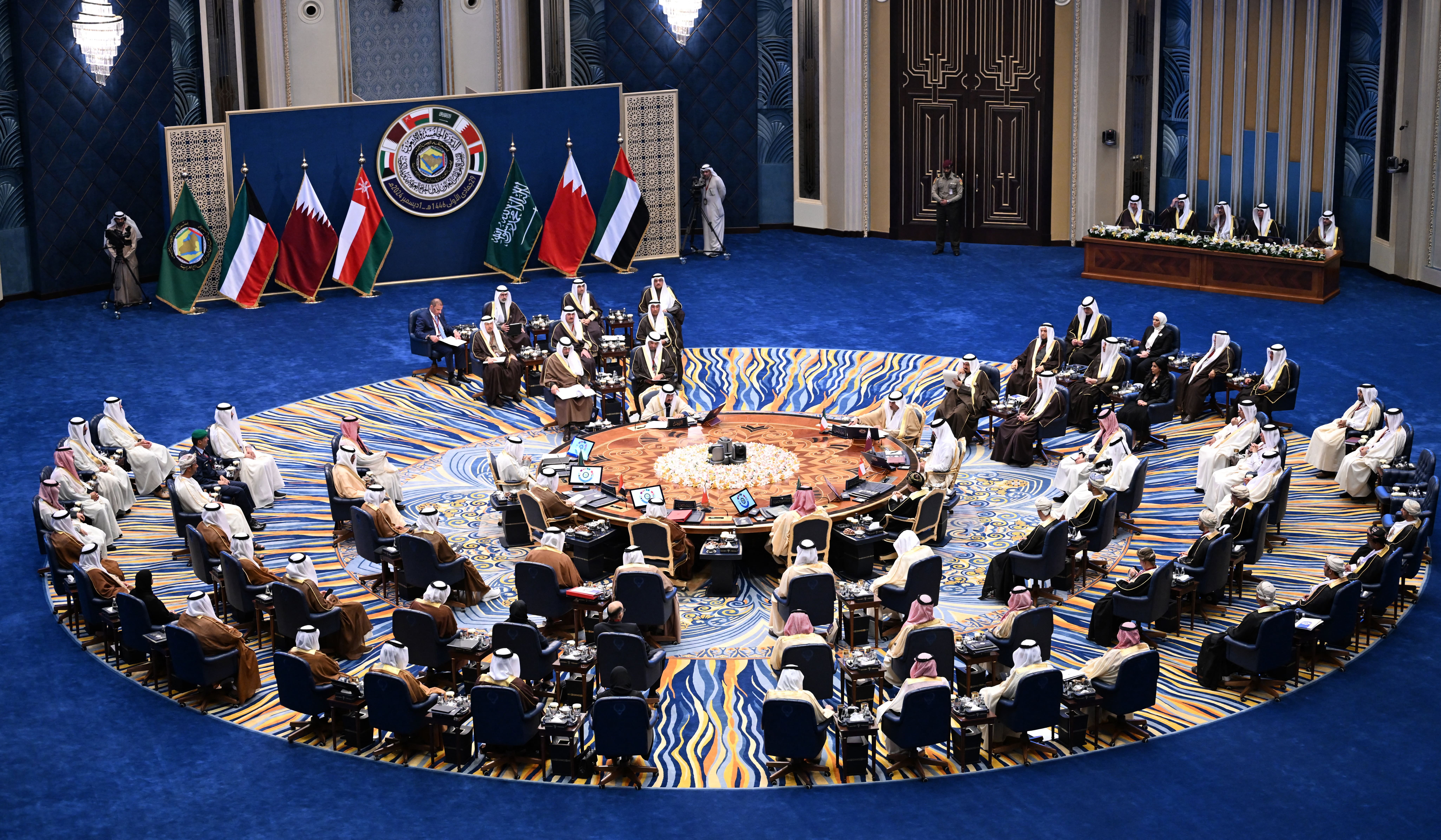
At this point, realism brings us back to the title of this article, and we ask ourselves, as citizens of the GCC states: are we six states that have a bloc, or are we one bloc made up of six states?
This shared destiny, and our pragmatic understanding of it, compels us to evaluate our alliances, whether regional or international, through a lens based on convergence with others around higher common strategic interests. This would create mutual obligations to safeguard our interests, given their profound implications for political and economic stability. In this context, Arab and Islamic dimensions, while emotionally resonant and culturally significant, should be regarded as supportive rather than determinative factors. Their influence remains vulnerable to shifting sentiments, particularly where contradictions arise or where Arab and Islamic considerations intersect in shaping policy positions. This is evident, for instance, in current responses to the brutal Iranian attacks on the Gulf States, which are at times conflated with reactions to Israeli-US actions against Iran. Such realities underscore the need for the Gulf States, guided by their shared destiny, to recognize that Arab and Islamic affinities cannot be assumed as a sufficient basis for alliance-building. Instead, they should be treated as complementary considerations within a framework of clearly defined strategic interests, clarity of rules, and well-articulated responsibilities.
The thoughtful reader may reasonably argue that interests themselves are subject to change – and this is true. Yet interests can be measured, managed, and addressed, they are not like emotional factors, which can shift and fluctuate unless governed by a state’s interests and the destiny of its political and economic future.
In recent years, it has become clear that the Gulf states stand at a historic juncture, in which the notion of a shared destiny is evolving from a mere belief in principle into tangible steps on the ground. Cultural and civilizational commonalities – including religion, lineage, and geographic proximity – as previously noted, remain important elements that foster closeness. However, they ultimately serve a more fundamental and vital objective: collective existence and prosperity.
Modern international relations demonstrate that the most resilient alliances are those built upon clear strategic interests, not sentiment alone. States draw closer when their fundamental interests in security, stability, and prosperity converge, not merely when symbolic ties are invoked.
Therefore, the most important lesson the Gulf States can take from this war is the need to move from a phase of cooperation to the formation of a strategic bloc capable of unifying its vision on security challenges, enhancing economic integration, and coordinating political positions in response to regional crises.
The founding leaders of the Gulf Cooperation Council States recognized the looming dangers facing our region and established the GCC in 1981. After all the dangers we have faced, continue to face, and will face in the future, the question remains: are we six states that have a bloc, or are we one bloc made up of six states?
