

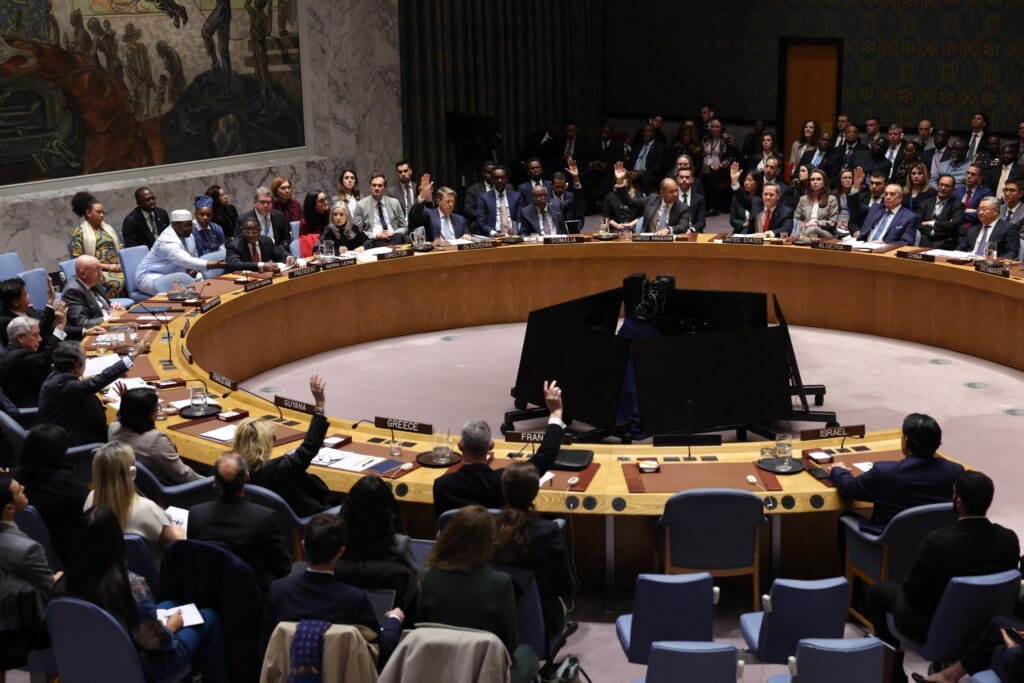
On November 17, the United Nations Security Council passed Resolution 2803, which endorsed U.S. President Donald Trump’s 20-point plan for Gaza and authorized the deployment of an International Stabilization Force (ISF) to the territory until the end of 2027. Saudi Arabia, Qatar, Egypt, Jordan and the United Arab Emirates all subsequently backed the Security Council resolution. This means that the ISF has a UN mandate—albeit a vague and problematic one—and key regional backing before any boots even hit the ground.
Just before the vote, U.S. Ambassador to the UN Mike Waltz addressed the Council and threatened that a rejection of the U.S.-drafted resolution would mean a return to war in Gaza. Holding up a copy of the resolution, he claimed it would provide a “lifeline” that Gaza’s inhabitants desperately needed to avoid returning to “hell on earth.”
That is a stretch. Resolution 2803, and the ISF deployment it legitimized, might keep Gaza from returning to the “hell” of the past two years, but the ISF will likely become less a stabilization force that gets Gaza to somewhere better—as Trump’s 20-point plan and Resolution 2803 supposedly envision—and more a peacekeeping force that traps Gaza in purgatory. Absent sufficient buy-in from local actors and contributing UN member states, while demanding much from the Palestinians but next to nothing from Israel, any stabilization force could end up being a fig leaf that entrenches rather than ameliorates Gaza’s dire status quo.
For now, Gaza’s ceasefire continues to hold despite repeated violations. But the divergence in casualties since October 10, 2025—three Israeli soldiers compared to more than 300 Gazans—illustrates the asymmetric nature of the conflict. It also demonstrates that Israel is still pursuing a “forever war” in Gaza, albeit a less intense one. The result is that Gaza’s “day after” will look a lot like the territory’s current and, supposedly, temporary reality.
Most critically, the flow of vital humanitarian aid remains heavily restricted, and there has been no reconstruction to speak of anywhere in Gaza, despite immediate stipulations for both in the Trump plan. World Bank estimates stating that it will take up to $70 billion to return the territory to pre-war levels, despite Gaza not being anywhere near prosperous prior to October 7, illustrate the scale of the destruction and the magnitude of the dire humanitarian crisis facing the territory’s two million residents.
Resolution 2803 and the ISF’s deployment provide a putative pathway to a “day after,” including creating conditions that will ensure Israel eventually leaves Gaza. But there is so much ambiguity in the resolution that it is difficult to see this as oversight, and rather as deliberate design that stacks the deck in Israel’s favor. Exactly when Israel should withdraw is left unanswered. There is also plenty of baked-in provisions against Palestinians violating the agreement, including the Palestinian Authority not meeting an undefined “reform” program, but no corresponding stipulations are placed on Israel. This is in spite of Israel’s continuous violation of the agreement since its inception by curtailing aid and carrying out near-daily military strikes. At its worst, the resolution justifies and legitimizes Israel’s continued occupation of Gaza by allowing it to maintain a security perimeter of unspecified size until Gaza is “properly secure from any resurgent terror threat.” But what a “resurgent terror threat” means and who decides what this constitutes is left unanswered.
Nevertheless, some analysts have expressed tentative hopes that the ISF’s deployment could help mitigate the Trump plan’s shortcomings, bring a degree of order to Gaza and even promote Palestinian statehood. Commentators have also repeatedly referred to the ISF as “peacekeepers,” a designation that is very different from the ISF’s actual and very ambitious mandate. This is because peacekeeping and stabilization are distinct operational frameworks with very different objectives and risk tolerances.
Peacekeepers traditionally preserve the status quo by separating two rival armies. They “keep the peace” but are expected to do little else. Stabilization operations, by contrast, are more ambitious, coercive and transformative. Whereas peacekeepers often provide a human buffer zone separating state-level adversaries, stabilization forces operate in areas where the state is weak or nonexistent. Their role is to bring order to chaos by helping create a state architecture, securing civilians and confronting or disarming hostile gangs and militias. This is what supposedly distinguishes “new” multinational stabilization efforts—in places like Haiti and the Balkans—from “old” peacekeeping missions, such as in Cyprus, the Golan Heights and the Sinai Peninsula.
The problem is that these “new” types of stabilization missions often devolve into more passive, “old” peacekeeping roles. Absent the political will from a critical mass of local actors to commit to a new order, foreign forces can do little else except try to minimize the violence. The only way to overcome this obstacle is if the parties that back and comprise the stabilization force are willing to devote significant resources to the mandate and expose themselves to a high degree of risk.
That is rarely the case. Foreign forces are understandably averse to committing to counter-insurgency campaigns that will inevitably cause casualties on all sides, particularly when they see the conflict as distant and with few potential ramifications for their own national security, or when there is no accompanying political process that will bring their role to a clear end.
This will likely be true for the far-flung rumored ISF contributors, such as Azerbaijan and Indonesia, whose motivations for sending troops surely do not outweigh the desire to keep human and material costs as low as possible. It also applies to potential regional contributors, such as Egypt and Jordan, who are particularly sensitive to the perception that they would be doing Israel’s dirty work. Jordanian officials have already signaled their willingness to contribute to the ISF but have ruled out armed patrols within Gaza, let alone confronting or disarming the roughly 20,000 Hamas fighters that Israel estimates remain active within the territory.
This strategic preference has already manifested in Resolution 2803, whose broad goals sit awkwardly with the specification that the ISF deploy to Gaza’s borders. Reading between the lines, this suggests that the ISF will avoid the territory’s urban areas and will not police the fault-lines within Gaza between Hamas and Israeli forces. It is also unrealistic to assume that an international force could demilitarize Gaza, something that Israel’s two-year-long brutal war on the territory failed to do.
Moreover, even while the ISF’s capacity and willingness to engender the rebuilding of Gaza is questionable, Israel is actively working to prevent this outcome. This is because Gaza’s current status quo does not compromise Israel’s red lines. It retains the “strategic depth” that will supposedly prevent another October 7. Israel can keep vocalizing its commitment to the cease-fire and the Trump plan, while continuing its military operations within Gaza. Just like Israel committed for years to the “peace process” while establishing “facts on the ground” that undermined it, now it has imported these same dynamics to Gaza.
The humanitarian implications are stark. Without a political way forward, the billions of dollars that some parties have suggested they would be willing to invest in Gaza will remain largely hypothetical. Even if the ISF reduces the day-to-day violence within the territory, outside investors will hesitate to invest in a place that remains wide open to Israeli military activity.
By deliberate design, it is the approximately 95 percent of Gazans who live outside of the territory directly occupied by Israeli forces who will suffer the most. Although aid convoys are once again moving into Gaza, Israel is tightly controlling and even seeking to restrict to a trickle the supplies bound for districts where Hamas currently calls the shots or those outside of Israel’s direct control. This conforms to the Trump Plan, which stipulates that aid will be funneled to “terror-free areas handed over from the IDF to the ISF.” Yet this will create a two-tier reality, where most Gazans will be kept above the threshold of hunger, but just barely. They will remain deeply destitute and at risk of death by a myriad of preventable diseases. This constitutes a return to the logic behind the post-2007 “Siege of Gaza,” when Israel responded to Hamas’ takeover by tightly restricting all access to the enclave by land, air and sea.
Rather than a toothless “stabilization” force or UN resolutions that heavily favor Israel’s myopic “day after” vision, Gaza’s reconstruction requires sustained investment and political pressure, at the intergovernmental level and on the ground. It will require an unusually high level of risk tolerance for a multinational stabilization mission. This is a tall and unlikely order. But the alternative is that one-sided UN resolutions and a passive peacekeeping force will constitute at best a sticking plaster or at worst part of the problem, by contributing to a perfect storm that leaves Gaza destroyed, deprived and in perpetual political purgatory.