
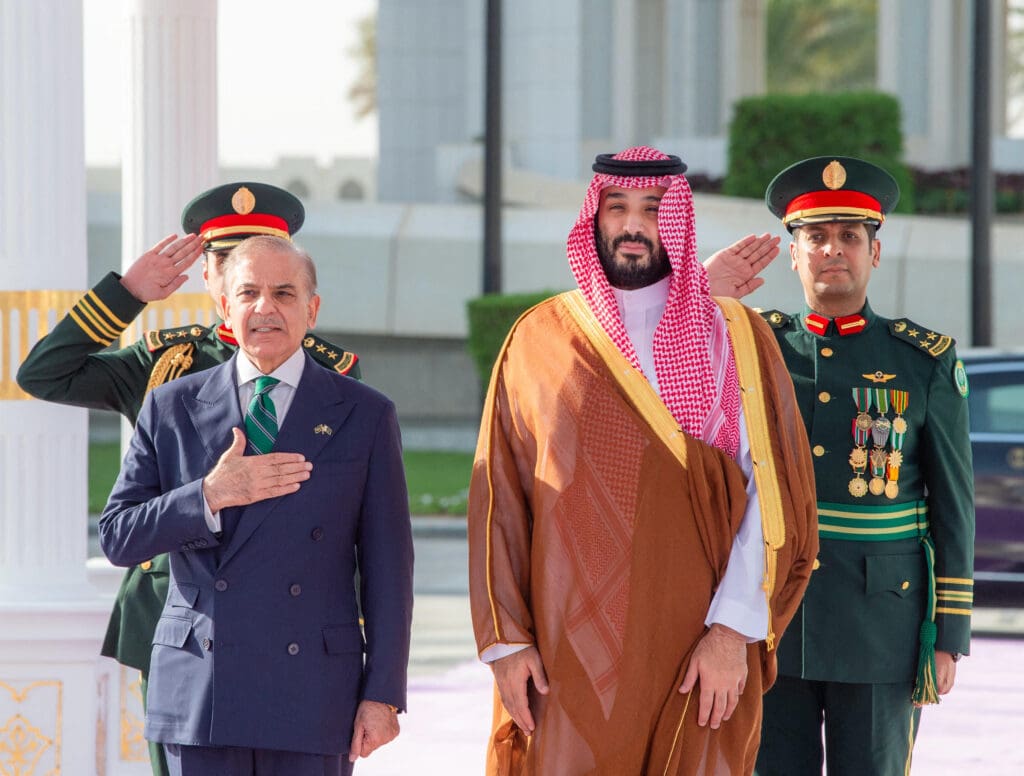
A defense pact is only as credible as the state that signs it. When Pakistani Foreign Minister Ishaq Dar told reporters on March 3 that he had warned Tehran not to strike Saudi Arabia—invoking a mutual defense agreement signed just six months ago—he did not sound like a man laying down a tripwire. He sounded like one hoping no one would test it.
In so doing, he may have ensured that someone will.
In international relations theory, “audience costs” are the domestic and international sanctions that leaders pay for reneging on public commitments, whether those are threats to use force or solemn promises of solidarity. The logic, first developed by Thomas Schelling and further refined by James Fearon, is straightforward: the stronger the public commitment, the higher the price of backing down, and therefore the more credible the deterrent. Leaders invoke audience costs deliberately: they speak to journalists precisely because they want adversaries to believe the commitment is real.
Dar’s press statement was textbook audience-cost signaling. By publicly invoking the Pakistan-Saudi mutual defense pact—which states that “any aggression against either country shall be considered an aggression against both”—he converted a deliberately ambiguous agreement into something approaching a public promise. The problem is that Pakistan now faces audience costs on three fronts simultaneously: in Riyadh, where the Saudi leadership is watching to see if its nuclear-armed partner means what it says; in Tehran, which knows Pakistan intimately and will not be deterred by a press statement alone; and on Pakistan’s own street, where 40 million Shia citizens are watching a neighboring Islamic republic absorb massive American and Israeli strikes. That is not merely a pincer. It is a three-body problem.
To understand why Dar’s statement is as dangerous for Islamabad as it is for Tehran, it is necessary to understand what the pact actually is—and what it deliberately is not. Pakistani and Saudi officials have described its terms in intentionally vague language. As Joshua White of the Brookings Institution told the Financial Times, “You can’t have deterrence without some constructive ambiguity.” Ali Shihabi, a commentator close to the Saudi royal court, was more forthright: The deal “puts you under [Pakistan’s] nuclear umbrella in case of an attack.” Pakistan’s own defense minister, Khawaja Mohammad Asif, appeared to confirm this on Thursday, saying Pakistan’s capabilities “will be made available to [Saudi Arabia] according to this agreement”—before walking the statement back entirely to Reuters the following day.
That contradiction is not a diplomatic mishap. It is a window into the impossible position Islamabad now occupies. The pact was engineered to be ambiguous precisely so that both parties retained room to maneuver. Dar spent that ambiguity in a single press conference.
History suggests this is a pattern, not an anomaly. Pakistan’s relationship with Saudi Arabia is among the most transactional and consequential in the Muslim world, built over decades of petrodollars, military advisers and mutual strategic convenience. In 1998, when then-Pakistani Prime Minister Nawaz Sharif needed cover to conduct a nuclear bomb test in the face of certain Western sanctions, it was Saudi Arabia that provided 50,000 barrels of oil a day, free of charge, to cushion the blow. Pakistani troops guarded Saudi Arabia’s northern border during the Iran-Iraq war in the 1980s. A former Pakistani army chief commands a Saudi-led counterterrorism force in Riyadh today.
But the relationship has a ceiling. When Saudi Arabia and the United Arab Emirates launched airstrikes against Iranian-backed Houthi rebels in 2015, Pakistan’s parliament voted not to join them. The rebuke from Gulf officials was sharp. A senior Emirati diplomat complained publicly that despite “inevitable” financial support from Riyadh and Abu Dhabi, “Tehran seems to be more important to Islamabad than the Gulf countries.” Pakistan absorbed the criticism, maintained its equidistance, and kept its western border with Iran quiet.
The Yemen precedent reveals the consistent logic beneath Pakistan’s elaborate performance of solidarity: Islamabad shows up for Riyadh when the costs are manageable and the threat is distant. It finds reasons to step back when they are not.
Those costs now appear stratospheric.
Pakistan is not entering this crisis from a position of strategic equilibrium. It is entering it already encircled. To its northwest, the military is prosecuting Operation Ghazab Lil Haqq, launched on February 27 against the Afghan Taliban—a “forever war” that has no visible exit and consumes enormous military resources. To its west, the 560-mile Balochi frontier with Iran, long managed through a sophisticated “live and let live” arrangement born of mutual nuclear vulnerability, is freighted with the symbolism of Iran’s dead supreme leader and a Pakistani street that has already turned violent.
The audience cost calculus that once made Pakistani neutrality workable has collapsed. When Hezbollah’s Hassan Nasrallah was killed in September 2024, the Pakistani state successfully managed domestic outrage through performative protest and carefully channeled rhetoric—a pressure-release valve that kept the street satisfied without a single death at the U.S. consulate. That was also the moment Islamabad secured its 24th IMF bailout, a $7 billion Extended Fund Facility that cemented its accountability to international creditors, who have no appetite for regional adventurism.
The 22 rioters killed in front of the American consulate in Karachi on March 1 suggest that the same toolkit no longer works. The street has not merely expressed outrage—it has taken action against sensitive diplomatic installations on its territory. The state’s capacity to act as a neutral arbiter has not been strained. It has been visibly broken.
This is the commitment trap in its most acute form. Dar’s public invocation of the defense pact was intended to raise the cost of Iranian aggression against Saudi Arabia. Instead, it has raised the cost of Pakistani inaction to a level that Islamabad may be unable to pay. If Islamabad honors the pact and moves toward military solidarity with Riyadh, it risks Iran abandoning the bilateral “ballistic silence” that has kept the western border stable since a January 2024 missile exchange—a crisis both states resolved within 72 hours precisely because neither wanted international scrutiny of their respective nuclear and ballistic programs. It also risks handing the Afghan Taliban, which has committed to cooperating with Iran in the face of American aggression, an incentive to open a second front.
If Islamabad stays silent, it concedes that the pact is worthless—destroying the deterrent value it was designed to create, inviting a sharp rebuke from Riyadh, and potentially destabilizing the financial lifeline of Saudi debt rollovers and Gulf remittances that keep Pakistan’s economy afloat. More than 4 million Pakistanis reside in Gulf states as migrant laborers. One was killed when an Iranian missile struck Abu Dhabi on the first day of the war.
And if Islamabad attempts to thread the needle, it risks satisfying no one, while the street at home grows louder and the Taliban watches for an opening.
In September 2025 , when the Pakistan-Saudi pact was signed, Feroz Khan, a retired Pakistani Brigadier General and professor at the Naval Postgraduate School, offered a warning that now reads as prophecy: “Pakistan will need to be very, very careful not to rattle its geopolitical sweet spot with China, Iran, Saudi Arabia and the U.S. If this draws India and Israel closer, brings further sanctions to [Pakistan’s] ballistic missile program, and fuels India’s efforts to isolate Islamabad, it might end up as a strategic blunder.”
The more serious blunder, it turns out, was not the pact itself. It was the moment a foreign minister stood before reporters and tried to make ambiguity pass for resolve.
Pakistan’s commitment trap is now fully closed. Every exit carries a price the state may not be able to pay. What remains is the noise—of the street, of Riyadh, of Tehran, of a three-body problem with no clean solution—and a government discovering that speaking loudly, when you cannot be certain the stick will follow, is indistinguishable from silence.