

In little over a month, Yemen has undergone significant changes on the ground and in the political dynamics underpinning more than ten years of war. In early December, the Southern Transitional Council (STC) initiated a military operation in the governorates of Hadramawt and al-Mahra that brought nearly the entirety of southern and eastern Yemen under its control. By January 3, this was completely undone, in large part by the intervention of Saudi Arabia and the Yemeni central government it supports.
At the heart of the whiplash in military and political fortunes was a high-risk gamble to seize areas of strategic importance to Saudi Arabia and Oman. Although the United Arab Emirates (UAE) denies its involvement, the campaign tested, like never before, the willingness of the emirate’s Gulf partners to accept a fait accompli that affected their own national security and strategic depth. Perhaps hopeful that Riyadh would simply accept the outcome and intervene to mediate, as it did in 2018 and 2019, the STC and its allies put at risk the strategic gains they had achieved over nearly a decade inside Yemen.
The gamble prompted Riyadh to act with uncharacteristic decisiveness and agility, making the other parties’ calculations look like a serious blunder. Moreover, the crisis has opened a window of opportunity made possible by a corresponding change in Saudi strategic thinking and dynamism that aligns with the hope of those defending a united Yemen.
Pushing the Limits
For years, the STC had operated with confidence that control on the ground would eventually produce political acceptance. Since 2017, it had enjoyed extensive Emirati support, including air cover, training, and an Emirati-run joint operations room. That backing enabled the movement to expand its influence across much of southern Yemen and dominate local politics.
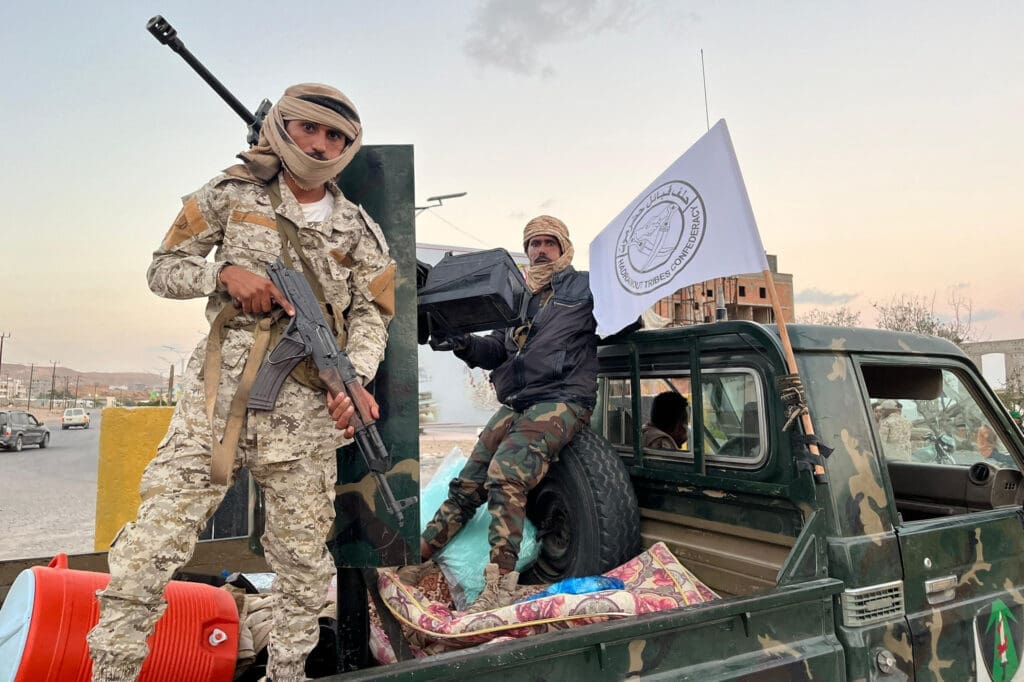
Then, on December 3, STC-aligned forces—redeploying from Aden, Abyan, Dhale’a and Shabwa—stormed state institutions, military bases and oil facilities in Hadramawt, and within 24 hours marched uncontested into al-Mahra. The rapid advance appeared designed to create a new reality mere hours before the arrival of a senior Saudi delegation. Yet what looked like a solidifying position was quickly revealed to be surprisingly brittle.
After weeks of failed diplomacy, Saudi Defense Minister Prince Khalid bin Salman issued a direct demand on December 27 that STC-aligned forces withdraw from the governorates of Hadramawt and al-Mahra and transfer control of those areas to local authorities and National Shield Forces, the Saudi-backed contingent operating under the Presidential Leadership Council (PLC). The demand was accompanied by a 72-hour ultimatum. Riyadh acted after Yemeni President Rashad al-Alimi formally appealed to the Saudi-led Coalition to Support Legitimacy in Yemen to take immediate measures to protect civilians and defend the sovereign position of the Yemeni Republic. Unlike in earlier years, when Saudi Arabia often mediated disputes between the government and the STC, this time it chose to enforce order.
On December 30, the Saudi-led coalition launched a limited air strike that disrupted STC military logistics and narrowed the UAE’s ability to continue backing the escalation. The strike was followed by Riyadh’s unprecedented public accusation that the UAE had pressured the STC to conduct operations near Saudi borders and had crossed its red lines.
Within hours of Saudi action, Yemen’s president took decisive steps: Al-Alimi cancelled Yemen’s defense agreement with the UAE, ordered Emirati forces and personnel to leave the country, declared a state of emergency, and labeled STC activities a rebellion against the state. Backed by Saudi logistical and political support, Yemeni government troops restored control over Hadramawt and al-Mahra within 36 hours. The STC fought its first major confrontation without UAE air cover or Saudi flexibility—and lost quickly. The defeat shattered the delusion that dominance in Aden or Aden-aligned territories automatically translates into wider legitimacy. By January 7, the STC had lost everything and its chief, Aidarous al-Zubaydi, had fled to Abu Dhabi instead of heading to Riyadh to negotiate.
Why It Mattered
The unusually strong Saudi reaction can be explained by the importance of the two eastern governorates, which contain vital trade corridors to the Arabian Sea and Indian Ocean. Al-Mahra shares roughly 300km of border with Oman, while Hadramawt runs along approximately 700km of Saudi Arabia’s southern frontier. Any attempt by an armed separatist movement loyal to a non-bordering country to entrench itself in these areas was therefore seen as directly threatening the security interests of Yemen’s neighbors. For both Riyadh and Muscat, the STC move crossed a line by converting internal Yemeni rivalries into potential border instability.
The episode signals a new willingness to manage confrontation publicly rather than quietly normalize instability, pivoting from a tendency toward over-tolerance to a willingness to set rules and enforce them. By acting decisively against an ally’s miscalculation, Riyadh has asserted itself as the primary architect of Yemen policy and demonstrated agility and command that were lacking in earlier years.
The shift also suggests that the Yemen file will return to the top table in Riyadh. After a decade of entertaining parallel tracks, Saudi Arabia appears prepared to invest more directly in strengthening Yemeni institutions, professionalizing local forces under government control and pursuing stabilization strategies that reflect the interests of Yemen and its immediate neighbors. The episode has also drawn Saudi Arabia and Oman closer together in border security coordination and in a shared preference for disciplined, state-centered solutions.
From Rivalry to Rupture
The confrontation is the product of a long-standing and multifaceted rivalry between Abu Dhabi and Riyadh, which is not confined to geopolitical competition but is experiencing considerable friction as a result. From the early days of the coalition intervention in Yemen, the two sides have held clashing visions. The UAE has largely pursued its own objectives, concentrating on coastline security and on cultivating local partners rather than strengthening central Yemeni institutions. Suspicion of Islah, a Sunni political movement the UAE associates with the Muslim Brotherhood, hardened Abu Dhabi’s preference for working through new armed groups. The STC itself emerged from that environment in 2017.
Saudi Arabia accepted this division of labor for years out of necessity. Protecting the coalition’s international image, and countering Houthi advances required Riyadh to keep the UAE inside the tent. But over time, the UAE’s growing use of proxies across theaters—in the Horn of Africa, the Mediterranean and Arabian Peninsula—sharpened Saudi concerns that Abu Dhabi was turning military partnerships into independent geopolitical leverage, in close coordination with Israel, no less. When Saudi Crown Prince Mohammed bin Salman pushed for a U.S. policy recalibration on Sudan during his November 2025 meeting with President Donald Trump, UAE-Saudi differences hardened further.
Finally, the combination of massive territorial advancements by the STC in Yemen and the UAE-backed Rapid Support Forces in Sudan, along with Israel’s recent recognition of the breakaway Somali region of Somaliland, triggered a realization in Riyadh that the UAE had gone too far in its geopolitical ambitions encircling the Arabian peninsula and must be stopped.
Implications for Yemen and the Region
Inside Yemen, the consequences are profound. The STC’s battlefield loss has created a political and institutional crisis within its ranks. For the first time, it has been forced to acknowledge that it does not hold a monopoly over the southern cause. The episode opens space for reorganizing security provision in liberated areas and for reducing parallel STC governance structures that have undermined Yemen’s government since 2017. It also highlights Hadrami aspirations for greater autonomy and more balanced representation across the south.
More importantly, the reversal has empowered Yemen’s central government and challenged the belief that the country was destined for permanent fragmentation. As recently as December, many diplomats feared the breakup of Yemen along the 1990 lines. Now, it has been shown that a political reordering is possible, restoring confidence in a unifying authority that can end competing chains of command and rebuild state legitimacy. STC domination, particularly after 2022, had complicated efforts to stabilize the country and its territorial waters, and harmonize the domestic and international agendas around countering the Houthis.
Regionally, the crisis will likely reshape UAE-Saudi relations. The UAE’s attempt to leverage proxy power in Yemen for cross-regional trade-offs has self-sabotaged its clout. It has curtailed Emirati influence in Yemen and forced UAE-backed proxies to make hard choices. It remains to be seen if this pushes the UAE to reconsider its foreign policy model elsewhere, especially if governments in Sudan, Somalia and Libya are inspired to resist its involvement more forcefully. Saudi Arabia’s assertive response, coordinated with Muscat, has reinforced the prohibition on militarization of their border areas. This makes strengthening border security cooperation—such as reactivating joint committees, border incident protocols, and force posture maps—alongside developing free economic zones and corridors, top priorities.
Additionally, this may encourage greater cross-regional coordination among other Middle Eastern states. Saudi Arabia, Türkiye, Qatar, Egypt, Jordan and Oman increasingly share interests centered on state sovereignty, maritime security and limiting proxy-driven fragmentation. These countries are likely to converge more closely on stabilizing Yemen, countering Iran-backed proxies, and reinforcing maritime security in the Red Sea basin. The December rupture could therefore accelerate a broader regional coordination for stability.
System Correction
The STC’s eastern maneuver, which combined local and regional motivational dynamics, quickly backfired and triggered a long-overdue system-level correction. The 36-hour reversal of the STC’s territorial advancements did more than change the distribution of power on the map; it exposed the limits of proxy power and shattered the illusion that facts on the ground are permanently settled. The lessons from this episode have extended well beyond Hadramawt and al-Mahra and will reverberate across the region, as Yemen enters a new phase and Saudi Arabia emerges as a more forceful actor in regional peace and security issues.