

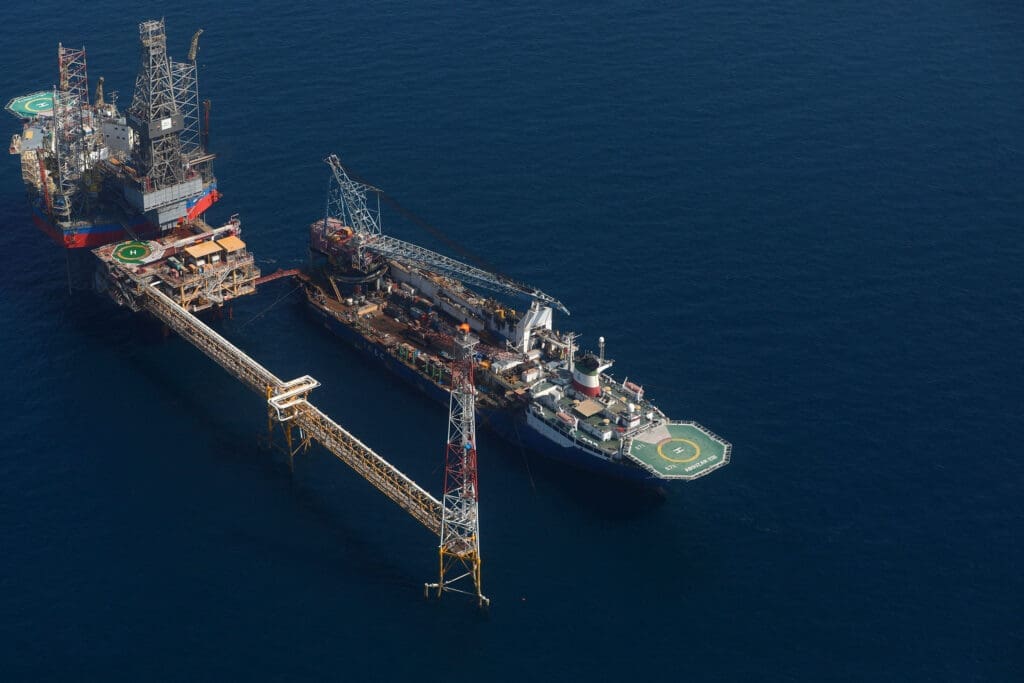
On March 18, 2026, an Israeli air raid targeted treatment facilities at Asaluyeh, the onshore processing hub for Iran’s largest natural gas field and a bedrock of domestic supply. The governor of Asaluyeh confirmed the facilities were “taken offline” to control fires, with no immediate disclosure of production losses. Israeli military sources acknowledged that the operation specifically targeted Iran’s gas infrastructure.
The strike marks a dangerous escalation in a war that has already expanded beyond traditional military targets. This was not simply an attack on an energy installation. It was the deliberate targeting of the world’s largest natural gas field—an integrated reservoir shared by Iran and Qatar that underpins a significant portion of global energy supply.
The Field
The North Field—known as South Pars on the Iranian side—lies beneath the waters of the Gulf, straddling the maritime border between Qatar and Iran. It is a geological giant containing an estimated 51 trillion cubic meters of recoverable gas.
On the Iranian side, South Pars produces 730 million cubic meters of gas per day, a record achieved only weeks ago in February 2026. That production supplies 70 percent of Iran’s domestic gas consumption, feeding power plants, heating systems, and the petrochemical complexes that sustain what remains of the country’s sanctioned economy.
The Qatari side is equally consequential. The North Field underpins Qatar’s LNG industry, which exports roughly 77 million tons annually—around one-fifth of global LNG supply. These exports heat European homes, fuel Asian power grids, and generate the revenues that transformed Qatar into a major global financial actor.
The two sides of the field are not merely adjacent; they are geologically continuous. Reservoir pressure, extraction dynamics, and environmental consequences are shared.
Escalation Already Underway
The Israeli attack comes amid an energy crisis that was already unfolding as a result of the war.
Iran’s earlier drone strike on Qatar’s Ras Laffen LNG complex on March 2 forced the state-owned QatarEnergy to suspend LNG production temporarily. Markets reacted immediately, sending benchmark prices in Asia and Europe skyrocketing by roughly 40 percent and 50 percent, respectively.
Since then, insurance companies have been withdrawing from the market. Lloyd’s of London and major reinsurers have imposed war-risk exclusions on Gulf energy infrastructure, while premiums for vessels transiting the Strait of Hormuz have multiplied tenfold.
The latest Israeli attack crosses a threshold that energy strategists have warned would transform a regional conflict into a global supply crisis. Whereas previous strikes targeted downstream infrastructure like export terminals and storage facilities, the Asaluyeh attack hit upstream production facilities—assets that directly sustain the energy system itself.
Judging by the rate of escalation seen so far, the world should be bracing for “catastrophic scenarios” ahead.
Israel’s Gamble
The attack on South Pars is part of a deliberate and incremental Israeli strategy that has now reached its third phase: hitting Iran’s economic lifeline. It is also meant to send a clear message that nothing is off limits, including targets that accelerate the economic fallout that Tehran itself is trying to use as leverage.
Israeli strategists describe a “priority of targets” that begins with nuclear facilities, moves to military delivery systems, and then to economic infrastructure. By hitting “Iran’s wallet,” Israel is now attempting to cripple the regime’s capacity to sustain its military machine.
This is intended to shock the enemy, subvert its chain of command, and create chaos, thereby slowing the regime’s capacity to react. The strikes also aim to generate internal pressure through electrical blackouts, factory closures, and heating disruptions, which, in turn, compound the external military pressure of attacking forces.
Israel’s strategy to overthrow the regime accepts that internal chaos is likely as layers of bureaucratic succession are removed and the chain of command fragments. Civilian pain and broader regional instability are not unintended consequences—they are calculated costs of a policy designed to destabilize Iran sufficiently for internal collapse.
By this logic, the global economy is nothing but collateral damage. Israel accepts that attacking South Pars means “energy-for-energy” retaliatory escalation may follow.
It is a cynical gamble—one that wagers regional stability, global energy security, and countless civilian lives on the possibility that chaos will produce a favorable political outcome before it produces catastrophe.
Iran’s Retaliation and the Expanding Energy War
Iran had already threatened to target Gulf energy infrastructure if its own facilities were struck. Following the Israeli attack on South Pars, those threats have begun to materialize.
Within hours of the strike, Iranian state media issued warnings of imminent attacks against facilities across the region, including Saudi Arabia’s SAMREF refinery and Jubail Petrochemical Complex, the UAE’s Al Hosn Gas Field, and Qatar’s Ras Laffan refinery and Mesaieed petrochemical complex. A short time later, the Qatari LNG refinery was hit and suffered “extensive damage,” according to QatarEnergy.
These actions confirm that the conflict is moving toward an “energy-for-energy” escalation dynamic in which critical infrastructure becomes the primary target.
At the same time, Iran’s ability to sustain escalation is uncertain. Since the war began, Israeli forces have conducted several thousand strikes across Iran, degrading portions of its military command structure and infrastructure. Iranian missile launch rates have declined from the saturation levels seen early in the conflict.
Yet these constraints do not eliminate risk. Iran’s ability to impede traffic through the Strait of Hormuz remains intact, for now. Moreover, for a regime that has lost its leadership, is facing domestic pressure to retaliate, and is seeing its economic lifeline burn, unpredictable behavior is likely.
Energy Markets Under Shock
With oil and gas prices already surging, the escalation into energy infrastructure is certain to make the situation far worse. The Asaluyeh strike alone took offline processing capacity for approximately 100 million cubic meters per day of gas—roughly 14 percent of South Pars output. That disruption directly affects feedstock for Iran’s petrochemical sector and may further strain pipeline gas supplies to Türkiye.
More significantly, any sustained disruption affecting Qatar’s North Field would reverberate through the global LNG market. Qatar accounts for approximately 20 percent of global supply, making the field one of the most critical energy assets on earth.
A sustained Gulf energy crisis could very likely trigger stagflation—a simultaneous supply shock, inflation spike, and financial instability—reminiscent of the 1973 Arab oil embargo but amplified by today’s tightly integrated global supply chains and fragile sovereign balance sheets in emerging markets.
Environmental Catastrophe and the Shared Reservoir
The environmental risks of the South Pars strike are also massive. South Pars wells operate at extreme pressures, often between 300 and 400 bar. Damage to wellheads or subsurface infrastructure could cause uncontrolled methane releases lasting weeks. Because methane has a global warming potential 86 times greater than carbon dioxide over 20 years, a single major blowout could equate to years of emissions from industrialized economies.
Burning petrochemical facilities also release toxic compounds—including dioxins, hydrogen cyanide, and particulate matter—that drift across the Gulf’s narrow waters. Because the Gulf is semi-enclosed with limited circulation, such pollution can persist for years, collapsing fisheries and damaging coastal ecosystems across the region.
The environmental dimension is not ancillary risk—it is strategic leverage. Iran understands that contamination of shared waters affects the Arab Gulf’s position. Israel understands that environmental damage degrades Iran’s remaining economic capacity. Both calculations point toward continued escalation.
Qatar’s Impossible Position
Qatar now finds itself in an extraordinarily difficult position. Within hours of the Israeli strike, Foreign Ministry spokesperson Majed al-Ansari issued a statement calling it “dangerous and irresponsible,” and emphasizing that “Iran’s South Pars gas field is an extension of Qatar’s North Field.”
This is not diplomatic boilerplate. It is an acknowledgment of a shared geological fate from a nation that cannot align itself with Iran, yet cannot survive the field’s destruction.
Qatar’s options—diplomatic protest, market adjustments to LNG exports, or quiet pressure on Washington—may determine whether this remains a bilateral conflict or expands into a Gulf-wide conflagration. The explosions being heard above Doha suggest that geography, not politics, will dictate the timeline.
The Catastrophe in Motion
Israel’s attack on South Pars represents the weaponization of global energy infrastructure in a regional conflict already destabilizing world markets. What energy strategists once treated as a theoretical worst-case scenario is now unfolding in real time, and the clock is ticking.
In the coming hours and days, Iranian missile retaliation could trigger regional facility evacuations and insurance market panic. LNG prices will spike. As days stretch to weeks, and the closure of Hormuz is prolonged, shipping disruption will intensify, and markets and economies will feel the pain. If the war drags on for months, regional energy investment will collapse, and the dreaded possibility of a nuclear crisis could emerge.
The danger is no longer limited to the battlefield. When the world’s largest gas field becomes a target in a military conflict, the consequences inevitably extend far beyond the region.
From Doha—where the offshore reservoir beneath these waters connects directly to the burning infrastructure across the Gulf—the trajectory of escalation is no longer an abstract forecast. It is a process already underway.