

The Trump administration’s trade policy has become a prominent source of global economic anxiety. Over the past year, the administration has turned tariffs and trade threats into blunt transactional instruments of foreign policy, demanding allies purchase more U.S. commodities—especially liquified natural gas (LNG)—in exchange for market access and political favor. What Washington calls “rebalancing,” many capitals perceive as coercion. For instance, Japan, the European Union and India have signed trade deals pledging billions of dollars in future energy purchases and investments to stabilize trade policy with the U.S. In energy markets, this uncertainty will likely shift countries’ purchasing decisions in the short run, while potentially leading to market realignment in the medium- to long-term.
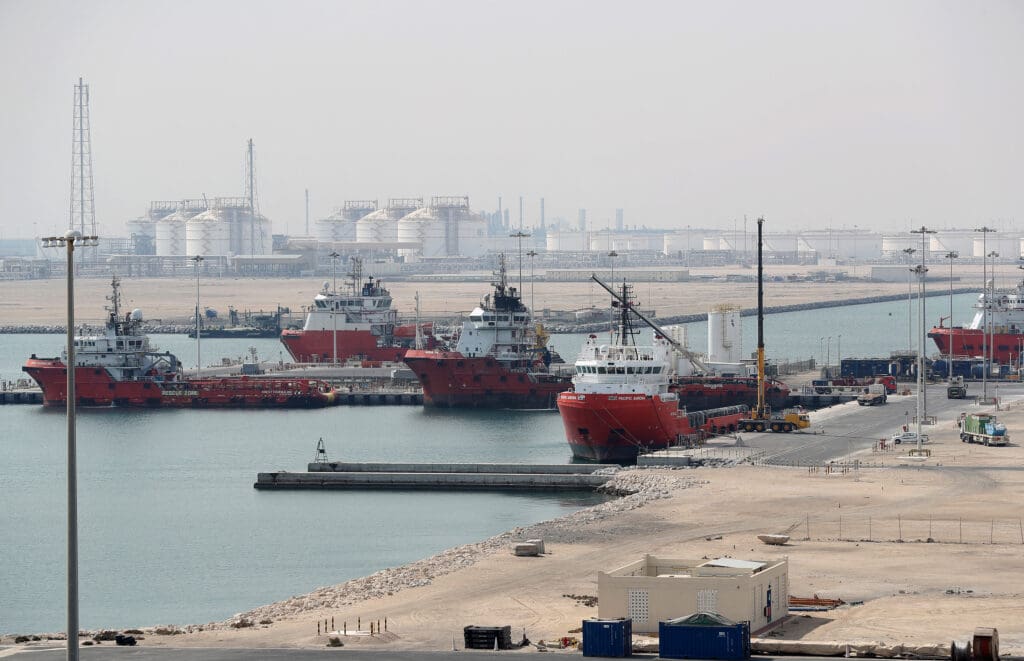
Yet energy demand does not bend easily to politics. The International Energy Agency projects another increase in global gas consumption in 2026, and governments must secure reliable supplies to fuel their economies. At a February LNG conference in Doha, the mood was filled with urgency. Delegates rushed between meetings to lock in contracts stretching from 17 to 25 years—an indication that buyers may be seeking shelter from policy storms by diversifying their LNG suppliers. Although the U.S. remains the world’s largest natural gas exporter and leads in new investment in its LNG sector, its hard-edged commercial diplomacy appears to be driving customers to hedge their energy supply. Qatar, and to a lesser extent, other members of the Gulf Cooperation Council, stand to benefit from greater international interest in the stability of long-term LNG contracts.
Supply and Demand Dynamics
In 2024, global demand for gas surged based on robust economic growth in Asia, Europe’s industrial recovery, oil-to-gas switching in the Middle East power sector, and extreme weather events across multiple continents. In 2025, LNG had a big year with global supply growing around four to five percent, primarily driven by LNG Canada and the U.S. Plaquemines projects coming online, resulting in the largest growth in global LNG exports in the last three years. Although this eased some of the pressure on prices, it was accompanied by heightened trade risk driven by the new administration in Washington. For Europe, which was continuing to reduce its demand for Russian piped gas and switching to U.S. LNG as an alternative—to the tune of more than 77 percent of its needs—tensions in the transatlantic alliance could pose a problem.
For instance, the European Union’s proposed agreement to purchase $750 billion in U.S. energy products, including LNG, stalled after President Trump’s territorial threats toward Greenland, illustrating the uncertainty of such arrangements. Skeptical European lawmakers are now asking why the EU should mortgage its energy future to a partner that treats energy contracts as bargaining chips.
Against this backdrop, European leaders are rediscovering the value of long-term contracts they once dismissed as relics. Already meeting around 20 percent of global LNG demand, Qatar offers predictable terms and long horizons for European officials weaning themselves off Russian gas and hedging against excessive dependence on American cargoes. Europe will likely need to buy over 185 bcm of LNG in 2026 to cover consumption and replenish depleted strategic reserves, but its policies have exposed it to energy price volatility and unanticipated geopolitical risk. EU Energy Commissioner Dan Jurgensen called these developments a “wake-up call” for the bloc.
Germany’s Chancellor Friedrich Merz recently toured Saudi Arabia, Qatar and the UAE with a delegation of business leaders, explicitly seeking to diversify its LNG supply. One-third of Germany’s LNG comes from American terminals, but the political risk attached to those volumes is rising. After Russia invaded Ukraine, Qatar became an important supplier of LNG to Germany, with talks held during the Mertz visit signaling potential for further growth. Germany’s biggest utility provider, RWE, announced a provisional agreement with the UAE’s ADNOC.
Driven by the need to power AI data center ambitions and economic growth in other sectors, Asia buyers continue to diversify LNG supply to insulate from geopolitical headwinds. Japan’s largest utility signed a 27-year agreement with Qatar at the recent LNG 2026 conference in Doha. Japan’s Mitsui & Co. is negotiating with QatarEnergy for a minority stake its exposure to short-run price spikes in LNG spot markets. In a July 2025 deal to lower U.S. tariffs, Japan also committed to buying up to $7 billion worth of U.S. energy products, including LNG. In October 2025, India also inked a 17-year LNG supply agreement with Qatar for up to 1 MTPA of LNG per year
The alternative alignments taking shape are not limited to energy. The EU and India reached an agreement in January that established the world’s largest free trade zone, encompassing 2 billion people and 25 percent of global GDP. Canada and China have agreed to reduce tariffs on Chinese electric vehicles and Canadian agricultural goods. Indeed, Beijing has seized the moment to portray itself as a steadier economic partner than Washington. Major Gulf energy producers such as Saudi Arabia and the United Arab Emirates are preparing to issue “panda” and “dim sum” bonds—debt instruments denominated in Chinese currency—to further deepen financial ties with China. Reading the tea leaves, or just watching oil and gas trade flows, reveals where confidence is moving.
Poised for opportunity
The first weeks of 2026 have confirmed that U.S. foreign and trade policy will remain a source of volatility. In January, President Trump threatened additional tariffs on countries “doing business” with Iran, namely China and India, ordered the U.S. military to capture Venezuela’s President Maduro, and brought warships to the Gulf region to motivate Iran to engage in nuclear negotiations. For the Gulf states – above all Qatar – this uncertainty provides an opportunity to grow their market share, and identify and court customers willing to commit to long-term LNG contracts.
Reliance on Gulf suppliers is not risk-free. Their shipping routes are threatened by regional conflicts—especially those involving Iran and Yemen—and transportation costs can be higher than those from the Atlantic Basin. With the rapid growth in global LNG trade, ship availability could become a growing constraint. Despite Qatar’s ample export growth potential, ramping up capacity through its North Field expansion will not occur overnight and will depend on securing purchasing commitments covering roughly 75-80 percent of future production. Still, the fixed prices and quantities offered by long-term contracts, which insulate customers from price pressures, are again becoming more appealing in this era of trade and political uncertainty. As a result, Qatar and its neighbors are poised to lock in decades of supply agreements and strengthen their energy security alliances.