

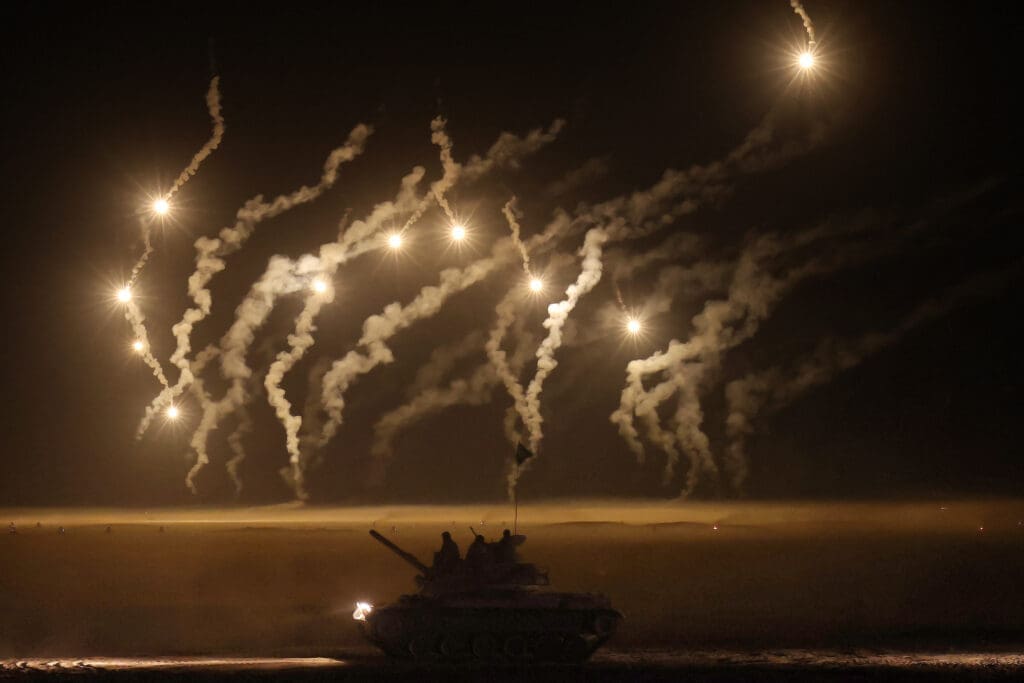
The Arab Gulf has entered a critical phase in which its security architecture is being actively reshaped. The expansion of the U.S.–Israeli confrontation with Iran, and the resulting spillover across the region, has moved the Gulf from a peripheral theater to a central arena of escalation. Cross-border attacks targeting vital infrastructure—using ballistic missiles such as the Shahab-3 and Fateh-110, alongside drone swarms designed to overwhelm defense systems—have underscored the scale and complexity of the threat. In response, several Gulf states have raised air defense readiness levels to confront simultaneous, multi-vector attacks.
What distinguishes this moment is not only the intensity of the threat, but its systemic implications. The repercussions are no longer confined to direct combatants; they are reshaping the broader architecture of regional security. At the same time, a notable paradox has emerged: as intra-Gulf political tensions have receded, a shared recognition has taken hold that current threats transcend national boundaries and directly affect the core of collective security.
The 2021 Al-Ula Declaration, which ended the Qatar blockade and restored full GCC diplomatic ties, now appears as more than a political reconciliation—it was a structural turning point. It demonstrated that shared threat perceptions can override bilateral disputes and create the conditions for meaningful security cooperation. Recent developments suggest a continued shift toward pragmatic coordination, where collective defense increasingly takes precedence over political divergence.
Toward the Restructuring of Gulf Air Defense Systems
The scale and nature of current threats have made clear that incremental adjustments are no longer sufficient. The need is no longer simply to strengthen national systems, but to move toward an integrated regional architecture capable of anticipating and neutralizing complex attacks.
The crisis has exposed the limits of unilateral approaches. Gulf security is now functionally interconnected: a breach in one state can rapidly cascade across others, particularly given the concentration of energy infrastructure and shared economic vulnerabilities. This reality has already driven greater intelligence sharing, closer coordination between radar and early warning systems, and expanded joint military exercises focused on missile and drone defense.
Institutionally, this shift is reflected in initiatives such as the GCC’s “Belt of Cooperation” (Hizam Al-Taawun), which aims to enhance joint aircraft tracking and coordinate air defense systems across member states. The sidelining of intra-Gulf disputes in this context is not merely tactical—it reflects a deeper recognition that the distinction between national and regional security is no longer sustainable.
This moment presents a rare opportunity to move from coordination to operational integration. That would require linking early warning systems into a unified network, standardizing engagement protocols, enhancing real-time intelligence exchange, and improving joint readiness. Existing deployments—such as Patriot PAC-3 and PAC-3 MSE systems across multiple GCC states and the UAE’s THAAD system—provide a technological foundation for such integration.
Recent U.S.-GCC coordination efforts, including meetings in Riyadh focused on building a common air picture and real-time data sharing, indicate movement in this direction. Yet the challenge remains as much political and technical as it is military. As analysts have long noted, interoperability has been hindered by incompatible systems, software discrepancies, and differing rules of engagement. What is different today is the alignment of political will with strategic urgency—a combination that has historically been rare.
Beyond immediate defense needs, investment in joint Gulf defense industries could further anchor this transformation, reducing long-term dependence on external suppliers and enhancing strategic sustainability.
Contours of a New Security Order
As the regional environment grows more volatile, GCC states are no longer merely responding to external pressures—they are beginning to shape the terms of their own security. The shift underway is not a rejection of external partnerships, but a recalibration toward greater internal capacity and collective agency.
Rising defense expenditures, exemplified by Saudi Arabia’s sustained high-level spending—around $69 78 billion in 2025—reflect this trajectory across the region. More importantly, the metric of strength is gradually shifting from individual national capabilities to the collective effectiveness of the GCC as an integrated system.
The current crisis provides a catalyst for this transition. A unified air defense system—grounded in shared infrastructure rather than ad hoc coordination—would mark a significant step toward a more autonomous regional security framework. At the same time, structural challenges remain. Even where GCC states operate similar platforms, differences in software, command structures, and engagement protocols continue to limit full interoperability. Addressing these gaps will require deeper institutional alignment, not just additional procurement.
The emergence of a more cohesive Gulf security bloc does not imply disengagement from global powers. Rather, it reflects a more mature approach to external relations—one that balances cooperation with autonomy. If sustained, this trajectory could position the GCC as a more influential actor capable of shaping, rather than merely absorbing, regional security dynamics.
From Dependence to Dynamic Partnerships
The evolution of Gulf security thinking has not come at the expense of international engagement. Instead, it has been accompanied by a redefinition of alliances as flexible, interest-driven instruments rather than fixed dependencies.
Regional security arrangements are increasingly characterized by adaptability. The integration of Israel into U.S. Central Command’s operational framework following the Abraham Accords has opened new channels for coordination on threat assessment and early warning. More broadly, GCC states have demonstrated an ability to engage a diverse set of partners while maintaining strategic autonomy.
This flexibility is not in tension with the goal of building a unified Gulf air defense system—it reinforces it. International partnerships can accelerate technological integration, enhance interoperability, and provide critical support during the transition toward a more self-reliant regional architecture.
What is emerging is a hybrid model: a Gulf security framework that combines internal integration with external connectivity. In this model, GCC states are no longer passive recipients of security guarantees, but active producers of regional stability. Their ability to balance autonomy with partnership will ultimately determine whether this moment of crisis translates into lasting structural transformation.