

In the months following Israel’s overwhelmingly disproportionate response to the October 7 attacks, diplomats and international observers repeatedly warned that the war risked expanding beyond Gaza and destabilizing the wider region. Governments and international organizations cautioned that unless the violence was halted, it would inevitably spill across borders and draw neighboring states into confrontation.
Israel’s conduct throughout the war suggested precisely that trajectory. Military operations steadily expanded across multiple fronts, accompanied by sweeping rhetoric about reshaping the regional order. Israeli Prime Minister Benjamin Netanyahu himself declared that Israel would “change the face of the Middle East.” Taken together, the widening scope of operations and the language surrounding them signaled that the conflict was unlikely to remain narrowly confined.
Those warnings proved prescient. What began as a devastating campaign in Gaza quickly expanded across the region. Hezbollah drew Lebanon into sustained and transformative hostilities, Syria became an active theater of strikes Israeli operations increasingly extended beyond the immediate Levant to the Red Sea, drawing in Yemen’s Houthis and other Iran-aligned nonstate actors. The escalation ultimately culminated in a direct confrontation between Israel and Iran, a 12-day war in June 2025 that marked one of the most dangerous escalations in the region in decades.
Even before the current crisis reached its present stage, regionalization became one of its defining characteristics. Israel demonstrated virtually no restraints operationally and geographically in choosing its targets, including an unprecedented airstrike on Qatar that triggered immediate diplomatic backlash across the world.
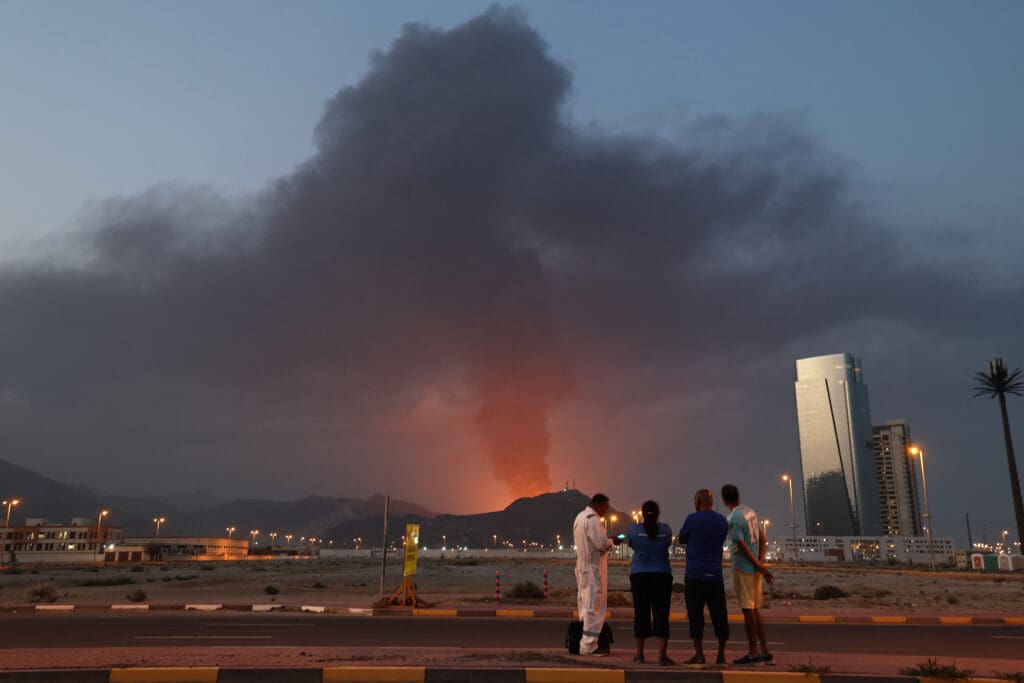
Despite the eight months that separate the 12-day war from the one now unfolding between Israel, the United States and Iran, the two are inextricably linked, including in the lessons derived by Iranian decision-makers. Whereas previously Tehran demonstrated cautious restraint and an overarching desire to de-escalate regionally—notwithstanding its attack on Qatar’s Al-Udeid base—this time the repeated U.S.-Israeli offensive has been met with a deliberate strategy to escalate and retaliate regionally. Missile and drone strikes have not only targeted Israel, but several Gulf neighbors.
Iran’s response may have been intended as a demonstration of resolve, yet its strategic consequences are deeply questionable. By targeting Gulf states that had spent years cautiously improving relations with Tehran, the Islamic Republic has jeopardized fragile diplomatic progress and undermined the regional détente that had begun to emerge.
For Gulf governments, the result is an immediate strategic dilemma. As Iranian missiles wreak havoc across the region, the pressure to retaliate is mounting. Yet the central question confronting Gulf states is not simply how to respond to Iranian aggression. It is whether entering the war would ultimately serve their own strategic interests or those of others.
In many ways, the future balance of power in the Middle East may hinge on that decision.
A Region Already in Flux
The current escalation did not emerge in isolation. In the years preceding the conflict, the regional landscape had been undergoing a quiet but significant transformation.
For much of the past decade, Israel’s strategic vision for the Middle East rested on the expectation that Arab states, particularly in the Gulf, would align themselves against Iran. From Israel’s perspective, Tehran represented the principal obstacle to regional dominance, and a broad coalition confronting Iran would fundamentally reshape the regional order in Israel’s favor.
Yet the region pivoted in a different direction. Instead of deepening confrontation with Tehran, the Gulf states recognized the net downside of confrontation and increasingly pursued strategies centered on diplomacy, mediation, and de-escalation. Relations between several Gulf capitals and Iran gradually shifted away from open hostility toward cautious coexistence, with channels for dialogue expanding and tensions easing.
At the same time, relations among key regional actors including Qatar, Saudi Arabia, Egypt and Turkey began to improve after years of rivalry and fragmentation. These rapprochements gradually produced a more cohesive regional environment and strengthened collective diplomatic leverage.
The Gaza war, despite being a major rupturing point, accelerated these dynamics. Gulf states adopted strong diplomatic positions condemning Israeli actions and mobilized international pressure for a ceasefire and humanitarian relief. Across much of the Arab and Muslim worlds, a growing degree of political coordination emerged, accompanied by a shared narrative portraying Israel’s actions in Gaza as a major threat to regional stability.
From Israel’s perspective, these developments were deeply troubling. Rather than moving toward normalization and alignment against Iran, the region appeared to be drifting toward a more independent and coordinated political posture that could constrain Israeli ambitions.
Escalation and Strategic Opportunity
Against this backdrop, the current war introduces a dramatically different strategic dynamic.
Iran’s decision to strike multiple Gulf states risks producing precisely the conditions Israel had long hoped for: a direct confrontation between the Gulf and Iran. If Gulf states enter the war militarily, launching retaliatory strikes and committing themselves to sustained confrontation, the conflict would cease to be primarily an Israeli-Iranian struggle. Instead, it would evolve into a broader regional war in which Gulf states become central participants.
For Israel, such an outcome could prove strategically advantageous. A prolonged confrontation between Iran and the Gulf would drain the resources of both while reshaping the region’s balance of power.
The Cost of Escalation
The risks of such a trajectory extend far beyond the battlefield. The Gulf’s rise over the past two decades has been built on stability, economic expansion and global connectivity. Cities such as Dubai, Doha and Riyadh have cultivated reputations as hubs of trade, finance and investment.
The regional war now underway threatens that foundation, and risks diverting attention and resources away from the broader geopolitical landscape that enabled the Gulf’s growing power and influence. In such a scenario, the Gulf could find itself transformed from an emerging center of regional influence into the principal battlefield of a conflict whose strategic consequences are shaped elsewhere.
As such, significant danger lies in the asymmetry of strategic incentives among the actors involved. For Israel, and to a lesser extent Iran, the conflict is increasingly framed in existential and civilizational terms. Wars perceived in such terms often carry no clear ceiling for escalation. The absorption of chaos, economic disruption and prolonged instability becomes an acceptable cost in pursuit of decisive strategic outcomes.
The Gulf states operate under a fundamentally different calculus. What may be tolerable costs for actors engaged in existential confrontation would impose far greater damage on Gulf societies and economies.
The implications extend far beyond the region itself. The Gulf remains central to global energy markets, maritime trade routes and financial flows. A prolonged regional war that destabilizes the Gulf would reverberate across the global economy. Ensuring that the region avoids becoming the center of a sustained military confrontation is therefore not only a Gulf interest but a global one.
The Strategic Value of Restraint
Given these realities, the Gulf faces a difficult but critical choice. Responding militarily to Iranian attacks may appear to be the most natural course of action. States possess a legitimate right to defend themselves, and public pressure for retaliation will be strong.
Yet strategy often requires resisting the most immediate impulse. If the Gulf states enter the war directly, they risk the region becoming the primary arena of a prolonged conflict whose consequences would be unpredictable and potentially devastating. If they prioritize restraint, diplomacy and strategic patience, Gulf states retain the ability to shape the broader regional environment.
Importantly, restraint does not imply weakness. It reflects an understanding of the larger strategic game unfolding across the Middle East. By refusing to be drawn further into a war with Iran, Gulf states may preserve their economic stability, maintain diplomatic flexibility and prevent others from dictating the trajectory of the conflict.
The Future of the Region
The decision Gulf states make now may prove decisive for the future of the Middle East. A region consumed by war between Iran and the Gulf would emerge profoundly weakened. Its economic centers would suffer damage, its political cohesion would fracture, and its strategic autonomy would diminish.
Conversely, a region in which Gulf states resist escalation and work to contain the conflict would retain the capacity to shape the post-war order. By prioritizing restraint, they would preserve the ability to use economic, financial, and diplomatic leverage to press for de-escalation. Moments of crisis often create the illusion that immediate action is the only viable response. Yet the most consequential strategic decisions are often those made in restraint.
It may feel as though the region stands only a few moves from strategic checkmate. Yet the most powerful response may simply be to refuse the trap. In other words, the only winning move is not to play.