


Rupture and Representation:
The Palestinian National Movement After October 7
Dossier, April 2026

Fellow

Nonresident Senior Fellow
 download
Introduction
The October 7 Hamas-led attack on Israel, and the Gaza Genocide that commenced that same day and continues more than two years later, mark a critical historical juncture for the Palestinian people. While the scale of destruction, loss of life, and displacement in Gaza has few contemporary parallels, the significance of this moment extends beyond the immediate catastrophe. For Palestinians, October 2023 did not simply usher in another episode in their protracted struggle for liberation; it exposed the cumulative consequences of decades of political fragmentation, institutional decay, and strategic paralysis within the Palestinian national movement itself.
There is broad consensus that these events constitute a rupture, clearly separating what came before from what follows. Much of the expanding body of scholarship, analysis, and commentary on this period has understandably focused on Israel and Hamas’ military conduct, the human and humanitarian toll, the legal and diplomatic responses, and the regional and international fallout. Yet one dimension has received comparatively less sustained and integrated examination: what this moment reveals about the present condition of the Palestinian national movement, and how the dynamics unleashed since October 2023 are reshaping its future trajectory.
The crisis that erupted in October 2023 exposed, in stark fashion, the myriad challenges confronting this movement, which were themselves long in the making. The decision to launch the attacks was neither the product of a unified national strategy nor the outcome of collective decision-making. More importantly, it could not have been, because Palestinian politics had been fragmented for decades, particularly since the Fatah-Hamas schism and associated geographic division between the West Bank and Gaza Strip that commenced in 2007. In this context, no single institution—including the functionally dormant Palestine Liberation Organization (PLO)—possessed the authority, legitimacy, or capacity to articulate and pursue a coherent national strategy across diplomatic, legal, military, and societal domains.
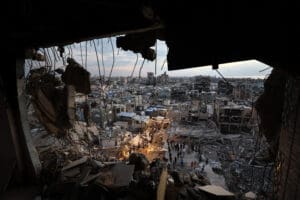
At the same time, Israel’s response to October 7—characterized by mass killing, the systematic destruction of Gaza’s civilian infrastructure, the targeting of life-sustaining systems, and the forcible displacement of nearly the entire population—has posed an existential challenge to Palestinian collective existence and to the broader Palestinian national project. It has unfolded alongside a dramatic escalation of violence, repression, and land seizure in the West Bank, as well as intensified efforts to marginalize, bypass, or re-engineer Palestinian political representation in postwar planning frameworks. Together, these developments have placed untenable strain on what remains of Palestinian political institutions and raised fundamental questions about their capacity to survive, let alone adapt.
The central concern of this dossier is therefore not the direct consequences of the Gaza Genocide per se, but what it has revealed—and accelerated—about Palestinian politics. How did the Palestinian national movement arrive at a point where it was structurally incapable of responding to such a moment? What are the implications of this condition for Palestinian agency across key arenas, including leadership, international law, regional diplomacy, physical reconstruction, diaspora activism, and engagement with the international state system? And what does this juncture suggest about the prospects for political renewal, reconstitution, or transformation—or, alternatively, further fragmentation, disintegration, and potentially collapse—in the period ahead?
Historically, such moments of profound upheaval have served as inflection points and catalysts in Palestinian political development. The Nakba of 1948 destroyed the leadership structures and socio-economic order that had emerged during the British Mandate. In so doing it gave rise, after a prolonged period of disarray, to new forms of political mobilization and organization. This culminated in the reconstitution of the Palestine Liberation Organization (PLO) in the aftermath of the 1967 June War as a national movement owned and operated by Palestinian organizations, one capable of imposing itself on regional and international politics, rather than a proxy for Arab states that had been defeated and discredited. By contrast, the Oslo process of the 1990s marked a different kind of transformation, re-orienting the movement away from liberation and toward limited self-governance under occupation, with far-reaching consequences for representation, decision-making, and legitimacy.
The transformative developments of the past two years suggest that a new and different Palestinian national project will emerge from the ashes. But the shape it takes will ultimately be determined by that of the national movement that is constructed in the years ahead. While a movement and its project are arguably organically intertwined and mutually reinforcing, there is no project without a movement to generate and sustain it.
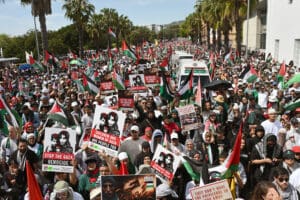
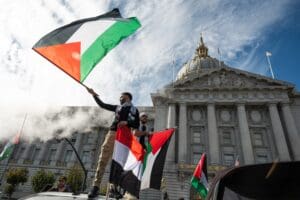
The chapters in this volume therefore situate the post–October 2023 moment within this larger historical context. Collectively, they identify a debilitated national movement unable to translate the resources at its disposal into political power and leverage. Across multiple arenas, Palestinians today possess unprecedented assets. International legal bodies have issued rulings and opinions affirming the illegality of Israel’s occupation, apartheid practices, and genocidal actions in Gaza. Global public opinion has shifted markedly in favor of Palestinian rights, particularly in Western societies. Significant segments of the Global South have mobilized diplomatically and legally in defense of international humanitarian law. Palestinian diaspora communities have demonstrated remarkable organizational capacity and discursive influence. Yet these developments have not coalesced, or been channeled, into a unified political project capable of significantly influencing outcomes on the ground. The political frameworks and institutional capacity to do so have been rendered impotent and, for all intents and purposes, must be built anew.
…
Each author, in their own way, reaches the same conclusion: Unless and until the Palestinians achieve national coherence and rebuild their national movement and its institutions as an effective and proactive agent of change, the initiative will remain in the hands of others, often to the Palestinians’ disadvantage.
To be clear, this dossier does not offer a roadmap for Palestinian political renewal, nor does it conclude or predict that such renewal is imminent. Instead, it seeks to examine the nature of the crisis that has emerged since October 2023, and to identify the structural conditions under which political reconstitution might—or might not—occur.
Ultimately, the purpose of this volume is to open analytical space for serious reflection on the future of the Palestinian national movement at a moment when its component parts are under unprecedented strain. Whether the current rupture will produce renewed political organization, prolonged fragmentation, or new modalities of struggle remains an open question. What is clear, however, is that October 7 has both rendered the status quo untenable and eliminated the conditions for its restoration. The chapters that follow engage this reality from different vantage points, collectively illuminating the possibilities and constraints that will shape Palestinian politics in the years ahead.
It should also be noted that this project was started and completed amid a rapidly evolving context. This affected the writing and editing processes and made drawing conclusions a difficult undertaking. Indeed, the situation on the ground in Palestine-Israel continues to unfold in transformative ways, yet the papers assembled here were designed to remain valid and relevant to the utmost possible.
Table of Contents
Introduction – Omar H. Rahman and Mouin Rabbani
Chapter 2: October 7 and the Depth of the Palestinian Leadership Crisis – Omar H. Rahman
Chapter 3: The Palestinian National Movement and the Challenge of International Law – Mouin Rabbani
Chapter 5: How to Rebuild Gaza: Land, Sovereignty, and the Right to the City – Abdalrahman Kittana
Conclusion – Mouin Rabbani and Omar H. Rahman
Dossier Chapters


Nour Odeh

Omar H. Rahman

Mouin Rabbani

Khaled Elgindy
Abdalrahman Kittana
Sarang Shidore
Zaha Hassan

Related
Publications
view more

Since October 7, 2023, China has responded to the unfolding crisis in the Middle East by supporting multilateral efforts to bring an immediate end to the violence in Gaza and…
learn more
The characterization of Israeli control over Palestinians as an apartheid system represents a significant shift in the way the regime is portrayed and understood. While the application of the term…
learn more