


What Future for the US Dollar in the Gulf?
Policy Paper, October 2026

Nonresident Senior Fellow
Abstract
The GCC’s dollar peg is conventionally explained by three pillars: dollar-invoiced oil, Treasury-recycled surpluses, and imported Federal Reserve credibility. This paper argues that account mislocates the source of dollar dominance, oil invoicing is sticky because offshore dollar bank funding is sticky, not the reverse, so the trade pivot to China erodes the peg’s rationale without dislodging the dollar from the barrel. Through this lens, the 2026 UAE swap-line episode is better interpreted as dollar entrenchment than as drift. The real question, then, moves from whether oil stays dollar-invoiced to who sets the terms of the anchor. Examining the pressures through geoeconomic, geopolitical, and macroeconomic lenses, and disaggregating the six members’ differing buffers, the paper recommends: publish qualitative, non-numerical trigger criteria for regime review to avoid inviting speculative attack; commission basket design in reserve; replace the moribund Monetary Council with an all-six-member coordinating body; and formalize liquidity assurance for Bahrain and Oman before any of the above is announced.
Key Recommendations
1. Publish trigger criteria, but no transition plans. Each GCC finance ministry and central bank should publish a formal framework specifying the conditions under which it would review its exchange-rate regime, without pre-committing to any alternative. The framework should be qualitative and directional, featuring institutional review and monitored indicators, but without concrete thresholds, and with any operative triggers kept confidential. This captures much of the uncertainty-reduction benefit of a regime change at little cost or risk, giving investors and banking counterparties a contingency framework to anchor to.
2. Commission basket design before it is needed. Large GCC economies should commission independent analysis of optimal basket weights, calibrated to trade composition, oil-revenue structure, and reserve profile, with results held in reserve. This is routine institutional risk management short of a policy commitment; as Kuwait did before its 2007 switch, members should not be caught designing under pressure.
3. Coordinate through a GCC-wide mechanism to prevent competitive devaluation. The GCC Monetary Council has been dormant since 2009 and features only four members, excluding the UAE and Oman. A new body, e.g., a central-bank governors’ committee or a purpose-built technical secretariat covering all six, should develop shared trigger criteria and basket-design principles, so that differentiated national timelines do not harden into uncoordinated, competitive moves.
4. Formalize liquidity assurance for Bahrain and Oman. Saudi Arabia and the UAE should convert ad hoc support into formal bilateral liquidity commitments, conditional on credible consolidation. Bahrain’s reserves cover about two months of prospective non-hydrocarbon imports (below the IMF’s three-month benchmark) and its debt (131% of GDP) is rising. Without explicit assurance, any exchange-rate uncertainty invites a disorderly exit that coordinated planning can pre-empt.
Introduction
In April 2026, the UAE Central Bank governor, Khaled Balama, made a puzzling request to US Treasury Secretary Scott Bessent: a dollar swap line. As the UAE holds more than $250 billion in foreign exchange reserves and one of the world’s largest sovereign wealth funds, it does not need emergency dollar liquidity. The UAE embassy thus dismissed any suggestion of distress as “misread[ing] the facts.”1 Yet the US Treasury agreed, and Secretary Bessent told the Senate he would build “new U.S. dollar funding centers in the Gulf and Asia,” evidence of “the US dollar’s primacy and the strength of America’s economic shield.”2 Observers interpreted the episode as the UAE sending a signal. The Economist called it a demonstration that Abu Dhabi could “turn to China and perhaps initiate a petroyuan programme.” Balama reportedly told Bessent that if dollar liquidity tightened, Abu Dhabi “could settle some oil sales in yuan.”3 But a more mundane explanation is equally plausible: a reserve-rich state locking in cheap backstop liquidity for its banks.
The swap line, however, points to a question the Gulf has long treated as settled. This paper argues that the GCC’s real vulnerability lies not in the dollar’s role as the currency in which oil is invoiced, but in the monetary anchor to which its currencies are pegged. Gulf states, then, must decide who sets the terms of that anchor rather than have the question answered for them.
Concurrently, the question of dollar dominance and global reserve currency status has gained momentum from preeminent academic and policy voices. In May 2025, Kenneth Rogoff stated that “My thesis is that the U.S. dollar is about to get knocked down a couple pegs […] It will still be first in global finance, because nothing is poised to fully replace it. The dollar just won’t be as unique as it once was.”4 Christine Lagarde concurred that the dollar’s dominance is “no longer certain.”5 And in an April 2026 interview, Barry Eichengreen said that, “[t]o me, the argument that the dollar is in a secular decline as the dominant global currency remains intact.”6 Of course, while the long-term demise of dollar hegemony is plausible, it is not imminent, as no alternative plumbing exists at global scale, and no issuer is able or willing to step into the dollar’s shoes. But even if the dollar is unlikely to be dislodged from Gulf oil invoicing soon, the anchor currency may.
For fifty years, the GCC’s dollar pegs have been analyzed in terms of three mutually reinforcing pillars. Oil revenues invoiced in dollars created demand for the world’s reserve currency, US Treasuries were the natural vehicle for recycling the surpluses, and young Gulf monetary institutions, lacking the depth and track record to anchor expectations on their own, borrowed the Federal Reserve’s credibility by pegging to it. The conventional account holds that each pillar is now under strain, with the trade pivot to China eroding the first, the unwinding of petrodollar recycling and doubts about US reliability the second, and political pressure on the Federal Reserve the third. However, this mislocates the dollar’s dominance in the invoicing currency, while the next section will argue that it lies in the anchor. The 2026 war on Iran is lending the debate renewed immediacy.
The peg persists out of inertia, on the difficulty of coordinating six governments with divergent fiscal positions, and on substantial short-run transition costs. Its end has, officially, been a non-issue, and no GCC central bank has published a framework specifying the conditions under which it would even review its exchange rate regime, let alone what a review might conclude. Firms making capital-allocation, investment, and pricing decisions cannot anchor to a contingency framework that does not exist, while Washington is filling the vacuum with its own architecture of bilateral swap lines and “dollar funding centers,” built to keep the Gulf in dollar channels without GCC input. The lack of a framework may thus reflect deliberate discretion, but that objection dissolves once the recommendation is framed correctly: publish trigger criteria, not transition plans.
The paper’s contribution is an analytical reframing applied to policy. It separates the anchor question from oil invoicing, treats the swap-line architecture as dollar entrenchment rather than retreat, and interprets the peg as a distributive pillar of the rentier bargain. Applied to the Gulf’s simultaneous 2026 pressures, it sets out a member-differentiated, operative prescription: publish formal, differentiated frameworks for when each state would review its regime, leaning into institutional risk management while avoiding geopolitical signaling.
The Rationality of the Peg Architecture
The peg has been a rational choice for fifty years, but the same conditions that sustained it also explain why it is now weakening. The first pillar was political. In 1973–74, Secretary of State Henry Kissinger and Treasury Secretary William Simon negotiated an arrangement with Saudi Arabia under which oil was priced in dollars in exchange for security guarantees and preferential access to US Treasury markets; the other Gulf states followed within a decade.7 That informal understanding is now questioned. Specific bilateral arrangements have lapsed, even if the mechanics persist for want of an attractive alternative: Saudi Arabia held $149.5 billion in Treasuries in December 2025, up about $12 billion year-on-year.8
The other pillars were interlocking. High oil prices generated dollar surpluses, which bought Treasuries, keeping yields low. Cheap US borrowing then financed the security umbrella that protected Gulf production, and that production sustained the oil price.9 Meanwhile, central banks that could not yet anchor expectations on their own imported the Fed’s credibility, eliminating the dominant category of exchange-rate risk at minimal institutional cost. The whole structure assumed four conditions: the United States as the Gulf’s dominant trade and security partner, net-creditor status for most members, a politically independent Federal Reserve, and a broadly honored security guarantee. All four have since changed, at different speeds and through different channels.
The conventional three-pillar view locates dominance in the dollar’s invoicing role and in recycling into Treasuries. The stronger view is that dominance rests on the offshore dollar funding system that prices, funds, and collateralizes global trade: firms invoice in the currency their banks fund in, and banks fund in the currency their clients invoice in.10 Viewed this way, oil invoicing is less central than it seems, and its durability reflects the solidity of that bank funding: what would dislodge the dollar from oil is less a redirection of trade flows than a relocation of the trade-finance, hedging, and settlement system. Two implications follow. First, the China trade pivot erodes the transaction-cost rationale for the peg without dislodging the dollar from oil, so the critical question is the anchor, not the invoicing currency. Second, crisis-era instruments like the dollar swap lines now spreading through the Gulf are mechanisms of dollar entrenchment. The next three sections trace these changes through three converging lenses.
The Geoeconomic Lens
Two principles explain both why the peg made sense and why it is now weakening. First, a peg works best against the currency of your main trading partner, minimizing the transaction costs and exchange-rate risk that matter most for daily commerce. In 1974, that partner was unambiguously the United States. Second, a mobile workforce can absorb shocks in place of a flexible exchange rate. This fits the Gulf’s large expatriate labor force, which shrinks when economies slow, easing demand and wage pressure without a currency adjustment. Both once pointed firmly to the dollar but are now weakening.11 China has displaced the United States and, around 2020, the European Union as the GCC’s leading trade partner, and now takes the bulk of Gulf oil exports: before the 2026 war, Saudi Arabia sold several times as much crude to China as to the United States.12 Payments have partly followed: by one estimate, roughly 60 to 80 percent of direct UAE–China payments now settle in renminbi.13 That figure is suggestive but limited to direct bilateral payments; it points to a shift in plumbing, not in the currency that prices or funds the trade, and what non-dollar oil trade exists so far reflects sanctioned sellers like Russia and Iran more than Gulf choice. Still, China’s monetary diplomacy signals the direction: at the Lujiazui Forum in June 2025, PBOC Governor Pan Gongsheng predicted a system in which “a few sovereign currencies coexist, compete with each other, and check and balance each other.”14 In short, the logic that once pointed to the dollar now points to a trade-weighted basket as the better anchor — though that says nothing about where oil will be invoiced.
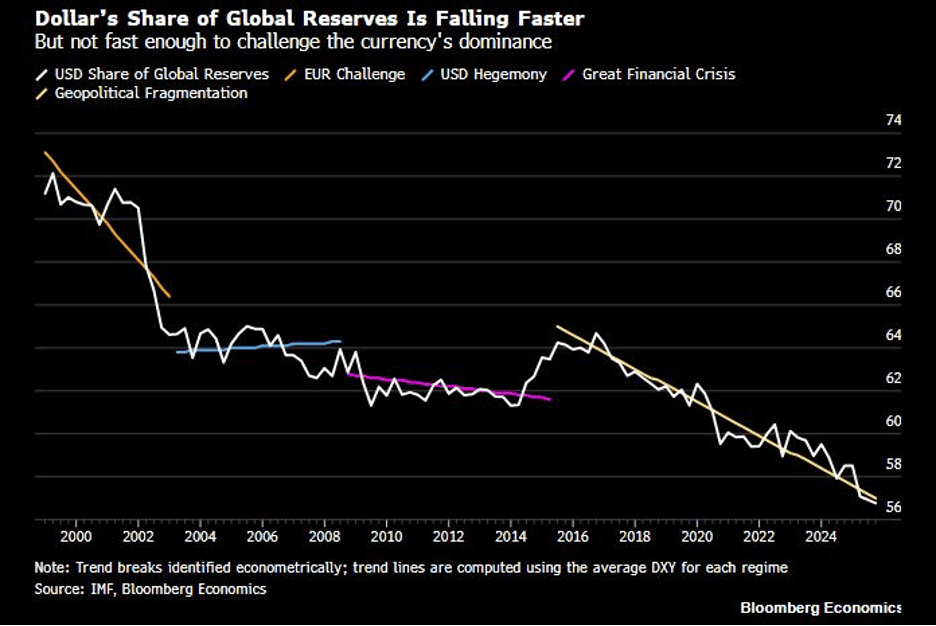
Dollar share of global reserves, 1999–2025. On the IMF COFER measure (allocated foreign-exchange reserves, excluding gold), the dollar stood at about 57 percent at end-2025, still more than twice the euro’s ~20 percent, though the post-2022 decline is the steepest in the series. Counting gold, now 27 percent of total reserves, the dollar’s share of all reserve assets is correspondingly lower. Source: IMF COFER; Bloomberg Economics; ECB (2026). Reproduced with permission.
Petroyuan infrastructure has run well ahead of any repricing of oil: Saudi Arabia joined mBridge in 2024, the UAE and Qatar host renminbi clearing centers, and both hold PBOC swap lines; yet, the share of oil settled in yuan stays marginal, because invoicing and bank funding reinforce each other, and because it is the offshore Eurodollar system, not the oil-for-dollars arrangement, that carries the dollar’s dominance.15 Dollar dominance itself has barely moved: the dollar’s share of FX transactions has held near 88 percent for two decades, with about half the world economy still anchored to it by inertia.16 The question for this paper is narrower, namely, whether these shifts change the anchor calculus of the pegging Gulf states, for whom importing US conditions has grown costlier.
Reserve data show gradual, fragmented change. Gold has risen fastest, both in valuation (now 27 percent of total reserves, overtaking the euro as the second-largest reserve asset17) and official tonnage: net buying ran above 1,000 tons a year in 2022–2024, easing to about 850 tons in 2025. The exit from dollars has been dispersed: of the decline in the dollar’s reserve share since 2000, about three-quarters went to non-traditional currencies (the Australian and Canadian dollars, the won, the krona) and only a quarter to the renminbi.18 Gulf reserve managers themselves resist yuan oil pricing, which would hand the pricing mechanism to Beijing.19 But change, when it comes, may not be linear: reserve shifts have an estimated seventeen-year half-life but also a tipping dynamic once a challenger nears the incumbent’s share,20 so the anchor is sticky by default, as the window for building frameworks is longer than crisis narratives suggest. But, critically, a tipping point gives no warning, so those frameworks must be ready first.
The second principle is fraying too. The expatriate workforce absorbs shocks, but is asymmetric (it cannot easily add workers in a boom), socially costly, and increasingly at odds with the Saudisation, Emiratisation, and Omanisation targets at the heart of Vision programs. Manufacturing competitiveness, a core Vision objective, points in the same direction: it needs the real-exchange-rate flexibility a basket provides but a hard dollar peg forecloses.
The Geopolitical Lens
The petrodollar system was always as much political as economic: oil in dollars for security, capital-market access, and a measure of tolerance of Gulf governance. It holds when economic and security interests align and strains when they diverge. For three decades they have aligned but are now pulling apart. Four mechanisms are pulling at once.21
The first is the erosion of the US security guarantee. The United States struck Iran on February 28, 2026, without consulting its Gulf partners, and weeks later, after Washington announced a unilateral plan to reopen the Strait of Hormuz, Saudi Arabia suspended US use of its bases and airspace, the first time in the relationship’s eighty-one-year history that base access has been used as a strategic lever.22 Major non-NATO ally status, the State Department notes, “does not entail any security commitments.”23 By contrast, Saudi Arabia’s September 2025 defense pact with Pakistan and the 2026 Pakistani–Saudi–Turkish Mecca Agreement carry Article 5-style mutual-defense clauses from countries other than the United States. The Gulf is diversifying its security partnerships for the same reason it is diversifying everything else.24
The second mechanism is the unwinding of petrodollar recycling. The informal Saudi–US understanding had lapsed by 2024, and Saudi Arabia is shifting from net creditor to net debtor.25 The direction matters as much as the level: a creditor recycling surpluses into Treasuries funds the system, while a debtor competing for capital is its client, and the Gulf is crossing that line as it scales up domestic spending. The Public Investment Fund’s 2026–2030 strategy redirects an estimated $91–92 billion inward, lifting its domestic target to 80 percent, and its US-listed equity portfolio fell from $35.5 billion in early 2023 to about $12 billion by early 2026.26 Washington has responded not by rebuilding the wholesale system but by improvising a retail one: bilateral swap lines negotiated one country at a time, on US terms.27
This evidence cuts both ways. Central-bank dollar swap lines are the canonical mechanism by which the dollar system entrenches through crisis: in 2008 and 2020 the Federal Reserve backstopped the offshore dollar system, and extending “dollar funding centers” to the Gulf (unusually, through the US Treasury rather than the Fed) continues that logic.28 Regardless of whether one reads the current direction as drift or entrenchment, the anchor calculus of the pegging states is shifting, independent of dollar dominance.
The third mechanism is dollar weaponization and the crisis of confidence it breeds: “Exposure to US financial sanctions significantly increases the share of reserves that emerging and developing economies hold in gold.”29 The Gulf understood its exposure as early as 2016, when Riyadh threatened to sell up to $750 billion in Treasuries if US courts let its assets be frozen under JASTA, the first public admission that its dollar holdings were a strategic vulnerability as much as an asset.30 The freezing of Russia’s reserves in 2022 deepened the lesson for every reserve manager, as Deutsche Bank’s George Saravelos warned of “a broader confidence crisis… a dramatic regime change in markets.”31 A manager who once treated US Treasuries as the definition of a safe asset must now price the possibility that access to them is politically contingent.
The fourth mechanism is the conversion of US trade policy into a geopolitical weapon. The average effective US tariff rate reached 18.6 percent by August 2025, the highest since 1933, and tariffs have been aimed at Brazil over a court ruling, India over Russian oil, and European allies over Greenland — punishments for behavior unrelated to trade.32 For the Gulf, deep dollar integration now carries a novel, unforeseen category of risk. The question is whether this much exposure is prudent when the anchor country behaves so unpredictably.
Together, these mechanisms point to a “financial interregnum”: dollar dominance fading without a clear successor into a more fragmented order.33 The unraveling is slow but can accelerate abruptly, similar to the UAE’s unilateral April 2026 exit from OPEC, taken without consulting partners, showed for oil governance.34
The Macroeconomic Lens
The Mundell-Fleming trilemma states that a country cannot simultaneously hold a fixed exchange rate, open capital flows, and an independent monetary policy. The GCC chose the peg and open capital accounts, surrendering monetary sovereignty: the Federal Reserve sets rates for American conditions, and Gulf central banks follow.35 For most of the peg’s life this was tolerable, because US conditions broadly suited GCC economies and the Fed’s credibility was precisely what the Gulf was importing. But both premises are now in doubt.
The 2022–2024 tightening cycle showed the cost. The Fed raised rates from near zero to above 5 percent, the most aggressive move since the Volcker era, and the Saudi Central Bank (SAMA), the Central Bank of the UAE (CBUAE), and the Central Bank of Kuwait (CBK) all followed to defend their pegs.36 The timing was off for the Gulf, whose post-COVID, Vision 2030 investment cycle called for accommodation, not restraint. The peg ended up raising borrowing costs for flagship projects, slowing real-estate market momentum, and lifting debt-service costs just as Gulf states scaled up domestic spending.
Moreover, research suggests the trilemma is closer to a dilemma: under open capital accounts, US monetary and financial conditions propagate across borders regardless of the exchange-rate regime, because a country imports much of the global financial cycle whether it floats or pegs, and recovers genuine autonomy only by managing capital flows directly.37 On the one hand, this confirms that the peg imposes a real and rising cost of sovereignty in that Gulf central banks import the Fed’s cycle undiluted. On the other, it also limits what any alternative can promise: a basket under open capital accounts still imports the global cycle, so the marginal autonomy gain is small. What a basket really delivers is automatic terms-of-trade stabilization, softening when commodities fall and hardening when they rise. The case for a recalibrated anchor therefore rests on cushioning, not autonomy.
The peg’s other foundation, imported credibility, is eroding as the Federal Reserve comes under political pressure, with a criminal investigation into its outgoing chair, the dismissal of a sitting governor, and claimed presidential control over Fed functions well beyond monetary policy.38 Whether the incoming leadership can hold the line on independence, especially on the international-finance questions where the Gulf is most exposed, is now an open question.39
A weaker anchor matters because it threatens the dollar’s reserve-currency status, and fiscal discipline is one of the threats. During the Iran war, the 10-year Treasury yield rose about 100 basis points from about 4.0 to 5.0 percent, where a classic flight-to-safety would have pulled it down. The rise cannot be dismissed as oil-driven inflation, either, as it was concentrated in real yields: the 10-year TIPS real yield rose from 1.7 to 2.2 percent, or 48 basis points, while breakeven inflation stayed flat,40 pointing to the confidence channel of a weakening safe haven and a rising fiscal-and-term premium rather than an inflation shock.41 For states that peg to the dollar, the quality of the anchor itself is in question.
The peg also carries a rising opportunity cost. Holding large low-yield dollar reserves for peg defense made sense when domestic returns were weak. But as the Vision programs open high-return opportunities at home, the cost of tying up capital climbs. The PIF’s inward redirection made that calculation explicit, as a judgment that domestic deployment now matters more than the implicit subsidy embedded in Treasury holdings.42
The war has intensified every one of these dynamics. Foreign central banks were net sellers of Treasuries for five straight weeks after the February strikes, New York Fed custody holdings fell to their lowest level since 2012, and gold surpassed the euro as the second-largest reserve asset.43 These developments accentuate developments that predate the war, since by October 2025, a “great debasement debate” was already moving investors from sovereign bonds into gold against the prospect of runaway deficits.44 While a dollar crisis remains unlikely, it is no longer unthinkable.
Why have these rising costs not produced action? The anchor is embedded in the distributive bargain of rentier states, and the bargain’s winners are concentrated and politically powerful, while those who bear the costs are dispersed, unorganized, or even not yet born. The peg keeps imported consumption cheap and underwrites an import-merchant class whose balance sheets are dollar-denominated; banks carry large dollar liabilities and no hedging infrastructure for a regime change, and their lobby is powerful; and the reserves held to defend the peg double as elite wealth preservation and geopolitical insurance. The costs, meanwhile, accrue elsewhere: project financiers and mortgage holders import the Fed’s cycle undiluted, while the tradable and manufacturing sectors which the Vision programs are trying to expand need the real-exchange-rate flexibility a hard peg denies. A peripheral state pegs not mainly to economize on transaction costs but to buy access to, and borrow credibility from, the top of a dollar-centered monetary hierarchy. Leaving that system needs the consent of the coalition that benefits from that subordinate position.45 With GCC central banks enjoying only limited independence, that consent is ultimately a sovereign policy decision rather than a technocratic one: Kuwait’s 2007 switch required Emiri assent. Speculation risk compounds the caution, since exchange-rate regimes are sensitive to announcement effects and a mishandled signal can trigger the very pressure a transition is meant to avoid, a point the recommendations return to.
Alternatives and Their Limits
If the peg produces adverse monetary conditions, devaluation looks tempting, resulting in a cheaper currency to lift competitiveness and cushion shocks. However, for the GCC, devaluation would have complicated effects. A 10 percent real devaluation would worsen the non-oil current account of every member, Kuwait by 4 percent, Qatar 3.1, Saudi Arabia 2.8, Oman 2.3, Bahrain 2.1, and the UAE 1.7.46 The oil balance is dollar-priced and short-run price-inelastic, still dominates the overall external position, and moves differently. Gulf economies import most of their capital goods, food, and consumer products, so depreciation raises import costs faster than export earnings.
A better-supported alternative is a Currency-Plus-Commodity Basket (CCB), which is a peg to a weighted basket of partner currencies plus the oil price, an approach designed for oil exporters. It stabilizes automatically against terms-of-trade shocks: when oil falls the currency softens, cushioning fiscal adjustment without a discrete decision; when oil rises, it hardens, dampening inflation. In past periods when the peg left economies undervalued against a CCB, inflation ran well above overvaluation periods: 4.7 versus 1.4 percent in Saudi Arabia, 4.3 versus 2.2 in Kuwait, 3.5 versus 0.7 in Oman, and 2.4 versus 1.5 in Bahrain.47 These are an upper bound from an optimally weighted basket that an actual, politically negotiated basket will not realize. Crucially, a basket needs no yuan pricing of oil: it can carry a renminbi weight reflecting trade shares without changing how oil contracts are denominated.
The cost of misalignment surfaced during the 2007 oil surge, when Saudi Arabia, Bahrain, and Oman ran roughly 40 percent below their commodity-based equilibrium rates. A basket corrects that imbalance automatically, which is one of the reasons that precipitated Kuwait’s switch.48 Kuwait’s 2007 move from a pure dollar peg to an undisclosed basket remains the only GCC precedent. It establishes three things: that a Gulf central bank can switch in an orderly (if not frictionless) way, that the other members will tolerate it, and that the decision runs through government before the central bank’s technical announcement. Its limits matter, too: the weights were not published, the basket is thought to remain 70–80 percent dollar-weighted, and it thus behaves close to a dollar peg, with terms-of-trade stabilization below the theoretical optimum. The realistic claim is modest: a politically feasible basket delivers partial, automatic cushioning around oil shocks and a little more distance from the Fed cycle. Its true value lies in risk management, as it cannot deliver a textbook monetary revolution.49
The two alternatives most often floated are weaker. No near-term substitute currency for the dollar exists, for mechanical reasons: an anchor issuer must supply net safe assets to the world, which requires sustained current-account deficits or a fully open capital account. China wants neither, which is why the renminbi remains at about 2 percent of allocated reserves, and why Gulf fund managers remain wary of Chinese markets.50 The other alternative, a full float, is harder to dismiss but remains weak for now: its appeal is the recovery of monetary autonomy, but, as noted above, that recovery is only partial under open capital accounts. Meanwhile, the cost is concrete, as without the institutional depth to anchor expectations, a float risks reintroducing the volatility the peg removed.51 The current balance favors a recalibrated anchor over a float, although that could shift as Gulf markets deepen, which is itself an argument for building analytical capacity now.
The IMF still regards the dollar pegs as appropriate, citing open capital accounts and shallow markets. This does not diminish the prudence of building review capacity alongside the peg. Modeling, however, is necessary but not sufficient: whatever the regime, resilience rests on complementary machinery, i.e., fiscal rules, SWF buffers, standing liquidity facilities, deeper domestic debt and interbank markets, and, for a managed basket specifically, credible policy transmission and FX hedging instruments. Building that infrastructure pays off even if the pegs remain.
The petrodollar arrangement, for all the yield it handed US borrowers, made a “stronger case for stability than change,” and the era will not end soon.52 Bank dollar liabilities still argue for exchange-rate stability, and uncoordinated unilateral moves would do far more harm than good.53 But careful contingency planning beats emergency improvisation under duress, and the war on Iran, having battered Gulf economies and exposed the limits of cooperation with Washington, has made that planning more urgent.54
Differences between GCC Members
The six members differ fundamentally in fiscal buffer, trade structure, institutional capacity, and political economy, which is why no single exchange-rate prescription fits all of them. The scorecard below summarizes the variation, which determines whether and how to adopt a basket, on what timeline, and in what sequence.
| Member | Fiscal breakeven | Buffers/SWF | Reserve cover | Export structure | Recommended step and sequence |
|---|---|---|---|---|---|
| Saudi Arabia | High (IMF ~$91; ~$113 incl. PIF) | Very deep (PIF) | Ample | Oil-dominant | Anchor coordinator: basket design ≤12 months, trigger framework ≤24 |
| UAE | Low (IMF ~$50) | Very deep (ADIA) | Ample | Entrepôt/diversified | Potential first mover, coordinate pace with others |
| Qatar | Low (IMF ~$45) | Deep (QIA) | Ample | LNG (dollar-invoiced → hybrid Asian) | Distinct case, analyze LNG-invoicing transition; Qatar blockade as playbook |
| Kuwait | Moderate-high (IMF ~$81) | Very deep (KIA) | Ample | Oil-dominant | Basket precedent contributes 2007 experience |
| Oman | Moderate (IMF ~$57) | Thinner | Adequate | Oil/gas | Consolidate first, then coordinate; liquidity backstop |
| Bahrain | Very high (IMF ~$130, ~$167 by 2030) | Thin | ~2 months (below benchmark) | Oil (Abu Safah-reliant) | Consolidate first, liquidity backstop before any regime step |
Fiscal breakeven from FRED’s IMF-sourced Breakeven Fiscal Oil Price series ([ISO3]PZPIOILBEGUSD)
The war’s fiscal fallout is uneven. Saudi Arabia’s first-quarter 2026 deficit of $33.5 billion consumed 76 percent of its full-year borrowing authorization;55 Goldman Sachs projects up to a 14 percent GDP contraction for Qatar and Kuwait if the Strait of Hormuz stays closed.56 Sequencing then follows each country’s situation. The UAE is a likely first mover, featuring deep institutions, financial sophistication, a demonstrated willingness to act alone (the swap line and the OPEC exit), and a large share of its China payments already in renminbi.57 But moving early would pressure members that cannot match its pace. Saudi Arabia has the buffers to commission basket design and publish trigger criteria at little political cost, yet moving unilaterally would destabilize the other pegs. Qatar is analytically distinct, with a low breakeven, deep buffers, an LNG-based, volume-exposed export structure, and a 2017 blockade that is instructive on sovereign liquidity support, central-bank communication, and the offshore-onshore riyal spread as an early-warning gauge. Its specific task is to analyze an LNG-invoicing transition. Kuwait brings the region’s only basket experience and a transition model, with a government decision preceding a technical announcement. However, its parliamentary politics slow down large moves even as they broaden consensus. Bahrain’s position is dire: reserves well below the IMF benchmark and no room to defend a peg under attack,58 so the exchange-rate question is secondary to fiscal sustainability, and the right sequence is consolidation first, including deficit reduction, subsidy reform, a broader revenue base, backed by formal liquidity commitments before any regime step; excluding Bahrain from framework design would leave the most vulnerable member exposed to moves it had no hand in shaping. Oman’s position is far less severe but qualitatively similar.
Scenarios and Recommendations
The matrix below describes three scenarios that capture the trajectories GCC policymakers most need to prepare for. The paper’s recommendation is robust to all three.
| Scenario | Description | Leading indicators | Most exposed | Relation to recommended posture |
|---|---|---|---|---|
| 1. Managed erosion | Gradual pressure; no acute shock forces a decision, and the peg persists at rising cost | Slow drift in reserve shares; rising renminbi settlement | All (slowly) | A ready framework enables states to meet each pressure point deliberately and proactively |
| 2. Depreciation shock | A sharp dollar fall imports inflation and rapidly erodes reserves, echoing the 2003–08 depreciation (10–15% Gulf inflation) that triggered Kuwait’s switch | Rising US real yields; gold bid; reserve losses | Import-dependent economies; all pegs | A pre-commissioned basket avoids choosing weights and sequencing under fire |
| 3. Fiscal & reserve stress | Reserve depletion and speculative pressure toward a disorderly exit; the trigger is domestic and visible in advance | Reserve cover falling; offshore–onshore spread widening; breakeven far above the oil price | Bahrain, then Oman | Liquidity backstop plus credible consolidation pre-empt a forced exit |
Recommended posture: Managed transition. This path requires choices to be made before the pressure arrives. States publish trigger criteria calibrated to their fiscal positions, Saudi Arabia and the UAE pre-commission a basket design and hold it in reserve, a six-member coordinating body develops shared principles, and Bahrain and Oman receive formal liquidity assurance, contingent on credible consolidation. None of this requires resolving the war, defeating entrenched interests, or committing publicly to change. Moreover, a framework built for it pays off under all three scenarios.
Publishing trigger criteria is not entirely costless. Announced numerical thresholds are focal points, as a state that names the oil price or reserve level at which it would review its peg exposes itself to a second-generation, self-fulfilling attack.59 That is why the weakest members must be backstopped before any announcement, and why the criteria themselves should be qualitative and directional rather than numerical and, where quantitative anchors appear at all, as bands with undisclosed weights. While this concedes part of the uncertainty reduction, as actors cannot calibrate to a threshold, it preserves the essential signal that the state has a position and a process. The result is an expectation anchor without an attackable line. The indicators below can populate such a framework without committing to concrete thresholds:
| Indicator | Tracking: |
|---|---|
| Fiscal breakeven vs. prevailing oil price | Whether the budget is sustainable at current prices |
| Official reserves, in months of import cover | Capacity to defend the peg |
| Gross government debt / GDP | Fiscal space |
| Offshore–onshore forward spread on the pegged rate | Market devaluation expectations (early-warning gauge) |
| US real interest rates / global financial conditions | The imported monetary stance relative to the domestic cycle |
| Non-oil fiscal and current-account balances | The underlying external position |
Publishing this architecture, including the review process and the monitored indicators, while keeping any operational thresholds confidential, preserves preparedness without giving markets a testable line.
The cost of continued silence, on the other hand, is substantial, because other actors are filling it. Washington’s bilateral swap-line architecture (“dollar funding centers in the Gulf and Asia”) is built to lock the Gulf into dollar channels even as its confidence in them weakens.60 Countries that publish their own trigger criteria and commission their own basket designs set the terms of any future transition and avoid having to receive terms for them.
The paper makes four core recommendations:
1. Trigger criteria: qualitative and directional, with thresholds (where published) expressed as bands, and differentiated by fiscal position: Saudi Arabia and the UAE within 24 months, Qatar and Kuwait in parallel, Bahrain and Oman after fiscal stabilization. Publishing criteria commits a state to having a position while, importantly, not signaling a regime change per se.
2. Basket-design commission for Saudi Arabia and the UAE; results held in reserve until a review is triggered; methodology informed by the CCB framework and updated for trade composition. Similar to scenario 1, this provides analytical readiness without making a policy announcement.
3. GCC-wide coordination mechanism: a GCC central bank governors’ committee or a purpose-built technical secretariat to provide an institutional backbone. In contrast to the existing Monetary Council, this would include the UAE and Oman and would be mandated at summit level to develop shared trigger criteria and basket-design principles. Importantly, the body’s task is coordination but needs to avoid homogenization, producing a common framework while preserving differentiated solutions.
4. Liquidity assurance for Bahrain and Oman, conditioned on credible consolidation to avoid moral hazard, structured as standing facilities, and established before any other steps are published. Sequencing is crucial, since announcing trigger criteria for Saudi Arabia or the UAE before securing the weakest members would invite the speculative attack that this paper seeks to prevent.
Conclusion
The GCC’s dollar peg has rested for fifty years on three pillars: oil invoiced in dollars, surpluses recycled into Treasuries, and credibility borrowed from the Federal Reserve. The system was carried by the offshore dollar funding system, making the dollar pegs stickier than the de-dollarization narrative would suggest. More than the invoicing currency, however, the anchor is the relevant question. Importantly, the conditions that made the anchor cheap are fraying, accelerated by the 2026 war on Iran through the very channels the arrangement was meant to make reliable: Hormuz, the US security guarantee, and dollar-denominated finance.
Devaluation would worsen every member’s current account, no credible alternative to US capital markets has emerged, and the coordination problem among Gulf governments remains unresolved. But the cost of the default has risen. Official silence on the conditions for a regime review, once costless, now shapes private investment decisions, the Gulf’s monetary sovereignty, and the question of who sets the terms of the next phase. Markets will fill that silence with their own scenarios, and Washington is already filling it with an architecture of its own, but one that perpetuates the dollar’s role on terms decided in Washington, managing the Gulf one bilateral deal at a time.
The argument here is not for or against any particular regime, but rather that the GCC should treat its own monetary architecture with the seriousness it deserves: publish trigger criteria, commission basket design, coordinate through an all-GCC body, and formalize support for Bahrain and Oman. The 1974 arrangement served the Gulf well. What replaces it, and on whose terms, is not yet settled. That question should not come from the outside. It should be answered in Riyadh, Abu Dhabi, Doha, Kuwait City, Muscat, and Manama.
Notes
1 Jon Gambrell, “UAE thanks Trump for currency swap mention,” Associated Press, April 22, 2026, https://apnews.com/live/iran-war-israel-trump-04-21-2026.
2 On the UAE swap-line approach and Bessent’s Senate testimony: Jules Rimmer, “The real meaning of UAE reportedly requesting a dollar swap line,” MarketWatch, April 20, 2026, https://www.marketwatch.com/story/the-real-meaning-of-uae-reportedly-requesting-a-dollar-swap-line-6a40d630; “Bessent Defends U.S. Dollar Swap Lines as Iran War Harms Global Finances,” CNBC, April 24, 2026, https://www.cnbc.com/2026/04/24/bessent-iran-war-uae-swap-lines-gulf-asia.html; “US Treasury Secretary Bessent Says Gulf, Asian Allies Request Swap Lines,” Al Jazeera, April 22, 2026, https://www.aljazeera.com/economy/2026/4/22/us-treasury-secretary-bessent-says-gulf-asian-allies-request-swap-lines.
3 Brad Setser, “Petrodollars: Myth and Reality,” Council on Foreign Relations, April 14, 2025, https://www.cfr.org/articles/petrodollars-myths-and-reality; Gregg Carlstrom, The Economist, quoted in Jules Rimmer, “The real meaning of UAE reportedly requesting a dollar swap line,” MarketWatch, April 20, 2026; David S. Cloud, Alexander Saeedy, Nick Timiraos, “UAE Asks US About a Wartime Financial Lifeline,” The Wall Street Journal, April 19, 2026, https://www.wsj.com/world/middle-east/u-a-e-asks-u-s-for-a-wartime-financial-lifeline-3f9ea3a0.
4 Kenneth Rogoff, quoted in Christy DeSmith, “Era of U.S. dollar may be winding down,” Harvard Gazette, May 9, 2025, https://news.harvard.edu/gazette/story/2025/05/era-of-u-s-dollar-may-be-winding-down/.
5 Christine Lagarde, “Europe’s ‘global euro’ moment,” European Central Bank Blog, June 17, 2025, https://www.ecb.europa.eu/press/blog/date/2025/html/ecb.blog20250617~7de14a39c3.en.html.
6 Christoph Gisiger, “The Foundations of Dollar Dominance Are Weaker Than Anticipated,” The Market NZZ, April 8, 2026, https://themarket.ch/english/the-foundations-of-dollar-dominance-are-weaker-than-anticipated-ld.16505.
7 David E. Spiro, The Hidden Hand of American Hegemony: Petrodollar Recycling and International Markets (Ithaca, NY: Cornell University Press, 1999).
8 “Saudi Holdings of US Treasuries Rise to $149.5B in December 2025,” Argaam, February 19, 2026, https://www.argaam.com/en/article/articledetail/id/1881813?amp.
9 Recycling Gulf surpluses into Treasuries suppressed US yields by an estimated 10 to 25 basis points, transferring roughly $700 billion from GCC reserve holders to US borrowers between 2005 and 2023. See Ziad Daoud, “The Problem with Petrodollars: How Cristiano Ronaldo, an Artificial Moon, and Flying Taxis in the Desert May Push US Interest Rates Higher,” in The Price of Money: A Guide to the Past, Present and Future, eds. Jamie Rush, Tom Orlik, and Stephanie Flanders (Oxford University Press, 2025), 126–139.
10 On the “money view” of dollar dominance — that it rests on the offshore eurodollar funding-and-collateral system rather than oil-for-dollars bargains or surplus recycling: Perry Mehrling, The New Lombard Street: How the Fed Became the Dealer of Last Resort (Princeton: Princeton University Press, 2011); Daniela Gabor, “Critical Macro-Finance: A Theoretical Lens,” Finance and Society 6, no. 1 (2020): 45–55; Steffen Murau, “Offshore Dollar Creation and the Emergence of the post-2008 International Monetary System,” IASS Discussion Paper (2018), https://papers.ssrn.com/sol3/papers.cfm?abstract_id=3191981.
11 Ronald I. McKinnon, “Optimum Currency Areas,” American Economic Review 53, no. 4 (1963): 717–725; Robert A. Mundell, “A Theory of Optimum Currency Areas,” American Economic Review 51, no. 4 (1961): 657–665.
12 Mike Dolan, “Iran war rattles Gulf petrodollar foundations,” Reuters, March 25, 2026, https://www.reuters.com/markets/commodities/gulf-war-rattles-petrodollar-foundations-2026-03-25/.
13 Nasser Alshareef, “The Petroyuan and Renminbi Internationalization: Probing Gulf-China Relations,” Noria Research, July 1, 2024, https://noria-research.com/mena/the-petroyuan-and-renminbi-internationalization-probing-gulf-china-relations/#_ftn31.
14 Thomas Hale and Cheng Leng, “China’s Central Bank Chief Expects New Currency Order to Challenge Dollar,” Financial Times, June 18, 2025, https://www.ft.com/content/ed04b26c-657d-4653-859d-c5a560c6b3e9; “PBOC Chief Sees Currency Competition as Dollar Dominance Falters,” Bloomberg, June 18, 2025, https://www.bloomberg.com/news/articles/2025-06-18/pboc-chief-sees-currency-competition-as-dollar-dominance-falters.
15 Gita Gopinath and Jeremy C. Stein, “Banking, Trade, and the Making of a Dominant Currency,” Quarterly Journal of Economics 136, no. 2 (May 2021): 783–830; Brendan Greeley, “There’s No Such Thing as the Petrodollar,” Financial Times, April 25, 2026, https://www.ft.com/content/be345914-7b4b-4264-bcbd-6e5e33b798c7.
16 Carol Bertaut, Bastian von Beschwitz, and Stephanie Curcuru, The International Role of the U.S. Dollar — 2025 Edition, FEDS Notes No. 2025-07-18-1, (Washington, DC: Federal Reserve Board, July 18, 2025), https://www.federalreserve.gov/econres/notes/feds-notes/the-international-role-of-the-u-s-dollar-2025-edition-20250718.html; Ethan Ilzetzki, Carmen M. Reinhart, and Kenneth S. Rogoff, “Exchange Arrangements Entering the Twenty-First Century: Which Anchor Will Hold?” Quarterly Journal of Economics 134, no. 2 (2019): 599–646.
17 European Central Bank, The International Role of the Euro, June 2026, https://www.ecb.europa.eu/press/other-publications/ire/html/ecb.ire202606.en.html; Olaf Storbeck and Leslie Hook, “Gold overtakes euro as global reserve asset, ECB says,” Financial Times, June 11, 2025, https://www.ft.com/content/0d175cad-db7c-4dc2-83a8-90736f96f198.
18 Serkan Arslanalp, Barry Eichengreen, and Chima Simpson-Bell, “The Stealth Erosion of Dollar Dominance and the Rise of Nontraditional Reserve Currencies,” Journal of International Economics 138 (2022): 103656.
19 Jim Krane, Exploring the Options: Arab Oil Exporters and the US Dollar. (Washington, DC: Arab Center Washington DC, June 21, 2024), https://arabcenterdc.org/resource/exploring-the-options-arab-oil-exporters-and-the-us-dollar/.
20 Menzie Chinn and Jeffrey A. Frankel, “Will the Euro Eventually Surpass the Dollar as Leading International Reserve Currency?” in G7 Current Account Imbalances: Sustainability and Adjustment, ed. Richard H. Clarida (Chicago, Illinois: University of Chicago Press, 2007), ch. 8, 283–335, https://www.nber.org/system/files/chapters/c0126/c0126.pdf.
21 Frederic Schneider, After the Shock: The Israel-Iran War’s Economic Impact on the Gulf. Policy Note. (Doha, Qatar: The Middle East Council on Global Affairs, July 31, 2025), https://mecouncil.org/publication/after-the-shock-the-israel-iran-wars-economic-impact-on-the-gulf/.
22 Mosheh Gains, Courtney Kube, Andrea Mitchell, Natasha Lebedeva and Daniel Arkin, “Trump’s Abrupt U-Turn on a Plan to Reopen the Strait of Hormuz Came After Backlash From Allies,” NBC News, May 7, 2026, https://www.nbcnews.com/politics/white-house/trumps-abrupt-u-turn-plan-re-open-strait-hormuz-came-backlash-allies-rcna343845.
23 “Trump Abandons ‘Project Freedom’ After Saudi Arabia and Kuwait Suspend Access to Bases and Airspace,” Democracy Now!, May 7, 2026, https://www.democracynow.org/2026/5/7/headlines/trump_abandons_project_freedom_after_saudi_arabia_and_kuwait_suspend_access_to_bases_and_airspace; US Department of State, “Major Non-NATO Ally Status: Fact Sheet,” January 20, 2025, https://www.state.gov/major-non-nato-ally-status.
24 Naade Ali and Marvin C Weinbaum, Pakistan’s Strategic Defense Pact With Saudi Arabia: A new security architecture in the wider Middle East, Analysis Paper. (Washington, DC: Middle East Institute, October 8, 2025), https://mei.edu/publication/pakistans-strategic-defense-pact-saudi-arabia-new-security-architecture-wider-middle/.
25 Brad Setser, Petrodollars: Myth and Reality, (New York: Council on Foreign Relations, April 14, 2026), https://www.cfr.org/articles/petrodollars-myths-and-reality.
26 Hagar Omran, “Why Saudi PIF Slashed US Equity Holdings by 66% in 3 Years,” Forbes Middle East, May 24, 2026, https://forbesmiddleeast.com/money/markets/why-saudi-pif-slashed-us-equity-holdings-value-by-over-66-in-three-years; “PIF’s $92B Domestic Pivot: What 80/20 Really Means,” House of Saud, May 7, 2026, https://houseofsaud.com/pif-wartime-pivot-80-20-domestic-split/; Pramod Kumar, “PIF Investments in US Equities Fall Again,” AGBI, February 19, 2026, https://www.agbi.com/finance/2026/02/pif-investments-in-us-equities-fall-again/.
27 Elaine Dezenski, “This Economic Weapon Is Worth Congress’s Attention,” WSJ, May 14, 2026, https://www.wsj.com/opinion/this-economic-weapon-is-worth-congresss-attention-c7f5244a.
28 On the bilateral swap-line architecture, Scott Bessent, Senate testimony, April 2026; see note 2.
29 Barry Eichengreen, “Central Bank Gold Buying and the Dollar,” Project Syndicate, May 11, 2026, https://www.project-syndicate.org/commentary/rising-official-gold-reserves-symptom-of-deglobalization-by-barry-eichengreen-2026-05.
30 Tobias Pforr, Fabian Pape, and Johannes Petry, “Dollar Diminished: The Unmaking of US Financial Hegemony Under Trump,” International Organization 79 (S1): S117–S133, citing Mark Mazzetti, “Saudi Arabia Warns of Economic Fallout if Congress Passes 9/11 Bill,” New York Times, April 15, 2016, https://www.nytimes.com/2016/04/16/world/middleeast/saudi-arabia-warns-ofeconomic-fallout-if-congress-passes-9-11-bill.html.
31 George Saravelos, Deutsche Bank FX Research client note, April 3, 2025, quoted in Robin Wigglesworth, “‘Beware a dollar confidence crisis,'” Financial Times Alphaville, April 3, 2025, https://www.ft.com/content/7664bc1e-9551-430d-b64b-ccae1b7d1916.
32 Robert Falkner, “Donald Trump’s Tariff Wars Are Not Just About Trade,” LSE Business Review (blog), May 13, 2026; the 18.6% effective-tariff figure (highest since 1933) is from the Yale Budget Lab, “State of U.S. Tariffs,” August 7, 2025, https://budgetlab.yale.edu/research/state-us-tariffs-august-7-2025.
33 Pforr, Pape, and Petry, “Dollar Diminished.”
34 “UAE Announces Decision to Exit OPEC & OPEC+,” Emirates News Agency — WAM, April 28, 2026, https://www.wam.ae/en/article/bzxzuh7-uae-announces-decision-exit-opec-opec%2B; Council on Foreign Relations, The UAE Announces Exit From OPEC, (New York: Council on Foreign Relations, April 29, 2026), https://www.cfr.org/articles/the-uae-announces-exit-from-opec.
35 Ugo Fasano and Zubair Iqbal, “GCC Countries: From Oil Dependence to Diversification,” International Monetary Fund, September 5, 2003, https://www.imf.org/external/pubs/ft/med/2003/eng/fasano/.
36 Taylor Tepper, “Federal Funds Rate History 1990 to 2026,” Forbes, https://www.forbes.com/advisor/investing/fed-funds-rate-history-1/; “UAE Central Bank raises base rate by 50 basis points,” Gulf News, May 4, 2022, https://gulfnews.com/amp/story/business%2Fbanking%2Fuae-central-bank-raises-base-rate-by-50-basis-points-1.1651691455355.
37 Hélène Rey, Dilemma not Trilemma: The Global Financial Cycle and Monetary Policy Independence, Working Paper 21162. (Cambridge, Massachusetts: National Bureau of Economic Research, May 2015), https://www.nber.org/system/files/working_papers/w21162/w21162.pdf.
38 Simon Johnson and Erkki Liikanen, in “The US Dollar’s Fall from Grace,” Project Syndicate, May 14, 2025, https://www.project-syndicate.org/onpoint/the-us-dollar-s-fall-from-grace; Ana Faguy and Osmond Chia, “Fed chair Powell hits out at ‘unprecedented’ probe by US Justice department,” BBC News, January 12, 2026, https://www.bbc.com/news/articles/c801k7rkkd7o.
39 Kevin Breuninger, Jeff Cox, Alex Harring and Matt Peterson, “Kevin Warsh Hearing Takeaways: Trump Fed chair nominee defends finances, says president never demanded rate cuts,” CNBC, April 23, 2026, https://www.cnbc.com/2026/04/21/kevin-warsh-fed-confirmation-hearing-trump-live-updates.html; Scott Horsley and Steve Inskeep, “Takeaways from Fed Chair Nominee Kevin Warsh’s Confirmation Hearing,” NPR, April 22, 2026, https://www.npr.org/2026/04/22/nx-s1-5793983/takeaways-from-fed-chair-nominee-kevin-warshs-confirmation-hearing.
40 Author’s calculations from Federal Reserve Economic Data (FRED), 10-year series: nominal (DGS10), TIPS real yield (DFII10), and breakeven inflation (T10YIE), from the pre-strike trough (27 February 2026) to end-June 2026.
41 Aaron Brown, “The Iran War Just Broke the Petrodollar Loop,” Bloomberg, April 6, 2026, https://www.bloomberg.com/opinion/articles/2026-04-06/the-petrodollar-loop-supporting-the-treasury-market-is-broken; Sean Conlon and Hugh Leask, “10-Year Treasury Yield Moves Higher After Iran Reportedly Stops Communication With U.S.,” CNBC, June 1, 2026, https://www.cnbc.com/2026/06/01/treasury-yields-us-iran-war-oil.html.
42 Daoud, “The Problem with Petrodollars”; Omran, “Why Saudi PIF Slashed US Equity Holdings”; Kumar, “PIF Investments in US Equities Fall.”
43 Jamie McGeever, “Gold’s Rise in Central Bank Reserves Appears Unstoppable,” Reuters, September 5, 2025, https://www.reuters.com/markets/commodities/golds-rise-central-bank-reserves-appears-unstoppable-2025-09-04/; European Central Bank, The International Role of the Euro. Net official gold buying exceeded 1,000 tonnes annually in 2022–2024 before easing to ~850 tonnes in 2025.
44 Ruth Carson, Naomi Tajitsu, and Masaki Kondo, “The Great Debasement Debate Is Rippling Across World Markets,” Bloomberg, October 13, 2025, https://www.bloomberg.com/news/articles/2025-10-13/the-great-debasement-debate-is-rippling-across-global-markets.
45 On the currency hierarchy and subordinate monetary integration of peripheral economies: Barbara Fritz, Luiz F. de Paula, and Daniela M. Prates, “Global Currency Hierarchy and National Policy Space: A Framework for Peripheral Economies,” European Journal of Economics and Economic Policies 15, no. 2 (2018): 208–218; Bruno Bonizzi, Annina Kaltenbrunner, and Jeff Powell, “Financialised Capitalism and the Subordination of Emerging Capitalist Economies,” Cambridge Journal of Economics 46, no. 4 (2022): 651–678.
46 Luiz Pinto, Sustaining the GCC Currency Pegs: The Need for Collaboration, Policy Brief. (Doha, Qatar: Brookings Doha Center, February 19, 2018), https://www.brookings.edu/articles/sustaining-the-gcc-currency-pegs-the-need-for-collaboration/.
47 Jeffrey A. Frankel, The Currency-Plus-Commodity Basket: A Proposal for Exchange Rates in Oil Exporting Countries to Accommodate Trade Shocks Automatically, Working Paper RWP17-034. (Cambridge, Massachusetts: Harvard Kennedy School, August 2017), https://www.hks.harvard.edu/publications/currency-plus-commodity-basket-proposal-exchange-rates-oil-exporting-countries; Jeffrey A. Frankel, A Proposed Monetary Regime for Small Commodity Exporters, Working Paper RWP03-003. (Cambridge, Massachusetts: Harvard Kennedy School, January 2003), https://www.hks.harvard.edu/publications/proposed-monetary-regime-small-commodity-exporters-peg-export-price-pep.
48 Virginie Coudert, Cécile Couharde, and Valérie Mignon, “Does Euro or Dollar Pegging Impact the Real Exchange Rate? The Case of Oil and Commodity Currencies,” The World Economy 34, no. 9 (September 2011): 1557–1592.
49 Mohsin S. Khan et al., “GCC Monetary Union: Choice of Exchange Rate Regime,” IMF Middle East and Central Asia Department, August 28, 2008, https://www.imf.org/external/np/pp/eng/2008/082808a.pdf; Robert Looney, “Currency Conundrums in the Gulf,” Analysis Paper. (Washington, DC: Middle East Institute, January 1, 2008), https://mei.edu/publication/currency-conundrums-gulf/.
50 Bertaut, von Beschwitz and Curcuru, The International Role of the U.S. Dollar.
51 Rey, “Dilemma not Trilemma”; Eswar Prasad, The Dollar Trap (Princeton University Press, 2014); Ulrich Bindseil and Richard Senner, “Coordination, Contingency and Coercion: Monetary Sovereignty from Gold to the Dollar,” SSRN Working Paper 5717544, November 7, 2025, https://papers.ssrn.com/sol3/papers.cfm?abstractid=5717525.
52 Daoud, “The Problem with Petrodollars.”
53 Pinto, “Sustaining the GCC Currency Pegs.”
54 Matein Khalid, “In the Gulf, the age of the Petrodollar will not be ending soon,” AGBI, April 2, 2024, https://www.agbi.com/opinion/economy/2024/04/matein-khalid-gcc-currency-pegs/; Schneider, After the Shock.
55 On Saudi fiscal position: on the first-quarter 2026 deficit of $33.5 billion and Goldman Sachs’s war-adjusted full-year deficit estimate of ~6.6 percent of GDP (against the 3.3 percent official target), as reported by Mohammed Omar, “China–US Oil Deal: Saudi Arabia’s Market Share at Risk,” House of Saud, May 15, 2026, https://houseofsaud.com/china-us-crude-saudi-market-share/; on the PIF-inclusive fiscal breakeven and reserve adequacy, Middle East Council on Global Affairs, “Gulf Sovereign Wealth Funds and the Cost of Crisis Resilience,” Situation Assessment. (Doha, Qatar: Middle East Council on Global Affairs, May 26, 2026), https://mecouncil.org/publication/gulf-sovereign-wealth-funds-and-the-cost-of-crisis-resilience/; on the budget’s continued hydrocarbon dependence, “Saudi Arabia, MBS are far from ending their reliance on oil,” Bloomberg News, September 11, 2025, https://www.bloomberg.com/professional/insights/regional-analysis/saudi-arabia-mbs-are-far-from-ending-their-reliance-on-oil/.
56 Goldman Sachs Research, Iran Conflict: How Long, and How Bad? Issue 147, March 20, 2026, https://www.goldmansachs.com/insights/top-of-mind/iran-conflict-how-long-and-how-bad; Farouk Soussa; the up-to-14 percent GDP-contraction estimate for Qatar and Kuwait if the Strait of Hormuz stays closed as reported in Mirette Magdy, “Iran War: Gulf Economies Face Deepest Slump Since 1990s if Conflict Persists,” Bloomberg, March 15, 2026, https://www.bloomberg.com/news/articles/2026-03-15/gulf-economies-at-risk-of-worst-strife-since-1990s-on-iran-war.
57 Alshareef, “The Petroyuan and Renminbi Internationalization.”
58 Middle East Council on Global Affairs, Gulf Sovereign Wealth Funds.
59 On second-generation, self-fulfilling currency crises: Maurice Obstfeld, “Models of Currency Crises with Self-Fulfilling Features,” European Economic Review 40, no. 3–5 (1996): 1037–1047; Maurice Obstfeld, “The Logic of Currency Crises,” NBER Working Paper 4640, February 1994, https://www.nber.org/papers/w4640.
60 Rimmer, “The real meaning of UAE reportedly requesting a dollar swap line.”
Related
Publications
view more


As the Arab Gulf states transition away from reliance on hydrocarbons and seek to diversify their economies, governments are fostering industries that complement the oil sector, like mid- and downstream…
learn more
The 12-day war between Israel and Iran in June 2025 sent shockwaves through the Gulf, not for its immediate economic damage, but for what it revealed: the fragility of the…
learn more