

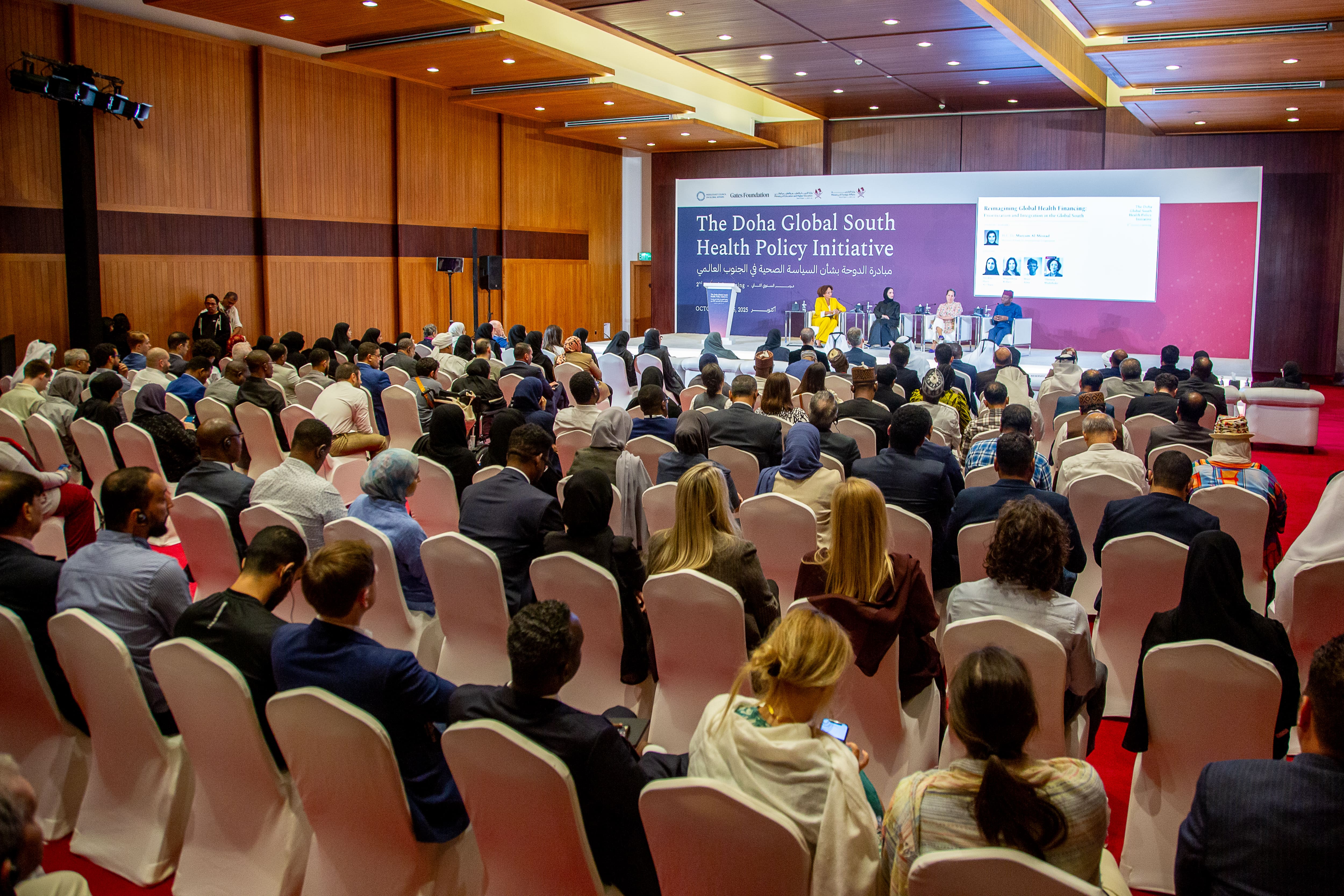
Annual Convening 2025 of the Doha Global South Health Policy Initiative
Event Report, April 2026
 download
Executive Summary
The Doha Global South Health Policy Initiative (DGSHPI) was launched in 2024 by the Middle East Council on Global Affairs (ME Council), in partnership with the Gates Foundation and with the support of the Government of Qatar. This initiative emerged as a response to persistent challenges in many Global South health systems, where indicators remain stagnant despite significant global investments. The Initiative provides a platform for countries in the Global South to share lessons, strengthen cooperation, and shape regionally driven health solutions. In a period marked by fiscal tightening, shifting donor priorities, and mounting pressure on overstretched health systems, the DGSHPI has become a platform where the sharing of experiences, not instruction, drives learning. Its Annual Convening serves as a peer-learning forum for senior public health officials from across the Global South and Qatar to reflect on real-time policy challenges and to exchange practical solutions. The 2025 Convening focused on three urgent themes: health financing, immunization system optimization, and strategic health communications. Discussions examined how countries are responding to donor funding cuts, assessing the feasibility of increasing domestic financing, and integrating and prioritizing essential services. Participants highlighted that while fiscal space remains limited, opportunities exist to improve efficiency, reduce fragmentation, and strengthen national ownership. To seize these opportunities, participants called for strong political leadership, evidence-based decision-making, and inclusive coordination across governments, donors, and communities.
Sessions on immunization explored how optimization, integration, and prioritization can improve program performance, with ministries of health leading coordination efforts to ensure alignment and sustainability. A dedicated focus on health communication on the second and third days underscored its role as a core element of health systems that is essential for building trust, combating misinformation, and translating science into public action. The Convening concluded with a high-level public panel, “Reimagining Global Health Financing: Prioritization and Integration in the Global South,” which brought together a public health director general, donors, and partners to discuss how countries can sustain essential services, strengthen resilience, and advance equitable health systems in the face of declining external assistance.
The 2025 DGSHPI Convening reaffirmed the importance of collective dialogue, peer learning, and co-created solutions among countries of the Global South. The resulting lessons and insights, which are summarized on the following page, feed directly into national and regional policy processes, enhancing the capacity of ministries of health to adapt global strategies to local realities. By focusing on mutual learning rather than prescriptive training, DGSHPI continues to strengthen policy leadership, foster South-South cooperation, and advance a shared vision for resilient, equitable health systems across the Global South.
Overview of All the Key Takeaways
For Health Financing in Times of Constraint:
National responses to donor funding cuts are in their initial phases and would benefit from the following:
- Fostering knowledge-sharing opportunities between countries.
- Strengthening national capacity for generating and synthesizing evidence on health financing.
- Building policymakers’ capacity for data-driven advocacy and communication.
- Promoting the involvement of regional stakeholders in national responses.
- Promoting the involvement of the highest political level in national responses.
- Promoting a collective narrative and data standardization that LMICs can tailor and use in their interactions with international partners.
For Optimization, Integration, and Prioritization of Immunization Services:
Immunization programs across LMICs have only recently started considering optimization, integration, and prioritization exercises. The following catalytic actions could accelerate progress:
- Provision of technical assistance to develop investment cases, especially for integration.
- Fostering of knowledge-sharing opportunities between countries.
- Development of communication strategies to build political and public support for evidence-informed optimization, integration, and prioritization in immunization programs.
- Advocacy for healthcare delivery approaches centered on community health workers and primary healthcare.
For Strengthening Health Communications:
The communications training underscored that communication is a core system capability essential for sustaining health reforms under constraint, emphasizing that:
- Communication is integral to the functioning of health systems, and should be institutionalized and funded within health programs.
- Trust precedes compliance: credibility is built before crises, through consistent, transparent, empathetic engagement.
- Integrated communication across sectors and agencies reinforces efficiency and coherence.
- Professionalization and media partnerships improve the accuracy and reach of public health messages.
- Storytelling and emotional intelligence remain the most effective tools to bridge the gap between science and society.
For the Public Panel – Reimagining Global Health Financing:
The public panel situated country experiences within the evolving global health financing landscape and emerging partnership models, with the following highlights:
- Sustainable reform begins with country ownership—countries setting priorities and leading implementation while partners align around locally defined strategies.
- Integrating services, particularly at the primary healthcare level, can improve efficiency and protect essential functions in the face of fiscal constraints.
- Gulf donors and philanthropic institutions are emerging as key actors in shaping flexible, locally anchored financing models.
- Shared learning and South-South Cooperation offer powerful tools for strengthening resilience and accelerating progress toward universal health coverage.
- Effective partnerships must be purposeful, strengthen systems, empower local actors, and sustain progress beyond donor cycles.
Related
Publications
view more

This situation assessment examines how domestic electioneering shapes Israel’s fragmented political landscape, its approach to Gaza, settlement expansion in the West Bank, and military operations and negotiations in Lebanon. It…
learn more
This situation assessment examines the strategic connection between Hormuz and Bab al-Mandab and its implications for Gulf energy trade and maritime security. It argues that a sustainable response requires re-establishing…
learn more