

How to Rebuild Gaza: Land, Sovereignty, and the Right to the City
May 2026

Palestinian architect and researcher
Introduction: The Crisis Beneath the Rubble
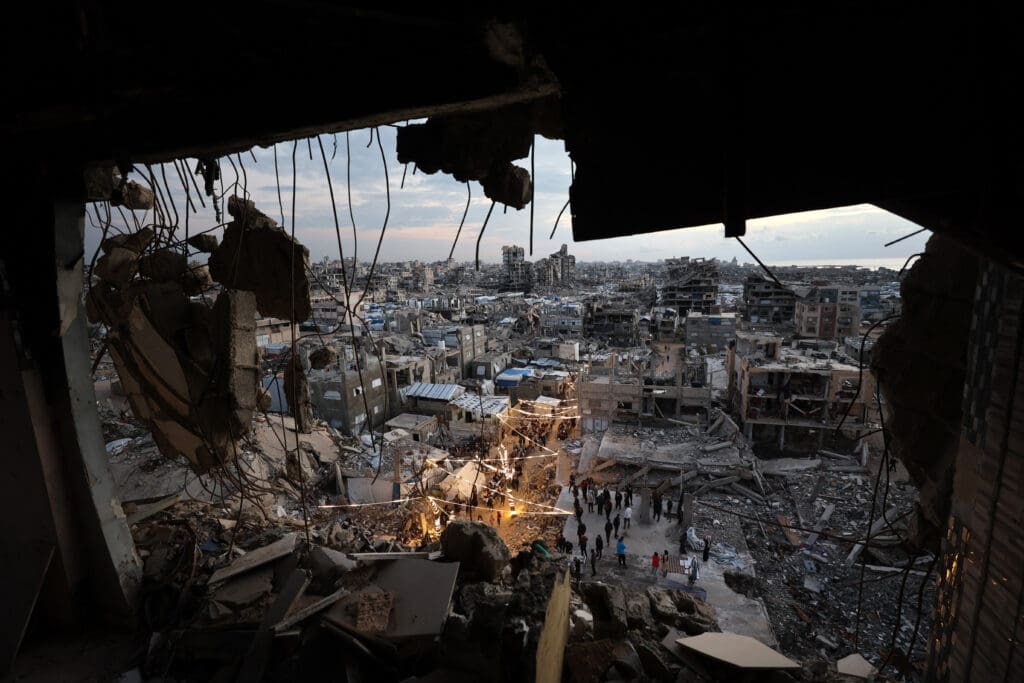
The destruction of Gaza after October 7, 2023, represents more than a humanitarian disaster—it signifies an existential assault on the Palestinian liberation struggle, as well as a global ethical and legal collapse. With over 70 percent of homes destroyed or damaged, hospitals and schools flattened, and entire neighborhoods obliterated, the sheer scale of devastation has been matched only by the world’s silence. Gaza has become a global rupture point, exposing the selective application of international law, the erosion of humanitarian norms, and the subordination of justice to imperial interests.1
In this context, the idea of “reconstruction” is already a battlefield. Historically, in Gaza, postwar recovery has operated less as a path to rehabilitation and more as a mechanism of containment, aiming to stabilize the crisis while leaving its colonial roots intact.2 Today, this logic is magnified. Global discourse has shifted away from liberation and justice, centering instead on Israeli security, donor governance, and technocratic management. The dominant policy questions, like who will govern Gaza and how aid will be administered, cast the territory as a zone of humanitarian crisis rather than an illegally occupied homeland to be liberated. Palestinian sovereignty is sidelined, the problems at hand are depoliticized, and reconstruction becomes a tool for normalizing injustice and fostering Israeli superiority instead of rebuilding Palestinian society.
This article intervenes in that discourse, aligning its arguments with the Gaza Phoenix Framework of January 2025, the only reconstruction plan developed by Gazans and published by the Union for Gaza Strip Municipalities.3 The article argues that postwar reconstruction must be treated as a political battlefield over sovereignty, spatial justice, and the right to liberation. Rather than reducing Gazans to victims or aid recipients alone, it affirms them as agents of recovery and future-making. It centers the rights to housing, land, and public infrastructure, not as technical issues, but as essential pillars of liberation. At the same time, it calls for the reunification of Palestinian geographies and economies, rejecting the colonial fragmentation that isolates Gaza from the West Bank and fractures national recovery.
Ultimately, this article challenges the notion that Gaza’s future planning must be primarily oriented around addressing Israeli security, as is the case with the so-called Trump peace plan endorsed by the United Nations Security Council on November 17, 2025.4 It insists that any meaningful reconstruction must be rooted in justice, dignity, and Palestinian agency. To rebuild Gaza is not to manage its people, but to empower them. The sections that follow explore what this empowerment could look like in practice, outlining a vision for reconstruction grounded in collective rights and national liberation.
Empower the People: From Survival to Sovereignty
In the aftermath of this catastrophe, the central priority must be empowering survivors to reclaim life on their own terms. This empowerment is not a gesture of humanitarian empathy or developmental charity. Rather, it is a political practice embedded in the right to self-determination, spatial justice, and popular sovereignty. As true liberation is never granted but reclaimed and fought for,5 in the context of post-genocide Gaza, this means restoring both political and material agency to the people of the land.
As Gaza endured relentless devastation, numerous “day-after” initiatives—political schemes, reconstruction plans, and recovery proposals—were produced by international powers, regional actors, corporations, and research centers. In a comparative study from June 2025, the Palestine Economic Policy Research Institute (MAS) concluded that most of these externally-driven frameworks reduced reconstruction to technical management, marginalized Palestinian agency, and obscured the colonial roots of destruction.6 Such visions risk remaking Gaza into a site of external control and neoliberal experimentation rather than liberation and indigenous sovereignty. By contrast, the Palestinian-led initiative Gaza Phoenix points to another path, one rooted in spatial justice, cultural continuity, and community participation. In other words, it is not just a plan for rebuilding but a framework for rights-based recovery.
Empowerment must be rooted in structural transformation. This entails guaranteeing multiple rights to the people—most importantly, securing the rights to dignified housing, to land, and to participate collectively in the ownership and governance of public infrastructure. These rights are not isolated entitlements, but interlocking foundations of what Henri Lefebvre described as the “right to the city.”7 This entails the right not only to access urban space, but to shape, inhabit, and claim it as a site of belonging, autonomy, and collective life. Hence, any plan to rebuild Gaza must enshrine the following rights:
1. The Right to a Dignified Home
Housing is far more than a humanitarian need or physical structure. In postwar contexts, housing plays a crucial role in restoring community life, rebuilding trust, and reweaving the fabric of kinship and social stability. In Gaza, the genocidal war has systematically destroyed the spaces that make dignified and communal life possible. Homes have been bombed, bulldozed, and erased; entire neighborhoods flattened; and the very basis of homing—providing shelter, safety, intimacy, continuity—devastated by design. As a result, the postwar period demands rapid housing production to meet the urgent and overwhelming need for shelter. Yet this necessity must not reduce housing to a commodity or a donor-driven product. The right to housing must be recognized as a cornerstone of dignity, stability, and recovery. A home is not a tent, a prefab unit, a concrete shell, or a modernist replica of failed post-World War Two housing projects, such as the Pruitt–Igoe Apartments in St. Louis, Missouri, or the Unité d’habitation in Marseille, France. It is the material embodiment of quality of life, including safety, privacy, family continuity, and a sense of belonging.
Therefore, design in this context is not an afterthought; it is central to recovery.8 How homes are designed now will shape how communities live, heal, and relate for generations to come. That is why the urgency of rebuilding must not come at the expense of quality, livability, and spatial dignity. Mass housing must not mean uniformity or neglect. Without dignified, habitable spaces, there will be no true recovery, only a continuation of displacement, this time under the guise of reconstruction.
As such, while Trump’s plan calls for the construction of an Emirati metropolis-style “Gaza Riviera,” the Gaza Phoenix plan advances a more socially rooted approach—rebuilding on original plots, tailoring designs to community needs, and ensuring genuine participation in the planning process. Crucially, it calls for serious research into the kinds of homes Gazans themselves aspire to inhabit. A survey prepared by Gaza’s municipalities, launched after the ceasefire and currently underway, asks residents not only about preferred housing types but also about intimate details such as the number of bedrooms and bathrooms, underscoring that recovery must be grounded in people’s lived desires, everyday needs, and practices.
2. The Right to Land
Access to land is foundational to autonomy. In settler-colonial contexts, land is not just territory; it is a tool of domination and survival alike. As scholars of settler-colonialism note, the elimination of the native is achieved through control of land and denial of its use.9 Nowhere is this clearer than in Gaza, where the extreme density, siege economy, and military restrictions have severed many people from access to the land beneath their feet. During the war, these constraints have been drastically intensified by massive amounts of rubble and debris, widespread soil contamination, and severe environmental degradation.10
Moreover, in postwar contexts, access to land is often determined by financial capacity, allowing elites and capital holders to dominate while the most needy are pushed to the margins. Without calculated intervention, land becomes a site of speculation rather than recovery. In Gaza, this dynamic threatens to reproduce inequalities unless a deliberate policy of land redistribution is implemented. A proper reconstruction framework must include the radical redistribution of state-owned land through long-term leaseholds or commons-based frameworks that prioritize marginalized and landless families.
This approach draws on deep-rooted indigenous and Islamic traditions, namely the concept of Mewat land—unclaimed or uncultivated territories that can be claimed by cultivation or building. By reviving such traditions, Gaza’s reconstruction can challenge the colonial and neoliberal logic of land as a commodity.
Land redistribution would provide Gaza’s poorest families with a foundation for dignity and productivity. With just 20 square meters, a household could establish a small workshop, plant vegetables, or produce handmade goods—shifting from being passive recipients of aid to active agents of community-based recovery. In this sense, land is not only a physical asset but a condition for social emancipation and empowerment.
3. Collective Ownership of Public Infrastructure
Alongside the right to land, a truly decolonial reconstruction demands a radical reimagining of public infrastructure not as a field for profit-making, but as a common essential to collective life. In many post-war contexts, international donors and private investors have instrumentalized infrastructure as a tool of neoliberal restructuring, promoting the privatization of basic services—such as electricity, transport, and water—under the guise of efficiency and modernization.11 These models often exclude the very communities they claim to serve from ownership and operation, deepening dependency and undermining public sovereignty.
To resist this logic, Palestinians must be empowered to co-own and co-govern public infrastructure projects through mechanisms such as community shareholding and cooperative management. This approach transforms infrastructure from a target of extraction into a platform for redistribution and solidarity. Whether in solar energy networks, public transport systems, or water desalination plants, these collective ownership models foster economic justice, civic accountability, and long-term social resilience.
From ‘Bare Life’ to Political Life
Too often, humanitarian interventions focus entirely on a population’s survival while ignoring their other needs and demands. In this context, it is vital to understand how reconstruction must restore not only homes or jobs but the political presence of the people. As Giorgio Agamben warned,12 humanitarianism often reduces people to bare life—subjects to be managed, not citizens to be empowered. But Palestinians are not passive survivors of a natural disaster; they are political actors demanding their right to liberty, and their rights to build, dwell, and self-govern in their homeland.
The neglect of Palestinian agency obscures a critical question: How have Palestinians in Gaza managed to endure two years of unprecedented bombardment, infrastructural elimination, and deliberate efforts to dismantle governmental, international, and civic institutions? Overlooked, too, are the ways in which municipalities, organizations such as the ‘Arab and International Organization to Construct in Palestine’ (AIOCP), neighborhood committees, local NGOs, charities, companies, families, and individuals have stepped in to sustain life under genocidal conditions. These actors have worked to reconnect water networks, clear rubble, assess building safety, establish camps, deliver food, and carry out countless other essential tasks—all while facing relentless attack, displacement and deprivation.
To truly empower the people, then, is not to delegitimize or neglect local agency and administer aid within the limits of the existing order, but to dismantle the structures of domination that made this war possible, and that continue to center reconstruction around Israeli concerns. In the international discourse on reconstruction, Gazans are spoken about but rarely listened to; they are framed as problems to be managed. Most non-Palestinian Gaza reconstruction plans frame Palestinian agency—if they acknowledge it at all—within donor-defined hierarchies and technocratic control. The UNDP’s Gaza Early Recovery Programme,13 the so-called Egyptian Plan,14 the Al Habtoor Gaza Reconstruction Plan,15 and the Trump Plan all invoke “local ownership” but, in practice, reduce Palestinian institutions to implementers. Strategic authority, however, lies with international agencies, regional states, or private investors.
By contrast, the Gaza Phoenix Plan reasserts planning as a political act of resistance, situating reconstruction within local knowledge, community participation, and decolonial governance. The contrast reveals how institutional design itself has become a battleground: External plans depoliticize and subordinate Palestinian agency, while indigenous frameworks insist on sovereignty from below.
A large part of the problem is that the absence of a unified Palestinian national leadership undermines Palestinian agency and its influence in international discourse. Institutions in Gaza are dismissed as illegitimate under the label of being Hamas-led, while the Palestinian Authority (PA) in the West Bank is deliberately sidelined, further dismantling Palestinian national representation. This political fragmentation and institutional failure severely constrain Palestinian agency, underscoring the urgent need to address the question of unified and legitimate leadership.
As such, Palestinians should go beyond geographic, political, and economic fragmentation to reclaim a unified political and territorial space. Despite the international consensus that the West Bank and Gaza Strip constitute a single geopolitical unit under illegal occupation, postwar policy planning continues to reinforce Palestinian territorial and political fragmentation. The Trump plan, for instance, largely excludes the PA until some ill-defined point in the future, while concentrating Palestinian agency in an apolitical “executive committee” tasked with narrow administrative functions and implementing directives from an externally-composed executive board. This technocratic framing not only echoes the failures of previous postwar governance models in Gaza but also reproduces the colonial logics of foreign domination and divide-and-conquer.
This territorial and political division further impacts the social and economic recovery of Palestinians. For example, the West Bank is home to a dense landscape of small-scale industries, workshops, and light manufacturing sectors, ranging from food processing and textiles to construction materials and household goods. These sectors have been systematically undermined by the dual pressures of Israel’s military occupation and aid-dependent development. Yet they remain vital assets for a national recovery rooted in self-reliance and interdependence. Their potential, however, remains unused—stifled by artificial borders and Israeli movement restrictions.
A decolonial reconstruction strategy must reimagine Gaza’s recovery within the broader Palestinian geography, activating latent capacities and reconnecting severed spaces. For example, enabling producers in Hebron or Nablus to supply goods and materials for rebuilding homes, schools, and markets in Gaza would reduce the time and costs of reconstruction, revitalize West Bank industries and support long-term material and economic recovery in Gaza. This is not a matter of aid—it is a strategy of intra-national solidarity and economic decolonization.
Why is it that Palestinians with Israeli citizenship from Haifa can own weekend homes in the West Bank town of Rawabi, yet no serious policy considers allowing displaced Gazans to rent homes there? Why is the idea of Gazan workers commuting to Hebron factories unthinkable, while Jewish settlers commute daily across “apartheid roads”16 from illegal colonies to workplaces in Jerusalem and Tel Aviv? These questions lay bare the deep structural conditions of dispossession that define Palestinian life under an entangled regime of settler-colonialism and military occupation. They reveal a system in which mobility, residency, and spatial access are not rights, but privileges distributed along ethnonational and religious lines.
This is not to say that Gaza’s future lies in dependency on the West Bank. Gaza must be rebuilt with its own thriving, autonomous economy and urban future. But in the short-to-medium term, reactivating West Bank industries, ensuring freedom of movement, and resisting enforced fragmentation will allow Palestinians to harness their full collective capacity in rebuilding what has been destroyed.
Conclusion
The imposition and adoption of the Trump plan in late 2025 largely sidelined other internationally produced “day after” visions and reconstruction plans, which similarly reduced recovery to a technical or financial exercise while ignoring the colonial conditions that produced the destruction in the first place. The Gaza Phoenix Framework, developed by the Union of Gaza Strip Municipalities, offers an alternative that treats planning as a form of liberation and a tool to restore dignity, agency, and self-determination.
Accordingly, this article insists that reconstruction is not a neutral logistical task but a political struggle over sovereignty and emancipation. True recovery cannot emerge from donor-driven mechanisms or security-centered frameworks that marginalize Palestinian voices. It must instead center the rights of Gazans to housing, land, and collective ownership of infrastructure, while also resisting the colonial fragmentation that separates Gaza from the West Bank. Only a reconstruction effort that is just, people-centered, and politically grounded—one that affirms the national rights of the Palestinian people—can break the cycle of destruction, bring an end to the war, and lay the foundation for dignity, liberation, and peace.
Endnotes
1 Tawfiq al-Humaidi, “Azmat al-qānūn al-dawlī: ḥarb Ghazza wa-iʿādat al-naẓar fī manẓūmat al-ʿadāla al-ʿālamiyya” [The Crisis of International Law: The Gaza War and Rethinking the Global Justice System], Arabi21, June 13, 2024, https://arabi21.com/story/1604743.
2 Sultan Barakat, Sansom Milton, and Ghassan Elkahlout, “The Gaza Reconstruction Mechanism: Old Wine in New Bottlenecks,” Journal of Intervention and Statebuilding 12, no. 2 (2018): 208–227, https://doi.org/10.1080/17502977.2018.1450336.
3 Union of Gaza Strip Municipalities, The Gaza Phoenix Framework (Gaza: Union of Gaza Strip Municipalities, January 2025), https://phoenix-gaza.org/.
4 United Nations Security Council, Resolution 2803 (2025), Security Council Resolution on President Donald J. Trump’s Comprehensive Plan to End the Gaza Conflict, S/RES/2803 (2025), November 17, 2025, https://www.un.org/unispal/document/security-council-resolution-on-president-donald-j-trumps-comprehensive-plan-to-end-the-gaza-conflict-s-res-2803-2025/.
5 Frantz Fanon, The Wretched of the Earth, trans. Constance Farrington (New York: Grove Press, 1965).
6 MAS (Palestine Economic Policy Research Institute), The Day After in Gaza: Proposals for Recovery, Governance and Resistance (Ramallah: MAS, 2025), https://mas.ps/cached_uploads/download/2025/09/02/study-day-report-2025-eng-1756812600.pdf.
7 Henri Lefebvre, “The Right to the City,” in Writings on Cities, ed. and trans. Eleonore Kofman and Elizabeth Lebas (Oxford: Blackwell, 1996), 147–159.
8 Enrico Dainese and Anamarija Staničić, eds., War Diaries: Design after the Destruction of Art and Architecture (Charlottesville: University of Virginia Press, 2022), https://doi.org/10.2307/j.ctv2b07tgp.
9 Patrick Wolfe, “Settler Colonialism and the Elimination of the Native,” Journal of Genocide Research 8, no. 4 (2006): 387–409.
10 United Nations Environment Program (UNEP), Environmental Impact of the Escalation of Conflict in the Gaza Strip, Second Assessment Report (Nairobi: UNEP, September 2025), https://doi.org/10.59117/20.500.11822/48536.
11 Mark Duffield, Development, Security and Unending War: Governing the World of Peoples (Cambridge: Polity Press, 2007).
12 Giorgio Agamben, Homo Sacer: Sovereign Power and Bare Life (Stanford: Stanford University Press, 1998).
13 UNDP, UNDP/PAPP’s Support to Gaza Emergency Response and Early Recovery Planning, Programmatic Updates (UNDP, September 2024), 3, https://www.undp.org/sites/g/files/zskgke326/files/2024-10/undp_papp_gaza_programmatic_updates_and_catalogue-september_2024.pdf.
14 Yara M. Asi et al., “An Arab Plan for Gaza: Obstacles and Possibilities,” Arab Center Washington DC, March 7, 2025, https://arabcenterdc.org/resource/an-arab-plan-for-gaza-obstacles-and-possibilities/.
15 Al Habtoor Research Centre, Gaza Reconstruction Plan (Dubai: Al Habtoor Research Centre, February 2025), https://www.habtoorresearch.com/publications/habtoor-gaza-reconstruction/.
16 Applied Research Institute–Jerusalem, “The Instigation of Apartheid Roads Era: Israel Blocks Palestinian Movement inside West Bank Governorates,” October 17, 2023, https://www.arij.org/latest/road-westbank-in-gaza-war/.
Related
Publications

The destruction of Gaza after October 7, 2023, represents more than a humanitarian disaster—it signifies an existential assault on the Palestinian liberation struggle, as well as a global ethical and legal collapse. With over 70 percent of homes destroyed or damaged, hospitals and schools flattened, and entire neighborhoods obliterated, the sheer scale of devastation has been matched only by the world’s silence. Gaza has become a global rupture point, exposing the selective application of international law, the erosion of humanitarian norms, and the subordination of justice to imperial interests.
learn more