

From Mecca to Tehran: Could a Four-Way Dialogue Produce Regional Security Arrangements?
Issue Brief, November 2026

Researcher in International Relations and International Law
Key Takeaways
Diplomatic Engagement Without Breakthroughs: Top Iranian officials hosted colleagues from Saudi Arabia, Türkiye and Pakistan for talks on October 26. While they established a channel for consultation, they left core issues unresolved—from preventing renewed conflict and securing the Strait of Hormuz to halting Houthi attacks and addressing the nuclear dossier.
Supporting Mediation, Not Strategic Autonomy: The initiative offers value by supporting mediation efforts and providing regional guarantees for any potential U.S.-Iran understanding. It does not represent a quest for strategic autonomy from Washington, which reportedly endorsed the effort.
The Challenge of Influencing Armed Groups through Dialogue: The degree to which the dialogue can influence armed groups is a critical benchmark for assessing its efficacy in enhancing Gulf security. Early signs were not encouraging: the meeting coincided with Houthi attacks on Saudi facilities, and it reached no agreement to halt them.
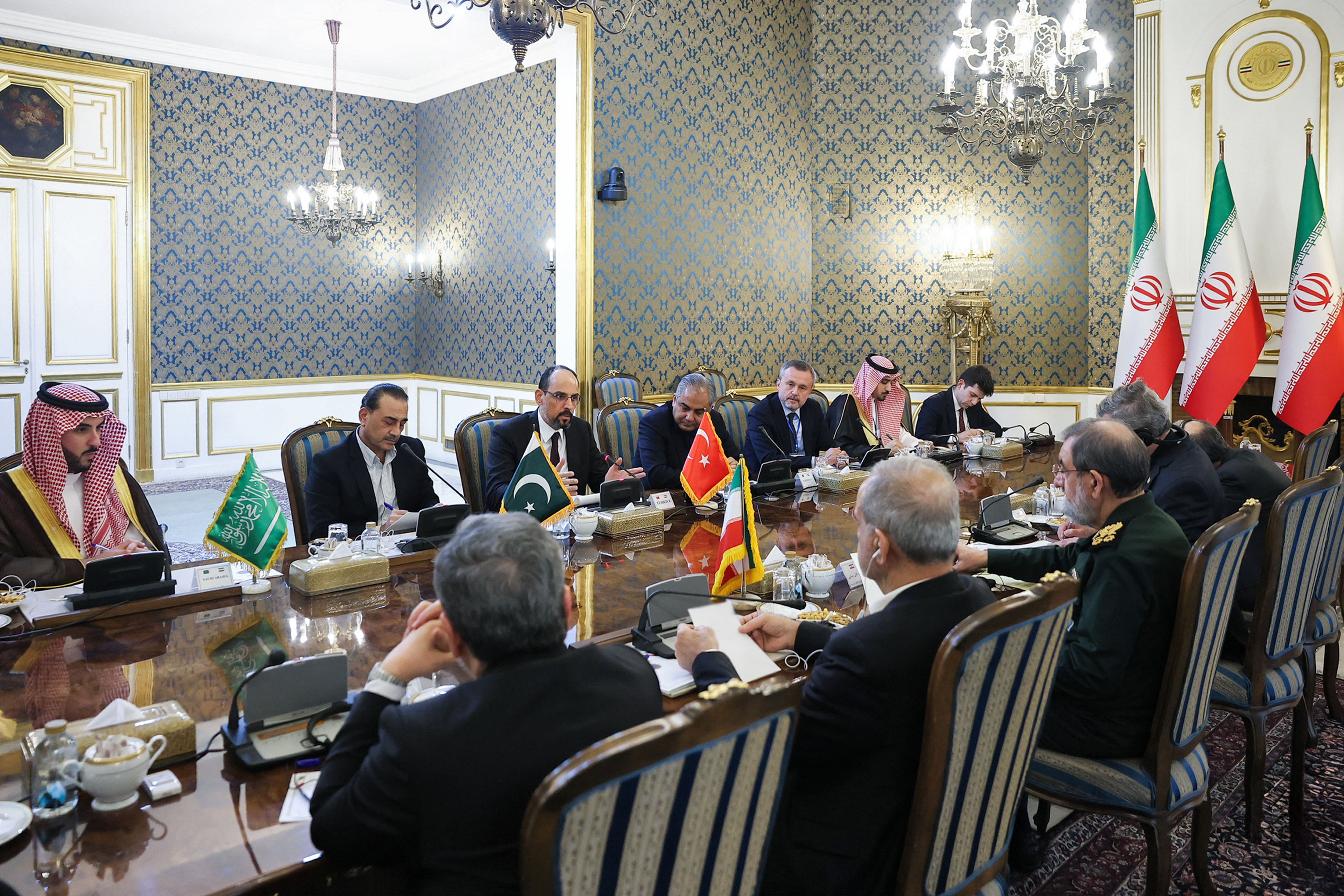
Eight months after the U.S. and Israel launched a war on Iran, which subsequently expanded to the Gulf states, maritime corridors, energy facilities, and critical infrastructure, top Iranian officials hosted a meeting of senior military and security officials from Saudi Arabia, Türkiye, and Pakistan.
The war since February 28 has exposed a growing disparity between the scale of military deployments and the resulting political outcomes, imposing costs not only on the belligerents but also on the economic and security interests of neighboring countries. However, it has also underscored the renewed importance of regional diplomacy in managing security dynamics.
It was in this context that Tehran on October 26 hosted officials from four nations—each with distinct international alignments and differing threat assessments, yet bound by overlapping interests dictated by geography, the repercussions of the war, and a shared need to restore stability.
The meeting was also notable as it came months after Iran’s interlocutors—Saudi Arabia, Türkiye, and Pakistan—signed the Mecca Agreement for Joint Defense. The Tehran dialogue thus marked a shift from coordination over mutual defense commitments into a security dialogue with Iran, whose foreign policies and military capabilities mean it remains a primary concern in the security calculus of the Gulf region.
This brings us to the central question of this brief. Did the Tehran meeting signify a shift toward regional security arrangements that combine deterrence with direct negotiation with adversaries? Or did it merely establish a channel for crisis management, within the framework of undergoing mediation and subject to constraints acceptable to Washington?
Clues to answering this can be found in three sources: The contents of the meeting’s joint communiqué; the content of the talks, even if they did not produce formal, public commitments; and interpretations of the meeting offered by Iranian officials.1
A New Security Architecture
The implications of the Tehran meeting cannot be understood in isolation from the Mecca Agreement on Joint Defense signed by Riyadh, Ankara, and Islamabad on August 7, stipulating that an armed attack against any signatory represents an attack on them all. The Mecca pact also sought to foster defense cooperation and collective deterrence, among nations with distinct positions in the international order and widely varying military and economic capabilities.2
The significance of the Mecca Agreement stems from the nature of its signatories. Saudi Arabia has economic and political clout that makes it a central player in Arab and Islamic affairs, as well as in global energy markets. Türkiye, the pact’s only NATO member, has a growing defense-industrial base and a strategic location connecting the Middle East to Europe and Central Asia. Pakistan brings to the table its nuclear capabilities, expertise in managing deterrence, and a geographic position linking South Asia to the Iranian and Gulf spheres.
Yet the pact is not predicated on a uniform threat assessment among its members. Saudi Arabia’s concerns regarding Iran relate directly to Gulf security, missile and drone attacks, and armed groups; Türkiye manages its relationship with Tehran through a blend of competition and cooperation; and Pakistan is primarily focused on the security of its western borders. Thus, the agreement’s strength is its function as a platform for coordinating threat assessments, enabling collective action when shared interests are at risk, while preserving the distinct international alignments of each signatory.
The three nations brought the clout of this framework with them to Tehran. Their dialogue with Iran thus represented a process of negotiation involving nations with strong channels of communication with Washington, governments that could act as “guarantors” should the process evolve toward a broader settlement.
Yet the guarantee on offer merits a more precise definition. It would not be a military one, whereby these states would be obligated to defend Iran or confront any party that violates the understanding. Under the Mecca Agreement, collective defense commitments are restricted to the signatory states. Nor are they triggered automatically; they require consultation and a joint decision, according to the memorandum accompanying the bill for ratifying the pact in the Turkish parliament.3
Instead, on the table is a political guarantee, under which the guarantor states would monitor the implementation of any agreement, report violations, leverage their influence with both parties to increase the political cost of any breach, and take part in agreed-upon mechanisms for communication and preventing aggression. So far, no text has been published that defines these roles, and the discussion of “guarantees” serves as a description of a potential function rather than an existing commitment.
Furthermore, interpreting this meeting as an expression of strategic autonomy from Washington runs counter to a Reuters report, citing a Pakistani official, that Chief of Staff General Asim Munir had presented his proposal to Tehran only after receiving U.S. President Donald Trump’s blessing for his efforts.4
This suggests that the move is more of a regional mediation effort than an attempt to counterbalance the U.S. or serve as an alternative to alliances with the West. In fact, it took place with a tacit U.S. mandate. Yet the irony remains significant: the Mecca Agreement, originally designed to bolster deterrence, has also become the political cornerstone of dialogue with the state that figures most sensitively in the security calculations of its signatories. This shift expands the scope for regional maneuvering within existing partnerships by enabling direct engagement with potential sources of threat, alongside the use of deterrence and containment measures.
This marks the Mecca Agreement’s evolution from a simple political declaration into a framework for establishing institutional channels for security decision-making. This was evidenced by the inaugural meeting of the agreement’s Strategic Political and Defense Committee in Istanbul on August 31.5
However, completion of the legal procedures has proceeded unevenly. On October 23, Pakistan’s Ministry of Foreign Affairs announced that both Pakistan and Saudi Arabia had finalized their ratification processes. Meanwhile, draft legislation ratifying the deal was submitted to the Turkish parliament that same week, and was subsequently approved by the Foreign Affairs Committee, paving the way for its presentation to the General Assembly.6
This incremental approach is significant, given the potential for consultations to expand to include Iran. Any regional security architecture necessitates a distinction between two levels: collective defense among allies; and the management of relations with others, based on non-aggression and dispute resolution. As such, the Tehran meeting serves as a litmus test for the possibility of transitioning from trilateral defense cooperation to a four-way security dialogue, while maintaining a clear distinction between participation in negotiations and entering into any formal military commitments.
Divergent Strategic Calculations
The make-up of the delegations that met in Tehran was particularly striking. Munir led the Pakistani delegation; Saudi Arabia was represented by Minister of Defense Prince Khalid bin Salman; and Türkiye by İbrahim Kalın, head of Ankara’s national spy agency, MİT. They were hosted by the Secretary of Iran’s Supreme National Security Council, Mohsen Rezaei, alongside President Masoud Pezeshkian and Foreign Minister Abbas Araghchi.7
While the preponderance of military and intelligence figures in the delegations could be read as suggesting that traditional diplomatic tools are no longer able to contain the crisis, it likely reflects the specific institutions tasked with managing the file within each country. In Islamabad, it is the military establishment that largely handles mediation efforts with Tehran; Ankara has traditionally used its intelligence service as its main channel for engagement with the Islamic Republic. Furthermore, the Araghchi’s presence indicates that diplomacy remained at the heart of proceedings. Consequently, this level of representation should be viewed as a reflection of where decision-making power resides in each nation, rather than an indication that the crisis has shifted from diplomacy to the security sphere—though the discussions certainly addressed deterrence and prioritized the protection of vital infrastructure.
Pakistan, for its part, occupies a unique position in this equation: it is a signatory to the Mecca Agreement, maintains diplomatic relations with Iran, and is able to engage with Washington. It has gained significant influence during the conflict, working in coordination with Qatar to bridge gaps between the U.S. and Tehran. Reuters, citing Pakistani sources, reported that the meeting was part of an effort to seek a settlement, and that Asim Munir proposed a framework that could potentially lay the groundwork for U.S.-Iran negotiations, with the signatories of the Mecca Agreement plus Qatar acting as guarantors should an acceptable understanding be reached.8
The initiative also signals a shift in Islamabad’s regional role. Instability in the Gulf and Iran directly impacts Pakistan’s economy and its energy security, while its proximity to Iran makes it keen to prevent chaos that could spill across its borders. Meanwhile, its partnership with Riyadh grants it a seat at the table in shaping regional arrangements that extend well beyond South Asia, while its engagement with Tehran underscores the broadening geographic scope of its strategic interests.
Saudi Arabia entered the meeting with a focus on safeguarding its national security and preventing the conflict from spreading, after Houthi-linked attacks on its energy and transport infrastructure underscored the deep links between the security of the Gulf, the Red Sea, and Yemen. On the day of the meeting, the Saudi Ministry of Foreign Affairs stated that it aimed to de-escalate tensions, promote diplomatic solutions, support Qatari and Pakistani mediation efforts, and open channels for negotiation, both to prevent the conflict from flaring up again and to pave the way for an agreement to resolve it.9
This reflects a profound shift in Gulf security policy. The Gulf’s development can no longer be protected solely through the expansion of defensive capabilities—especially as energy facilities, ports, airports, and desalination plants have become highly vulnerable targets in modern warfare.
Furthermore, it is notable that the value of any understanding with Iran hinges on its capacity to curb cross-border threats, ensure respect for sovereignty, and prevent the use of armed groups to exert pressure on neighboring states. The explicit reference to Qatari and Pakistani mediation further points to the emergence of complementary regional roles: states that enjoy the trust of the conflicting parties take on the tasks of negotiation and guaranteeing agreements, while nations with greater military and political capabilities help establish the security conditions necessary for implementing and sustaining those understandings.
Türkiye, for its part, entered these consultations from a posture of balancing its NATO commitments with an ambition to strengthen its role in establishing regional security, drawing upon Ankara’s extensive experience in managing competing regional relationships—as well as its complex ties with Iran, a relationship defined by both divergent and intersecting interests. Kalın’s involvement aligns with his long-standing role as a messenger between Ankara and Tehran; meetings between intelligence chiefs also facilitate dialogue and help establish measures to mitigate the risks of miscalculation—both critical tools for building trust during the initial stages of such a process. In this light, Ankara’s involvement appears to be aimed at expanding its regional options, rather than marking a shift in its international alignment; it remains keen to maintain a balance in its relations with Washington and NATO.
For Iran, the meeting came as it seeks to leverage its geographical position, military capabilities, and network of regional relations to bolster its negotiating position in a conflict through which it has demonstrated both its capacity to exert influence and the high costs that further confrontation would entail for itself and its neighbors.
The presence of Rezaei, with his military background, alongside Iran’s President and Foreign Minister, reflected Tehran’s desire to project a sense of sovereignty and to explore the possibility of securing guarantees that could reduce the likelihood of further strikes and alleviate economic pressures, facilitated by nations able to communicate with Washington and possibly influence it.
However, trust can only be built on mutual guarantees. Iran’s neighbors seek to address perceived threats stemming from Iran’s military activities and allied armed groups while Iran seeks security guarantees, as well as the resolution of issues concerning sanctions, the blockade, and its nuclear program.
Four-Way Understandings and Their Impact
The joint statement from the Tehran meeting was terse, announcing little more than a commitment by the four delegations to continue their dialogue and to enhance their cooperation, including over regional peace and security. This allowed each country to maintain its own position while avoiding specific commitments that might conflict with its national calculations.10
That brevity was significant in and of itself. In conflict environments, security negotiations often begin with an agreement on the bare minimum, the need for dialogue, well before any consensus is reached on the substance of a settlement. Maintaining a channel of communication becomes a shared interest for its own sake, especially when severing such a channel would carry costs.
While the meeting did not result in any public commitments, Reuters, citing Pakistani officials, reported that the talks covered the potential establishment of a regional non-aggression pact, the resumption of U.S.-Iran negotiations, Houthi attacks on Saudi Arabia, security in the Strait of Hormuz, and the U.S. blockade of Iranian ports.
The concept of non-aggression remains the most critical factor determining the viability of a four-party dialogue. While defense agreements govern responses to external attacks, non-aggression understandings can regulate conduct between states themselves, establishing boundaries for the use of coercive measures. In a region where states are deeply intertwined with armed groups, any such understanding would need to address issues like missiles, drones, cross-border operations, and the protection of civilian infrastructure—in addition to traditional commitments of respect for sovereignty and territorial integrity.
The Strait of Hormuz occupies a central position here. The conflict has demonstrated that even limited operations or recurring threats can drive up insurance and shipping costs and disrupt the flow of trade.
Nevertheless, the meeting did not produce a separate declaration on freedom of navigation. This implies that establishing a regulatory framework for the Strait will still require negotiations over transit rights and security guarantees, a process that should be led by the Gulf states, as they will bear the greatest cost of any disruption. Subsequent events have underscored the fragility of the situation; four days after the meeting, a Panamanian-flagged oil tanker was struck by limpet mines in the channel, causing a fire that temporarily halted the vessel. While the perpetrator remains unknown, the incident underscored the point that the true test of any understanding will be its ability to safeguard commercial shipping lanes.11
Another key element of regional maritime security is the situation in Yemen and the Red Sea. Houthi attacks have demonstrated that the security of the Gulf and that of maritime corridors, including the Bab al-Mandeb Strait, constitute a single strategic environment. This is evident in a joint statement by the foreign ministers of Saudi Arabia, Türkiye, Pakistan, and Egypt after they met in Istanbul three days prior to the Tehran meeting. On the same day, they held an expanded session also involving their counterparts from France, Germany, and the United Kingdom, and issued a statement condemning Houthi attacks on Saudi Arabia and on maritime traffic in the Red Sea, as well as calling for a diplomatic resolution to the U.S.-Israeli conflict with Iran and guarantees on freedom of navigation in the Strait of Hormuz. This underscores that the Mecca Agreement members’ core security parameters have not changed, even as they engage in direct dialogue with Tehran.12
This highlights the importance of distinguishing between managing disputes and resolving them entirely. The Tehran dialogue could result in understandings aimed at de-escalating tensions and preventing attacks on vital infrastructure, even while disagreements persist regarding the nature of certain armed groups and the future of regional security arrangements. Such an approach offers mutual benefits by curbing destabilizing behavior, without demanding the immediate resolution of fundamental disagreements. However, its sustainability depends on verification mechanisms and the alignment of stated commitments with realities on the ground.
The understandings reached in Tehran did not address the nuclear file; indeed, it was not even brought up for discussion, according to Iranian officials cited by Reuters. The same sources indicated that Tehran continues to demand an end to the war, the blockade and sanctions prior to any nuclear talks, whereas Washington insists on a reduction in uranium enrichment as a prerequisite for any settlement.
Consequently, the dilemma extends beyond the substance of the demands to the sequencing of their implementation. Each side expects the other to take the first step: Tehran seeks an end to the war and the blockade before addressing its nuclear program, while Washington demands a commitment to reduce uranium enrichment as part of the settlement itself. This gap exposes the nature of the guarantees offered by the four-party framework: they are political and procedural in nature, in that the mediating states are tasked with overseeing the fulfillment of each side’s commitments in the agreed order. None of this represents a binding security guarantee, and the joint statement contains no such pledges.
The problem resurfaced on October 25, when Qatari mediators proposed a series of incremental confidence-building measures to be implemented over seven days; an Iranian official rejected the proposal in its current form. This indicates that the meeting in Tehran failed to resolve fundamental disputes between the parties. Yet it remains valuable in its ability to support diplomatic efforts and provide regional guarantees, should it succeed in defining the terms of a settlement.13
Therefore, the real test for these consultations lies in their ability to distinguish matters over which regional actors have actual authority (such as non-aggression protocols and the protection of maritime navigation) from issues contingent on decisions made in Washington (such as sanctions, the U.S. blockade, and the nuclear program, over which regional actors can offer little beyond their good offices).
Shifting Balance of Power
Comments by Rezaei gave the Tehran meeting a political dimension beyond the joint statement. The Iranian security chief called for regional states to take responsibility for their own security and to reduce external interference in the region, presenting the visit of the three delegations as reflecting a new regional environment. He also demanded that Israel end its military operations and withdraw from territories it occupies in Gaza, the West Bank, southern Lebanon, and southern Syria. While his comments offer an Iranian perspective not necessarily reflected in the meeting’s joint statement, we can glean four key messages from them.14
The first concerns the concept of indigenous regional security. Iran has long advocated for a security framework managed by the states of the region themselves, whereas the Gulf states have relied on international partnerships to secure essential defense and intelligence capabilities. This reveals a divergence in threat perceptions rather than a fundamental disagreement over the principle of cooperation. It follows that the practical value of such a vision depends on its ability to generate mutual guarantees. Geographic proximity alone is insufficient to overcome historical contradictions; in fact, it may even heighten states’ sensitivity toward one another’s actions. Consequently, any regional security architecture would require established rules governing the use of force, mechanisms to verify compliance, and frameworks for resolving disputes before they escalate into military crises.
The second message relates to the position of the U.S. and Israel within the regional balance of power. Rezaei framed the meeting as reflecting a decline in the ability of American-led pressure to isolate Iran, and as an attempt to translate wartime resilience into diplomatic gains. However, assessing this shift requires recognizing both the decline of Washington’s capacity to dictate outcomes and the fact that it retains significant tools of influence, including deep-rooted defense partnerships within the region. However, the war has demonstrated that the ability to launch large-scale strikes does not guarantee control over their outcomes, and that managing those consequences requires that regional states are able to mediate and uphold agreements. It is this gap between military capability and the ability to forge settlements that gives the Tehran meeting its significance.
Rezaei’s third message concerns the Palestinian issue, Lebanon and Syria. The Iranian security chief’s linkage between regional stability and ending the occupation partially aligns with the positions of the three other states. The foreign ministers’ statement from Istanbul on October 23 affirmed support for a two-state solution and the right of the Palestinian people to an independent state based on the June 4, 1967 borders, with East Jerusalem as its capital. All three nations support an end to the occupation, notwithstanding divergent approaches to achieving a settlement, and to the future of relations with Israel. Thus, Rezaei’s remarks reflect Iran’s stance while maintaining the distinction between individual statements and collective commitments.15
His fourth message relates to how regional cooperation could transform from mere rhetoric to direct political engagement. Rezaei presented the visit by high-ranking officials from three key regional countries as evidence that cooperation with Iran is possible, and that the country is to some degree overcoming its isolation despite American pressure. That contrasts with reports that Washington had endorsed the Pakistani-led diplomatic track and that the meeting took place with tacit American approval, rather than marking an Iranian breakthrough against U.S.-imposed isolation. Furthermore, such high-level communication serves only as an initial phase; a sustainable security partnership would require formal institutions and mutual commitments. Engagement generated by crises often falters when negotiations turn to the specifics of guarantees and the distribution of responsibilities.
Taken together, these messages mark an attempt to redefine Iran’s position, from a belligerent in an open-ended confrontation to a key partner in managing regional security. However, the stability of this new role will rest on Tehran’s willingness to address its neighbors’ concerns, provide them with guarantees of non-aggression, respect their sovereignty, and stop threatening vital infrastructure and maritime navigation. Ultimately, it is practical steps on the ground, not rhetoric, that will determine how much trust such statements can generate.
Failing the Field Test: Implications for Gulf Security
Faced with its first test on the ground, the Tehran dialogue came up short. On the very day of the meeting, the Houthis announced attacks on pumping stations along Saudi Arabia’s East-West pipeline and Riyadh’s King Khalid International Airport, although there was no immediate confirmation from the Saudi authorities.16 The following day, the Iran-aligned Yemeni group claimed to have targeted the Ras Tanura refinery in the Eastern Province with a ballistic missile, while the Coalition reported intercepting missiles launched toward the Eastern Province and Riyadh.17 There was no announcement of any agreement to halt the attacks on Saudi Arabia.
Moreover, the day after the meeting, Rezaei received the Houthi envoy to Tehran, Ibrahim al-Dailami, praising the movement and presenting the four-way dialogue as a discussion on regional security arrangements and the withdrawal of foreign forces.18 This could lead to two conclusions: either Tehran has briefed its allies on the substance of the discussions, paving the way for them to play a role in de-escalation, or it seeks to maintain a separation between its ties with the signatories of the “Mecca Agreement” and its relations with the Houthis. In either case, Rezaei’s meeting with al-Dailami gave no reassurance over the possibility of combining deterrence with dialogue. While the signatories of the Mecca Agreement have maintained their defense commitments even as they engage in direct talks with Iran, this dual approach has yet to influence the behavior that directly threatens Saudi security.
This carries specific implications for Gulf security. First, for Riyadh, the issue of armed groups, particularly the Houthis, has become the practical benchmark for the viability of any dialogue with Iran. The value of any understanding will be measured against its impact on the security of Saudi facilities, not against the text of official statements. Second, Gulf energy security is simultaneously exposed on two fronts: the Strait of Hormuz, and the alternative export routes established to bypass it, notably the Saudi East-West pipeline to the Red Sea. Consequently, any arrangement regarding freedom of navigation remains incomplete unless it also encompasses the protection of terrestrial infrastructure and Red Sea ports. Third, Saudi Arabia is discussing the rules of regional security in a format that includes no other Gulf Cooperation Council (GCC) state, apart from Qatar, in a mediation role. This highlights the need for greater Gulf coordination to ensure that any broader understandings are rooted in respect for sovereignty, the protection of civilian infrastructure, and a prohibition against using the territory, maritime space, or airspace of neighboring states for military actions that threaten their security.
The future of these four-party consultations will be shaped by three interconnected trajectories: the progress of U.S.-Iran negotiations amidst the ongoing blockade and sanctions; the ability of Iran and its neighbors to reach practically viable non-aggression understandings which extend to the conduct of armed groups; and the potential evolution of the “Mecca Agreement” from a framework for mutual defense into a broader platform for political and security coordination. Accordingly, the Tehran meeting has opened a space for negotiating the rules governing security relations among powers in the region—even if those rules have yet to be established.
Perhaps the main lesson to be drawn from the Tehran meeting concerns the relationship between power and security in the Middle East. While states in the region have amassed growing military capabilities and extensive networks of alliances, conflicts continue to generate cross-border threats. The U.S.-Israeli war with Iran has demonstrated that the capacity to inflict harm upon an adversary can expand in inverse proportion to the ability of all parties to safeguard their shared interests. Whether this political potential translates into a strategic shift will depend on the extent to which these four nations can convert it into sustainable commitments and practices. In a region where geography intersects with international competition, and where sources of strength are inextricably linked to vulnerabilities, the capacity to manage disputes becomes an essential building block of security.