

Solidarity or Indifference? Charting Global South Responses to the Assault on Palestine
June 2026

Director of the Global South Program, the Quincy Institute
Introduction
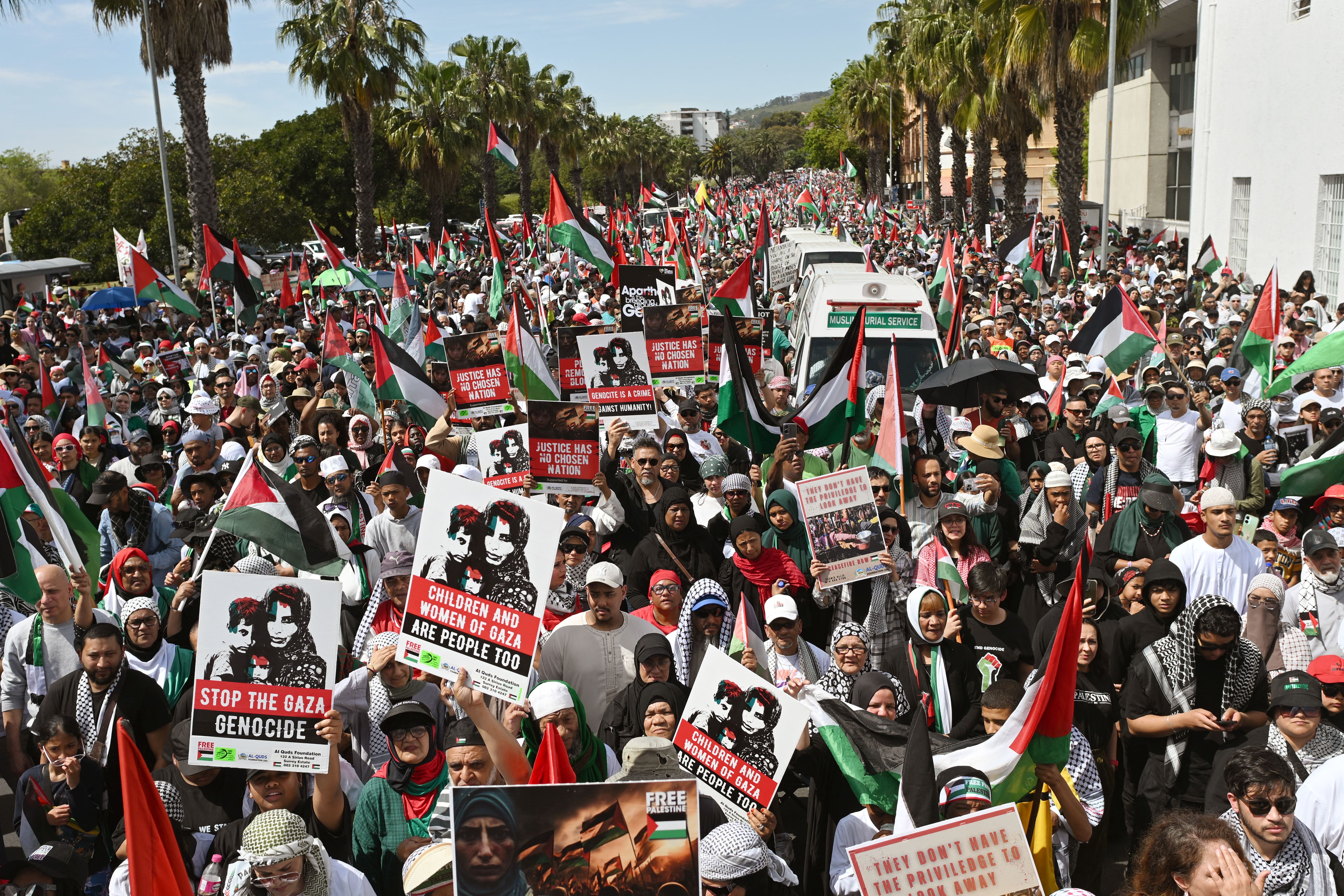
Israel’s brutal assault on Gaza following Hamas’ October 7, 2023, attack—which also targeted civilians—has triggered widespread global condemnation. While public opinion in the United States and Europe has increasingly shifted in favor of the Palestinian cause, Western governments have, by and large, strongly backed Israel.
To the extent that vigorous state-level opposition to Israel’s actions has emerged, it has come from the Global South. South Africa led the charge early by lodging a case at the International Court of Justice (ICJ) in December 2023, alleging violations of the UN Genocide Convention.1 Global South states also repeatedly and overwhelmingly voted in favor of an immediate ceasefire at the United Nations throughout the war.
There is a long history of solidarity with the Palestinian cause in the Global South, including at the landmark 1955 Afro-Asian conference in Bandung, Indonesia, and within the Non-Aligned Movement (NAM). This tradition weakened after the Cold War, as NAM was marginalized and attention to Palestine waned following the Oslo Accords in 1993 and the U.S.-led monopolization of the “peace process.”
This paper assesses the recent surge of Global South solidarity with Palestine by charting state responses.2 It asks how extensive and impactful this renewal is, what drives and constrains it, and what implications it holds for Palestine and the broader global order.
The paper argues that while Global South solidarity with Palestine has indeed increased significantly, its leverage over Israeli policies remains limited, with material sanctions aimed at changing Israeli policies only adopted by a small subset of states. Nevertheless, these responses have helped prevent the erosion of international humanitarian law at a moment when the great powers and most of their core allies are not only absent from safeguarding these norms but, in some cases, are flagrantly complicit in their violation. In doing so, Global South states are defending the principle of a world governed by a common minimum code of conduct amid multiple converging global crises.
The New South as a “Geopolitical Fact”
The Global South, previously known as the “Third World,” was born in the wake of decolonization of Asia and Africa.3 The 1955 Afro-Asian Conference in Bandung marked a seminal moment for Third World solidarity. The Non-Aligned Movement was subsequently founded in 1961, and Cuba hosted the more revolutionary components of the Third World at the Tricontinental Conference in Havana in 1966. Southern solidarity reached its peak in the 1970s, with the New International Economic Order debate at the United Nations and a near consensus on Palestine and the struggle against apartheid in South Africa.
However, the Global South today is not the same as it once was. The broad push for autarky has been replaced by a qualified welcoming of foreign trade and investment. A set of developing states, predominantly in Asia, has broken out of the low-income category and achieved rapid industrialization, prioritizing exports over import substitution. The upshot of all this is that the Global South has become economically more disaggregated in terms of wealth and income.
This diversity is also reflected in a shift in geopolitical identities, further buttressed by the receding memory of formal colonialism. Consequently, Global South states are prioritizing their own interests rather than attempting to form a NAM-like bloc.4 Their focus is national rise with a narrower interpretation of national interests in most cases. The new Global South may be described as a “geopolitical fact,” in which self-help behavior dominates.5 This is the world that Palestinians must reckon with.
Waging Lawfare
The horrors of Gaza have been met with a renewal of Southern solidarity in upholding international law. Lawfare has been the principal tool used by Global South states to counter Israeli actions in Gaza. Votes taken at the United Nations General Assembly (UNGA) demonstrated overwhelming support across the Global South for halting the fighting, enabling humanitarian assistance, and releasing all hostages.6 Four key resolutions demanding a truce or a ceasefire were passed with large majorities after the Gaza conflict began. Arab states, especially Jordan and Egypt, took a key role in drafting and introducing these resolutions, mobilizing broad coalitions of sponsors later joined by Spain.7
The first major step came on October 27, 2023, when the UNGA adopted a resolution calling for an “immediate and sustained truce” and cessation of hostilities. The text condemned all acts of violence aimed at civilians and demanded that all parties immediately and fully comply with international law. It was backed by a large majority of Global South states with 96 yes votes.8 However, a small but significant set of states chose to abstain, including Cameroon, Ethiopia, India, the Philippines, Panama, Uruguay, and Zambia. A handful, including Guatemala, Paraguay, Fiji, and several other Pacific Island states, voted against.
The next significant UNGA vote on December 12, 2023, called for “immediate humanitarian ceasefire” in the Israel–Hamas war, immediate and unconditional release of all hostages, ensuring humanitarian access, and that “all parties comply with their obligations under international law.” It was backed by an even bigger Global South majority, with the yes vote tally jumping to 109. In contrast to their October votes, Ethiopia, Fiji, India, the Philippines, and Zambia came out of the shadows to support the resolution.9
The next major UNGA vote was about a year later, on December 11, 2024. The resolution demanded an “immediate ceasefire” in Gaza and an end to the Israeli blockade. It passed handily, also with 109 votes from the Global South.10
Action at the UNGA resumed after a negotiated ceasefire in Gaza (that lasted for about two months) collapsed in March 2025 after Israel unilaterally resumed its attacks. The June 12, 2025, roll call represented a slight setback on Global South support, with the yes vote tally slipping to 99. Ecuador, Ethiopia, India and Panama were among the states that switched their votes to Abstain.
Looking under the hood of these numbers reveals major solidarity. But it also points to some subtle but important differences within the Global South. A revealing moment was a vote in December 2023 on an amendment sponsored by the United States citing Hamas (but not Israel) by name and condemning its “heinous terrorist attacks.”11 A contiguous belt of Muslim-majority countries stretching from Mauritania at the western tip of Africa to Pakistan, as well as Indonesia and Malaysia, opposed this amendment. They were joined by South Africa, Cuba, Bolivia, Nigeria, Uganda, and a few other non-Muslim majority countries. But the rest of the Global South—including key states such as India, the Philippines, Singapore, Chile, Peru, Kenya, and Ghana—supported the U.S. amendment, while Brazil, Colombia, Mexico, Jamaica, Ethiopia, and Thailand (among others) abstained.12
If the UNGA is the closest thing that exists to the world’s parliament, then the ICJ and the International Criminal Court (ICC) comprise the world’s judiciary. South Africa’s early filing of a case against Israel at the ICJ in December 2023, alleging the violation of the Convention on Genocide, was a landmark development. Pretoria explicitly invoked the historical context and root causes in its filing, including references to colonialism and apartheid.
But this case has gone well beyond being a bilateral affair. Several Global South states have formally intervened in support of South Africa’s case. These include Belize, Bolivia, Chile, Colombia, Cuba, Libya, Mexico, and the Maldives. In July 2025, Brazil announced its intention to join the case.13 Additionally, in April 2024, Nicaragua lodged a separate case at the ICJ against Germany, alleging Berlin was breaching its obligations by continuing to support Israel and demanding an end to its arms sales to Israel.14
The ICC, which prosecutes individuals and not states, is also a focus of the Global South’s lawfare. In November 2023, South Africa, Bolivia, Bangladesh, Comoros, and Djibouti made a referral to the ICC on possible crimes committed against Palestinians. In January 2024, Mexico and Chile made a referral to the ICC asking it to investigate war crimes and crimes against humanity conducted in Palestine since June 13, 2014.15 In a major victory for the complainants, the ICC prosecutor issued international arrest warrants for the Israeli prime minister and former defense minister (along with three Hamas leaders, including its military commander) for alleged war crimes and crimes against humanity.16
Taking Material Action
A set of states has gone beyond diplomatic and legal steps and taken materially significant actions with respect to Israel. Outside the MENA region, Belize, Brazil, Chile, Colombia, Bolivia, Honduras, Chad, and South Africa recalled their ambassadors, while Belize, Bolivia, and South Africa cut or suspended diplomatic ties with Israel. Chile recalled its military attachés.
Some states have taken economic measures against Israel. Malaysia imposed a maritime ban on vessels from the largest Israeli shipping company, ZIM.17 In June 2024, Colombia announced a prohibition on coal exports to Israel (valued at $300 million a year) and terminated its free trade agreement in October 2025.18 Chile’s President submitted a bill that would ban all goods produced in illegal Israeli settlements in the occupied West Bank.19 Brazil signed a free trade agreement with the Palestinian Authority in a show of support for Palestine.20 Indonesia announced it will treat 2,000 wounded Palestinians from Gaza in a medical facility on its territory.21
Curbs on defense ties with Israel have been undertaken by Chile, which canceled military training and stopped buying Israeli military and security systems.22
In January 2025, a set of Global South states founded The Hague Group in solidarity with Palestine and in opposition to Israel’s actions in Gaza.23 South Africa described the group’s efforts as “advancing international law in an era of impunity.”24 During the group’s Bogota meeting in July 2025, 13 states committed to implementing six specific measures to pressure the Israeli state to change course.25 These measures included the prevention of the provision or transfer of arms to Israel, the prevention of the transit, docking, and servicing of any vessels suspected of carrying military materials to Israel, ensuring that no public funds are supporting Israel’s occupation of Palestine, supporting national and international judicial actions to ensure accountability and justice, and backing international jurisdiction mandates.
Palestinian Efforts
On the ground in Global South countries across Africa, Asia, and Latin America, Palestinian ambassadors and other officials have made concerted efforts to press the Palestinian case in the media, at social gatherings and events, and to government officials directly since October 7, 2023. There are numerous examples of this in Mexico, Chile, Brazil, India, Indonesia, Nigeria, and South Africa, among others.26
Palestinian civil society groups have also played a significant role in shaping the discussion and policy outcomes in the Global South. The Boycott, Divestment, Sanctions (BDS) movement, for example, maintains activist coordinators dedicated to each region of the Global South where it has rallied support for years. In 2020, for instance, 10 ex-presidents and more than 700 members of parliament, distinguished individuals, and civil society leaders from across the Global South signed a statement endorsing BDS demands for punitive measures against Israel for its oppressive actions in Palestine.27
Of Leverage and Lenses
What patterns can be deduced in the empirical record of the Global South’s responses to Gaza?
At the outset, it should be emphasized that the demand for an immediate ceasefire, provision of humanitarian aid, and release of all hostages has been consistent from practically the entire Global South, which Israel and its Western backers have systematically rejected.
When it comes to more concrete actions beyond lawfare, however, only a smaller set of Global South states have stepped up. The Hague Group is a significant, plurilateral move in that direction. In a sense, the coalition is trying to intervene where the United Nations has failed. However, the 13 signatories of the Hague Group’s pledge represent a clear minority—11.5% and 20% of the Global South’s population and GDP, respectively.28
The Hague Group is further handicapped by the fact that the Global South has far less direct material influence over Israel compared to the U.S. and major European powers, such as Germany.29 Only India and Brazil count among Israel’s top fifteen export destinations,30 and Türkiye, India, and Vietnam are among Israel’s top fifteen sources of imports.31 Significantly, however, India is the biggest customer of Israeli arms worldwide. The Philippines is also an important Israeli defense customer. Of these five Global South states with significant material ties to Israel, only Türkiye and Brazil attended the Bogota meeting, and only Türkiye signed on to the Hague Group’s six concrete measures.
About 25–30 Global South states—roughly 20% of the total—either voted only sometimes or never at the UNGA in support of a ceasefire in the Gaza conflict.32 Various factors explain their ambiguity or opposition. Domestic politics is one of them. India’s ultra-conservative government has developed a deep ideological affinity with Israel since it came to power in 2014, although the trajectory of relations was moving in that direction since India’s recognition of Israel in 1992.33 Israel also provides arms and high-tech security assistance to India with few strings attached.
During the Cold War, many Latin American states, then under U.S.-backed military dictatorships, were supportive of Israel as an anti-communist bulwark. Contemporary views toward Israel in the region have more diversified drivers. The Left in the region has been a strong opponent of Israeli actions in Palestine. Leftist governments in Latin America, such as Bolivia, Colombia, Cuba, and Nicaragua, have been at the forefront of activism on the issue, also informed by the history of past Israeli backing for military dictatorships in some of these countries. On the other hand, Argentinian President Javier Milei and, to a lesser extent, Ecuadorian President Daniel Noboa have strong ideological alignment with Israel. Moreover, large segments of Latin America’s population are now Evangelical Christians, and Christian Zionism has consequently surged in the region.
Christian Zionism is also influential in the Pacific, where deeply evangelical orientations are common among the citizenry. Additionally, several Pacific states, such as Papua New Guinea and Palau, have close and dependent security relationships with the United States, which nudges them toward a neutral or pro-Israel/U.S. position.34
Strong personal relationships also matter. Cameroonian President Paul Biya, among the longest reigning leaders in the world, has a four-decade-long history of alignment with Israel. Cameroon, along with Eritrea in Africa, has never recognized Palestine. Ethiopia, too, has long-standing historical ties to Israel. It abstained from voting on the UN partition resolution in 1947 and recognized Israel only in 1961.
At a more fundamental level, two lenses are in play on the Palestine question. When presented with a frame of terrorism, many Global South states react with a statist, counterterror lens that tends to turn more sympathetic toward Israel, splitting the Global South coalition roughly down the middle. Postcolonial insecurities explain some of this shift, along with a general wariness of violent non-state actors. Many of these states are themselves products of colonial partitions and divide-and-rule strategies, resulting in incomplete projects of territorial integrity and nation-building. This lens came into play during the vote on the U.S. amendment condemning Hamas at the UNGA in December 2023, mentioned previously.35 Also revealing were the characterizations of the October 7, 2023, Hamas attack as a terrorist attack by key states such as Brazil, India, and Singapore in their immediate reactions.36
On the other hand, the Global South tends to rally in solidarity when the frame of discussion is neocolonialism or Western-backed foreign occupation. Palestine is among the oldest unresolved questions of decolonization under international law, with a long history of support in the Global South, and those memories still endure.
The solidarity-indifference spectrum may point to a tussle between postcolonialism and realism. Most Global South states possess both in good measure. However, realism is ascendant and postcolonialism is weakening as memories of the formal colonial era slowly recede.
Conclusion: A Glass Half Full
A widely heard question on Gaza is: How can the international community be so feckless in the face of such horror? But in a realist, self-help world, we should expect little different. This is especially true in the Global South, which has much to lose, relatively little influence to exert, and little to gain in confronting Israel and its powerful Western backers. A purely interests-based motivation would lead Global South states to be essentially indifferent to the plight of Gaza and Palestine.
The surprise, then, is that so many Global South states have acted against their material interests and stood up to censure, prosecute, and, in a few cases, even sanction Israel. As has been argued above, this indicates that the postcolonial lens and a sense that international law matters remain very much alive in the Global South.37
Whereas great powers could survive and defend themselves in a lawless world, middle powers and smaller states cannot. This gives the far-sighted among them an incentive to defend international law when it is violated most egregiously to prevent a future world in which anyone may be subject to the untrammeled domination of the weak by the strong.
States taking actions in response to Gaza are aware of the constraints of lawfare and their limited leverage in changing Israeli behavior. But in using diplomatic and legal tools, these states also ensure that international humanitarian law, battered as it may be, remains standing. Israel recognizes the significance of its actions; otherwise, it would not have fought hard at the ICJ with the best lawyers it could muster.
By forcing a sustained, structured international debate on the atrocities in Gaza, the Global South has ensured that international law lives on to fight another day and waits for a world in which all powers, big and small, fully recognize the indispensability of a common minimum code to live by. This is especially urgent when all of us, without exception, are increasingly threatened by global challenges such as war, environmental collapse, and disease.
Endnotes
1 International Court of Justice, Application of the Convention on the Prevention and Punishment of the Crime of Genocide in the Gaza Strip: South Africa v. Israel, (The Hague: International Court of Justice, December 29, 2023), https://www.icj-cij.org/sites/default/files/case-related/192/192-20231228-app-01-00-en.pdf.
2 The emphasis of this study is the Global South outside the MENA region.
3 Some analysts prefer the older term “Third World,” as they see “Global South” as, among other things, a rebranding exercise to win acceptance among the great powers. This paper will use both terms interchangeably. Membership in the G77, a UN group of developing countries founded in 1964, is a good approximation of who belongs to the Global South. China is not considered a Global South country in this analysis. See https://www.g77.org/; https://foreignpolicy.com/2024/10/10/china-is-not-the-global-south/.
4 Initiatives such as BRICS appear to be a counter example. However, BRICS, a loose coalition between the eight Global South middle powers and the “Global East” of China and Russia, represents a cooperative effort aimed more at economic problem-solving than anything else. See https://foreignpolicy.com/2025/07/02/brics-america-first-trade/.
5 Sarang Shidore, “The Return of the Global South,” Foreign Affairs, August 31, 2023, https://www.foreignaffairs.com/world/return-global-south-critique-western-power; Sarang Shidore, “What does the Global South want?” International Politics and Society, August 26, 2024, https://www.ips-journal.eu/topics/foreign-and-security-policy/what-does-the-global-south-want-7733/.
6 The focus in this paper is the UNGA rather than the UNSC, where several resolutions were also introduced, but failed to pass due to a U.S. veto. The UNGA is the best reflection of Global South perspectives due to its universal membership.
7 Algeria, as non-permanent member of the UN Security Council in 2024 and 2025, took a lead role in resolutions on Gaza introduced in that body. All such resolutions were vetoed by the United States.
8 Eight Global South states voted no, 16 abstained, and 13 did not vote.
9 Though Argentina, reflecting a change of government during an intervening election, switched to vote no. Six Global South states voted no, 12 abstained and six did not vote.
10 Also, a December 17, 2024, UNGA resolution on a broader but related matter of the right of the Palestinian people to self-determination received as many as 115 affirmative votes from the Global South. See https://digitallibrary.un.org/record/4069726?ln=en. In this and other tallies in this study, a total of 133 votes are attributed to Global South states.
11 Sarang Shidore and Dan M. Ford, “Mapping it: Striking US isolation in UN vote,” Responsible Statecraft, December 15, 2023, https://responsiblestatecraft.org/un-vote-global-south/.
12 The Global South vote tally on the U.S. amendment was as follows: Yes = 32, No = 56, Abstain = 25, Did Not Vote = 20, implying a defection of 53 states from the Yes votes on the December 12, 2023, UNGA resolution.
13 Lisandra Paraguassu, “Brazil to join South Africa’s Gaza genocide case against Israel at ICJ,” Reuters, July 24, 2025, https://www.reuters.com/world/americas/brazil-join-south-africas-gaza-genocide-case-against-israel-icj-2025-07-23/.
14 Matt Murphy, “Germany faces genocide case over Israel weapon sales,” BBC, April 9, 2024, https://www.bbc.com/news/world-middle-east-68759146.
15 The referral does not name any specific perpetrators, so the ICC could investigate such violations by both Israel and Hamas or any other entity since June 13, 2014.
16 International Criminal Court, “Statement of ICC Prosecutor Karim A.A. Khan KC on the issuance of arrest warrants in the Situation in the State of Palestine,” Press Release, November 21, 2024, https://www.icc-cpi.int/news/statement-icc-prosecutor-karim-aa-khan-kc-issuance-arrest-warrants-situation-state-palestine.
17 “Malaysia bans Israel-flagged ships from its ports in response to Gaza war,” Al Jazeera English, December 20, 2023, https://www.aljazeera.com/news/2023/12/20/malaysia-bans-israeli-affiliated-and-israel-bound-ships-from-its-ports.
18 Eman Abusidu, “‘Not a single ton:’ Colombian President orders navy to ban coal shipments to Israel,” Middle East Monitor, July 25, 2025, https://www.middleeastmonitor.com/20250725-not-a-single-ton-colombian-president-orders-navy-to-ban-coal-shipments-to-israel/; “Colombia expels all remaining Israeli diplomats, severs free trade agreement,” The Cradle, October 2, 2025, https://thecradle.co/articles-id/33467.
19 Laura Gamba Fadul, “Chile to ban goods from Israeli-occupied territories,” Anadolu Ajansi, June 3, 2025, https://www.aa.com.tr/en/americas/chile-to-ban-goods-from-israeli-occupied-territories/3588098.
20 Reuters, “Brazil adopts free trade with Palestinian Authority in show of support,” July 9, 2024, https://www.reuters.com/world/brazil-adopts-free-trade-with-palestinian-authority-show-support-2024-07-08/.
21 Khamis Saeed, “Indonesia readies island medical facilities for 2,000 wounded Gazans,” Al-Monitor, August 7, 2025, https://www.al-monitor.com/originals/2025/08/indonesia-readies-island-medical-facility-2000-wounded-gazans.
22 “Colombia pauses buying Israeli weapons and president calls war in Gaza ‘genocide’,” AP News, February 29, 2024, https://apnews.com/article/colombia-petro-israel-netanyahu-hamas-palestinian-59425fba3eee60114a3444d1c935364d.
23 Chloe Ross Bohn and Eric Omorogieva, “The Hague Group: A Unified Stand for Palestine Across Continents,” The SAIS Observer, https://saisobserver.org/2025/02/12/the-hague-group-a-unified-stand-for-palestine-across-continents/.
24 Laura Gamba, “Members of the Hague Group declare six ‘concrete’ steps against Israel at Bogota summit,” Middle East Eye, July 16, 2025, https://www.middleeasteye.net/news/gaza-war-several-states-announce-six-concrete-steps-against-israel-bogota-summit.
25 The 13 states are Bolivia, Colombia, Cuba, Indonesia, Iraq, Libya, Malaysia, Namibia, Nicaragua, Oman, Saint Vincent and the Grenadines, South Africa, and Turkey.
26 Addendum: In Latin America, Palestine’s Ambassador to Mexico, Nadya R.H. Rasheed, went to Guadalajara to meet with human rights organizations and request humanitarian aid for Gaza, addressed the country’s most prominent public university in Mexico City, and met with the President of the Mexican Senate and Mexican President Claudia Sheinbaum to win broader support in the country. Palestine’s Ambassador to Chile, Vera Baboun, spoke at a Catholic mass held at a cathedral in Santiago meant to bring together Chile’s Muslim and Christian communities, and gave interviews to multiple Chilean media outlets. She also met top Chilean and UN officials, including the Chilean foreign minister, Alberto van Klaveren, and spoke of the importance of international recognition for a Palestinian state. At the invitation of the Palestinian-Chilean Community, the ambassador raised the Palestinian flag on the town hall of San Felipe. Chile hosts the largest community of Palestinian descent outside the Arab world. In next door Brazil, President Lula de Silva met with Palestine’s Ambassador to Brazil Ibrahim Alzeben to discuss the ongoing crisis in Palestine. The ambassador also addressed the ruling party’s (Worker’s Party, or PT) national meeting. Palestine’s Minister of State for Foreign Affairs Varsen Aghabekian visited Brazil in March 2025 and held a press conference focused on Israel’s atrocities in Gaza, Palestinian statehood, and Brazil-Palestine relations. Palestinian diplomats have also been active in Asia. Palestine’s ambassador to India, Adnan Abu Al Hijah, gave interviews to prominent Indian newspapers The Hindu and Indian Express, in which he emphasized India’s role as a friend to both Palestine and Israel before advocating for India to mediate peace efforts. Palestine’s Ambassador to Indonesia, Dr. Zuhair S.M. Al Shun met with the President of Indonesia, Prabowo Subianto, and the Minister of Foreign Affairs, Sugiono, and expressed Palestine’s gratitude for Indonesia’s solidarity with Palestine and its people. Secretary of the Communist Party of Vietnam (CPV) Central Committee, Phan Dinh Trac, met with the Palestinian Liberation Organization Secretary General Azzam Najib Mustafa Al-Ahmad in Hanoi. During the meeting, Secretary Trac reaffirmed Vietnam’s steadfast support for Palestine and the Palestine liberation movement. In Africa, the Palestinian ambassador to Nigeria, Abdullah Abu M Shawesh, was active in print and broadcast media on making his case. He also met with the Nigerian Minister of Foreign Affairs, Yusuf M. Tuggar. Palestine’s Embassy in South Africa hosted an event in support of South Africa’s legal case at the ICJ. The attendees watched the first hearing of the South African case against Israel. The Palestinian ambassador Hanan Jarrar also engaged with multiple media outlets in the country.
27 BDS Movement, “‘All oppression will end, we must keep fighting’: A year of the Global South Response,” accessed November 25, 2025, https://bdsmovement.net/A-Year-of-the-Global-South-Response.
28 Calculation by author based on World Bank data. The corresponding fractions as compared to the world are 7.5% and 5.3%.
29 Indirect pressure could be applied through Israel’s Western backers, for example, by withholding trade and investment ties from such states, though this will carry its own costs.
30 “Which countries trade the most with Israel and what do they buy and sell?” Al Jazeera English, May 22, 2025, https://www.aljazeera.com/news/2025/5/22/which-countries-trade-the-most-with-israel-and-what-do-they-buy-and-sell.
31 Turkey is included in the Global South for the purposes of this paper, though it is arguably does not belong due to its membership of NATO. For a longer treatment of the definition of the Global South, see https://www.foreignaffairs.com/world/return-global-south-critique-western-power.
32 The ambiguous and opponent group is larger if the UNGA request on December 30, 2022, for an ICJ advisory opinion on Israeli policies in Palestine is also considered. The Global South tally on this resolution was as follows: Yes = 71, No = 11, Abstained = 26, Did Not Vote = 25. Key states such as Brazil (at the time under President Bolsonaro), India, Cote D’Ivoire, Ethiopia, Ghana, Tanzania, Philippines, and Thailand abstained, whereas Costa Rica, DRC, Kenya, Liberia, Togo and several Pacific Island states voted No. See https://www.securitycouncilreport.org/atf/cf/%7B65BFCF9B-6D27-4E9C-8CD3-CF6E4FF96FF9%7D/A.RES.77.247.pdf.
33 The main Indian opposition party, the Congress Party, has more recently taken a tough stand on Israel. See https://x.com/INCIndia/status/1933786778869354770. It is also noteworthy that India voted yes on other important UNGA resolutions on Palestine during the Gaza conflict, including a resolution on December 4, 2024, condemning Israeli settlements in occupied Palestinian territories as illegal which garnered 97 yes votes from the Global South.
34 This is also true to a degree for the Philippines.
35 The Global South vote on the UNGA resolution calling for an immediate ceasefire was as follows: Yes = 109, No = 6, Abstain = 12, Did Not Vote = 6. The tally on the U.S. amendment was 32–56–25–20, implying a defection of 55 states.
36 Sarang Shidore, “How the Global South is reacting to events in Israel and Gaza today,” Responsible Statecraft, October 9, 2023, https://responsiblestatecraft.org/hamas-israel-global-south/.
37 “…the most consequential event of the twentieth century might not be the First or the Second World War, the Shoah, the Cold War, or even the collapse of communism, but decolonization.” — Pankaj Mishra, The World After Gaza (London: Penguin, 2025), p. 210.
Related
Publications

Israel’s brutal assault on Gaza following Hamas’ October 7, 2023, attack—which also targeted civilians—has triggered widespread global condemnation. While public opinion in the United States and Europe has increasingly shifted in favor of the Palestinian cause, Western governments have, by and large, strongly backed Israel.
learn more