

The Repercussions of War on Iran and Regional Transformations
March 4, 2026
Summary
The Middle East has entered a volatile new phase following a major escalation triggered by joint U.S.–Israeli strikes on Iranian territory that killed several senior Iranian officials. Iran’s retaliation has extended beyond U.S. military installations in the Gulf to include strikes affecting strategic infrastructure and economic sectors inclding oil, gas and manufaturing sectors across the region. At same time, the conflict has expanded geographically, with increased involvement from Iran-aligned actors, foremost among them Hezbollah, while Israel’s northern front has become an active theater. The potential participation of Ansar Allah (the Houthis) and Iraqi militias further highlights the risk of a broader regional escalation. In light of these developments, the conflict has become inseparable from broader regional and international dynamics. It can no longer be viewed as an isolated crisis, given its far-reaching strategic, economic, and security implications, consequences that may ultimately reshape the Middle East.
Against this backdrop, the Middle East Council on Global Affairs convened an expert panel to examine the broader implications of the war for regional order and security architecture. The discussion addressed critical questions, including: How might the latest escalation reshape the regional order? How could the conflict accelerate new alignments or deepen existing fault lines between state and non-state actors? What are the implications for regional institutions and collective security mechanisms? How will sustained attacks on energy infrastructure and strategic industries affect economic interdependence and the political economy of the Gulf? To what extent are global powers likely to recalibrate their regional strategies, and how might this war redefine the Middle East’s evolving security architecture and broader regional order?
Haider Saeed
- The circumstances of today are nothing like the 2003 invasion of Iraq, which involved building an entirely new order from scratch. Trump and American officials have been explicit: they are not seeking regime change in the radical sense, but a change in Iran’s political behavior by bringing it in line with their interests, while avoiding the kind of nation-building entanglements that previously drained Washington and produced catastrophic, unforeseen consequences.
- The real objective behind this intense military escalation is to weaken Iran to the point where it is forced back to the negotiating table, but on strict terms dictated by the United States and Israel. Washington wants a new agreement that goes well beyond the nuclear file to encompass the full range of Iran’s military capabilities, including its ballistic missile program and regional influence. Trump seeks to present this as a historic achievement, cementing his image as a man of peace who imposes his terms through force.
- Trump wants what might be called the Venezuela model: replacing the head of the regime, the supreme leadership, while leaving the body of the state and its institutions intact. He believes that removing the current leadership could pave the way for a more pragmatic one, one open to addressing American demands, and that the remaining institutions would rush to negotiate to survive. This calculation, however, may collide with the entirely different complexities of Iranian reality.
- The countries of the region are terrified by the prospect of a country of Iran’s size and centrality coming apart at the seams, because of the devastating consequences of its fallout. Witnessing the events that unfolded in Iraq in 2003 and Syria’s descent into chaos, imagining what it would mean for a country as ethnically and sectarianly complex as Iran, with its deep ties to the Levant and Afghanistan, would be difficult. Even for those who are at odds with Tehran, a stable Iran remains a regional necessity, with the alternative being an uncontainable geopolitical catastrophe.
- This critical juncture represents a historic opportunity for Iraqi decision-makers. A retreat of Iranian influence could open the door for Iraqi political forces to redefine their relationships on the basis of Iraqi national interest first, freed from the axis rivalries that have long turned Iraq into an arena for settling regional and international scores at the expense of its own people.
Rashid Al Mohannadi
- This war is no longer a bilateral confrontation. It is, at its core, a comprehensive regional war, with seven different fronts engaged simultaneously. This unprecedented escalation reflects a strategic shift across the region, where military operations between states and armed factions have become deeply intertwined, making it extremely difficult to foresee any near-term end to a conflict that has already shattered traditional red lines and poses a direct threat to the security of global waterways and energy supply chains.
- Field data indicates that Iran’s combat capacity is steadily diminishing as a result of concentrated strikes on launch platforms and weapons depots. There has been a marked drop in the rate of missile fire, from hundreds on the first day to far fewer in the days that followed, signaling that Iran’s military infrastructure has been degraded and its offensive momentum eroded. This trajectory may ultimately push it to seek a diplomatic way out, as its ability to sustain the fight deteriorates.
- There is a visible breakdown in Iran’s command-and-control system following operations that targeted senior military leadership, resulting in a loss of centralized decision-making. Current circumstances point to contradictory political and military messaging, and some units deviating from established doctrine by striking civilian targets indiscriminately, a pattern that typically emerges when armed forces lose direct contact with the central operations room and the state’s supreme political leadership.
- The Gulf states have demonstrated remarkable effectiveness through their defense investments over the past two decades, successfully intercepting the vast majority of missile attacks. Qatar, for instance, achieved a 97% interception rate against ballistic missiles, a figure surpassing even that of Israeli air defenses, despite the shorter distances involved and the severe operational challenges. This success reflects the readiness of Gulf armed forces and their capacity to protect their territory and sovereignty independently and effectively.
- The most alarming dimension of this conflict is Iran’s targeting of civilian infrastructure and national facilities inside intermediary states, particularly Qatar and Oman, which constitutes a direct act of aggression against countries that have consistently pursued diplomatic channels. This shift in Iranian conduct will mark a turning point in Gulf security consciousness and reshape defense policies and regional alliances for decades to come.
Chafic Choucair
- Israel views this war as an irreplaceable historic opportunity to bring down the Iranian regime and permanently dismantle its regional influence. It has no concern whatsoever for the catastrophic repercussions this may have on regional stability, or even on its own allies in Europe, because its overriding priority is eliminating what it calls an existential threat. As far as Tel Aviv is concerned, a chaotic Iran is far preferable to a powerful regime that threatens its national security.
- Trump’s aim is not merely to destroy Iran’s military arsenal and neutralize its nuclear program but to strike at the ideological stockpile and credibility on which the regime relies to maintain the loyalty of its followers. He wants to shatter the prestige of the so-called “Axis of Resistance” and demonstrate the regime’s inability to protect itself and its own leadership, eroding its ideological legitimacy both at home and abroad, and setting the conditions for a structural transformation in the nature of its governance and its political conduct toward the world and the region.
- Trump, like Netanyahu, has found himself in a position where he requires a sweeping victory to bolster his political standing and personal legacy. He will accept nothing less than a fundamental change in the structure of the Iranian regime and its regional behavior. Failing that, he will push the military option as far as it can go. The pressure will not let up until Tehran submits entirely to his terms,which means:entering a decisive phase that will define the shape of the region for many years to come.
Moderator
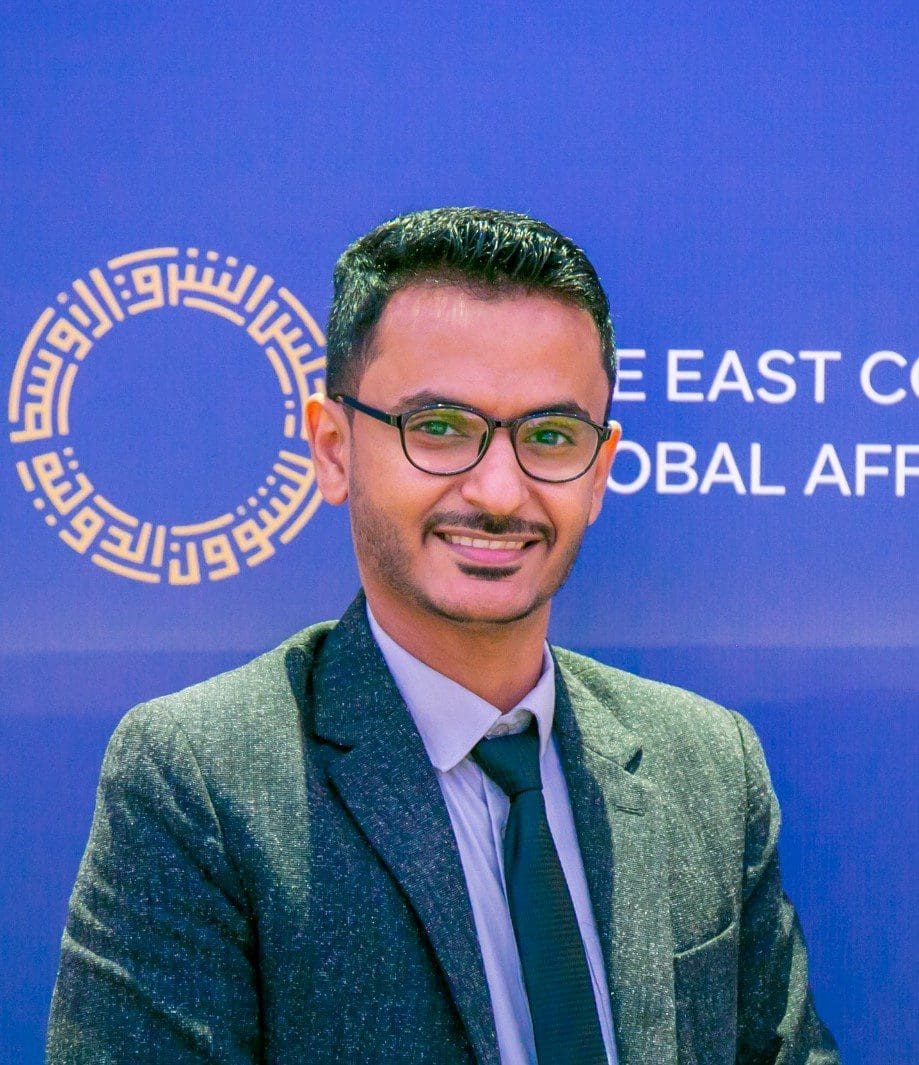
Visiting Fellow
Speakers

Chafic Choucair
Researcher at Al Jazeera Center for Studies

Haider Saeed
Head of the Gulf and Arabian Peninsula Studies Unit