

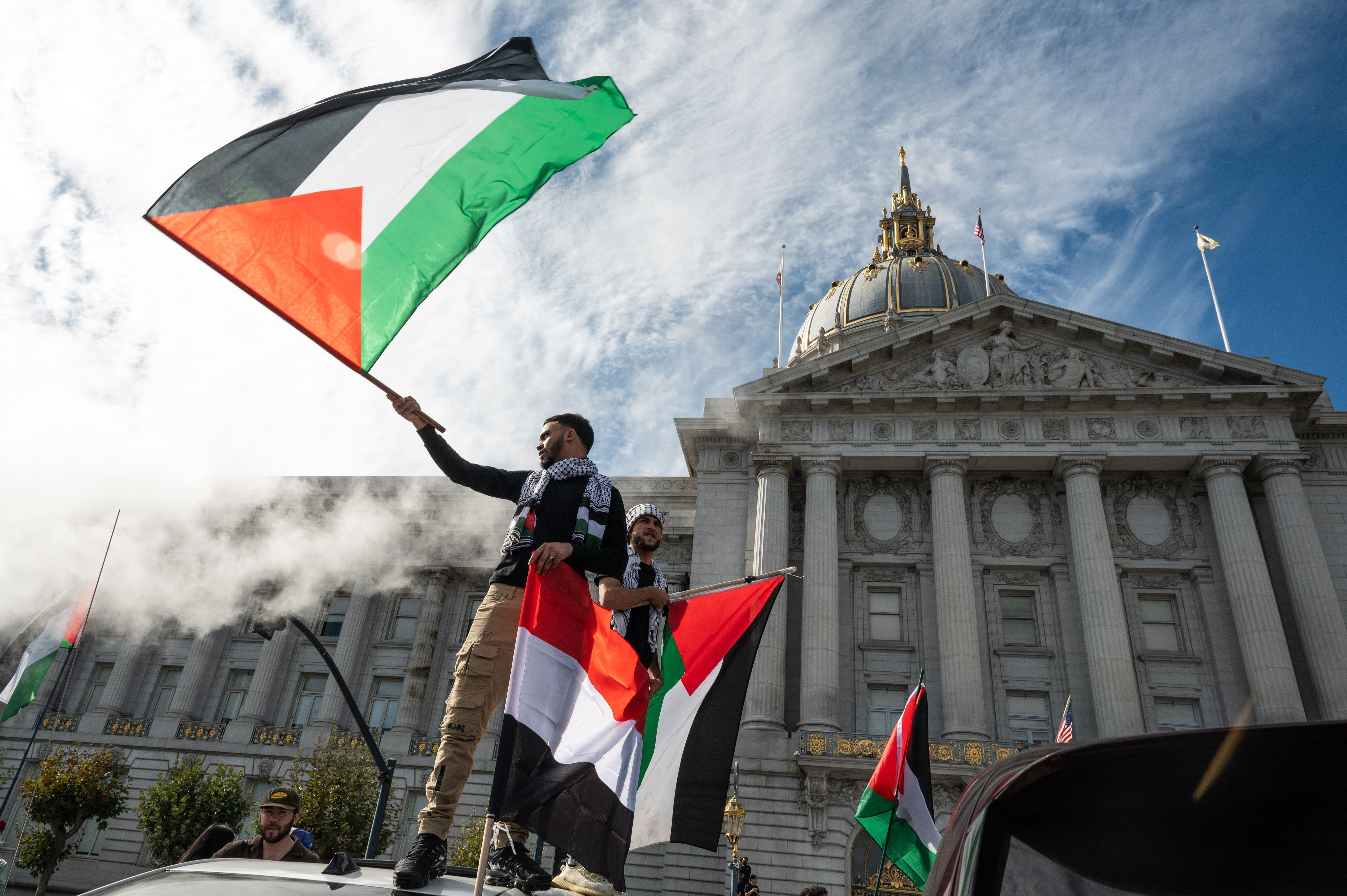
Palestinian Activism in the West after October 7: Opportunities and Challenges
June 2026

Human Rights Lawyer and Senior Fellow, Carnegie Endowment for International Peace
Introduction
The Palestinians living outside the Middle East constitute only a small fraction of the total population of the diaspora, roughly between 5–8%, ranging from 740,000 to 1.1 million persons.1 However, because most of this population lives within liberal democracies, they have an outsize influence on global activism in support of Palestinian national self-determination and rights and have been instrumental in shaping the global debate on Palestine/Israel. With wide socioeconomic differences and diverse lived experiences, political activism and organizing have offered Palestinian diaspora communities a point of unity and an opportunity to build social cohesion outside their ancestral homeland. Both the character and quality of diaspora activism have changed with the different waves of Palestinian immigration to the West, political events, the institutional decay of the Palestine Liberation Organization (PLO), and discrimination by host states that aimed to circumscribe or suppress such activism.2
This chapter examines diaspora communities in the United States, the United Kingdom, and Europe to understand: (1) how diaspora activism has evolved and what role it plays in the global movement for Palestinian rights; (2) the challenges and opportunities activists are facing since October 7, 2023; and (3) what lies ahead for the U.S. “peace plan” for Palestinians and Israelis amid a declining international legal order.
The Recent History and Character of the Palestinian Diaspora in the West
Palestinian immigrants moving to the West in the late 1960s, in the aftermath of the 1967 Arab-Israeli War, arrived without national institutions capable of supporting or providing direction for political activism in their adopted countries. The small Palestinian communities already established in North and South America were largely Christian and had some post-secondary education, which facilitated their social integration, often with the assistance of their local churches. Their activism tended toward political writing and direct engagement with policymakers and officials rather than street protest.3 Subsequent waves of regional conflict and political turmoil, however, brought increased Palestinian immigration to the US and Europe, including the 1970 PLO-Jordanian conflict, the 1982 Israeli invasion of Lebanon and civil war, the 1990 Iraqi occupation of Kuwait, and the mass expulsion of Palestinians from the Gulf that followed.4
Following the Fatah-led takeover of the PLO in 1969, its international recognition in 1974, and the opening of diplomatic offices in Western capitals, diaspora communities gained an institutional umbrella under which their cultural and political activism could be coordinated and supported. Central to this effort was the General Union of Palestinian Students (GUPS), a founding constituent member of the PLO, which linked university students worldwide to the national movement, promoted cultural programming, and helped direct activism on Palestine. At its height in the 1970s and 1980s, GUPS students—many of whom were first-generation immigrants to the West—maintained active affiliations with Palestinian political movements and factions, fostering sustained debate over the national movement’s direction, priorities, and strategic objectives.5
These movements were nationalist, leftist, secular, and anti-colonial, including Fatah, the Popular Front for the Liberation of Palestine (PFLP), the Democratic Front for the Liberation of Palestine (DFLP), and the Palestine Communist Party (PCP). Owing to their revolutionary character, they found common cause with similar counterparts in the West, including civil rights campaigners and the South African anti-apartheid movement. In Europe, where Palestinian populations were smaller and more dispersed, activism was channeled through a mix of cultural associations and solidarity groups. In 1986, the European Coordination of Committees and Associations for Palestine was established to amplify the work of the disparate organizations. In the US, village-based social groups originating from towns such as Ramallah, El Bireh, Deir Debwan, and Birzeit also helped mobilize protests to respond to events in the homeland.
The signing of the Oslo Accords in 1993 marked a fundamental shift in the Palestinian national movement away from national liberation and toward state-building in Gaza and the West Bank, with significant implications for diaspora communities. A rupture emerged between the newly established Palestinian Authority (PA) leadership and activists affiliated with Palestinian political factions and diaspora constituencies opposed to Oslo.6 The principal critique concerned whether Oslo’s “land for peace” formula sacrificed refugee rights and claims, and shifted the liberation movement’s center of gravity away from restitution and return to historic Palestine toward state-building within the occupied Palestinian territories.
As the PLO lost traditional sources of funding from Arab Gulf states, and donor assistance was redirected toward constructing the Palestinian proto-state, the organization and its institutions were hollowed out in favor of the PA. The result was that diaspora activism became unmoored from an organized national political framework. Without such PLO coordination and direction, the Palestinian diaspora in the US, for a period, also lost some of its connectivity with other anti-imperialist struggles. But even among those in the diaspora who supported the Oslo peace process and negotiations with Israel, political organizing around Palestine largely went dormant during the years of on-and-off-again Palestinian-Israeli peace talks.
Movement organizing would re-emerge when the Al Aqsa Intifada erupted in September 2000. Mobilization around Palestinian refugee rights also gained renewed prominence, including through the founding of US-based organizations like Al Awda Right to Return Coalition, a non-partisan, global, democratic association of grassroots activists and students, and as knowledge production on the right to return increased from Palestine-based organizations like Badil Center for Palestinian Residency and Refugee Rights in Bethlehem.
Palestinian Diaspora Activism After the Demise of the Oslo
During and after the Second Intifada, diaspora activism in the West increasingly centered on Israeli human rights violations, particularly extrajudicial killings and the complicity of Western governments in supplying military aid and weapons to Israel. As the Oslo peace process unraveled, anti-apartheid framing also became more widespread.7 In the United States, diaspora Palestinians and solidarity groups—such as Al Awda and the US Campaign to End the Israeli Occupation (later renamed as the U.S. Campaign for Palestinian Rights), an umbrella organization comprising more than 200 grassroots groups nationwide—focused their advocacy on either specific rights claims, most notably refugee rights, or on exposing U.S. involvement in human rights abuses abroad. Most organizing efforts deliberately avoided promoting a particular political outcome, both to sidestep intra-Palestinian divisions over the one-state versus two-state debate and because many organizations included substantial non-Palestinian memberships with limited stakes in any particular political framework. Consequently, activism by diaspora Palestinians and their allies tended to focus on their respective country’s role in furthering Israel’s military occupation and rights violations.
When the United States launched its “war on terror” following the September 11 attacks in 2001, the political space for Palestinian organizing in the West narrowed considerably. As armed Palestinian groups began using suicide bombing attacks against Israel, pro-Zionist organizations successfully cast all Palestinian resistance abroad and even human rights advocacy as forms of support for terrorism.8 Moreover, intensified surveillance and policing of Arabs and Muslim communities in the United States—through mechanisms such as “joint terrorism taskforces”—combined with Washington’s global leadership role on counterterrorism and tracking terrorism financing, made it more challenging for diaspora Palestinians to organize explicitly as Palestinians.9 Much of the diaspora activism for Palestine, therefore, tended to take place in coalition with other human rights, faith-based, and civil rights activity and organizing.
As the Second Intifada subsided in 2005, the Palestinian-Israeli peace process resumed, and the perceived threat to the American homeland from transnational terrorism diminished, Palestinian diaspora political organizing re-emerged more forcefully in the West. New and revitalized networks formed within major Christian denominations, Arab-American community organizations, the American Muslims for Palestine, and Students for Justice in Palestine, with parallel structures emerging across Europe and the UK. Though Palestinians tend to be a minority in these groups, they held leadership positions or were part of the steering committees.10 A central pillar of the early activism of these organizations, particularly after 2005, concerned supporting the global Palestinian call for boycott, divestment and sanctions (BDS) against Israel.11
Among more left-leaning organizations, a resurgence of cross-movement solidarity linked the Palestinian struggle to campaigns focused on women’s rights, anti-Black racism, and concerns related to immigrants and indigenous peoples.12 These engagements fostered greater awareness, education, and appreciation of the lived experiences of marginalized communities in Western societies and encouraged a shared understanding of and the common systems of oppression deployed domestically and abroad to control these populations. Given the relatively small size of Palestinian diaspora communities in the U.S., the UK, and Europe, this intersectional analytical framework has been critical to building political influence and sustaining long-term organizing capacity within their respective host countries.
Suppression of Diaspora Activism in the Age of Genocide: Opportunities and Challenges after October 7
Palestinian diaspora activism—particularly its investment in cross-movement coalition-building, engagement within solidarity networks, and narrative production through nontraditional media platforms—has been critical in reshaping the Western discourse on Palestine and Israel. Long before October 7, polling data in the U.S. pointed to shifting perceptions of Palestinians and their “conflict” with Israel among Democratic Party voters.13 Following the launch of Israel’s genocidal campaign in Gaza after October 7, 2023, however, these trendlines accelerated dramatically. According to a 2025 poll, 60 percent of Democrats reported greater sympathy for Palestinians, compared to only 12 percent for Israel,14 while more than half of American adults expressed an unfavorable view of Israel15—a figure that rose to 70 percent among adults aged 18 to 49.16 Sentiments have also shifted meaningfully among Republican Party voters: in March 2025, 37 percent of Republicans,17 and half of Republicans under 50, reported unfavorable views of Israel. More than 60 percent of Americans now agree that “Israel is playing a negative role in resolving key challenges in the Middle East.”18
Comparable shifts have occurred across Europe, where Palestinian-led and solidarity activism has achieved unprecedented public visibility and mobilization. Hundreds of thousands of people have turned out for pro-Palestine protests in Italy, the UK, France, Spain, Ireland, and elsewhere.19 For example, in Italy, a general strike held in October 2025 in solidarity with Gaza and a flotilla of international activists rallied 400,000 people nationwide and effectively shut down the country.20 In the UK, the Palestine Solidarity Campaign co-organized more than half a million people to protest the Gaza war in 2025.21 These mobilizations reflect not episodic outrage but a durable cultural and political shift in how Palestine is understood across broad segments of European societies.
Mounting grassroots pressure and widespread criticism of government inaction arguably pushed several European states and the UK to recognize the State of Palestine in 2024 and 2025. The European Union and individual member states began implementing—or seriously considering—punitive measures against Israel, including arms embargoes,22 divestment from companies complicit in human rights abuses,23 and the suspension of certain bilateral trade arrangements.24 Civil society-led efforts in support of BDS have been further mainstreamed. European artists, including prominent actors, joined hundreds of international counterparts in pledging not to screen, appear in films, or work with Israeli film institutions.25 Human rights groups and football/soccer fans launched the #GameOverIsrael campaign to exclude Israel from international tournaments, while Amnesty International (UK) and UN mandate holders called for teams based in illegal settlements to be banned from international sporting competitions and cultural events.26
These advances in Palestinian-led and solidarity activism, however, have provoked a fierce and coordinated backlash. Confronted with Israel’s rapidly deteriorating global public image—and the strategic openings this creates for Palestinians—Israeli partisans and allied institutions in the West have responded with unprecedented levels of punitive action. Drawing on entrenched institutional, financial, and political influence, Israel’s supporters have sought to brand virtually all criticism of Israel as antisemitic hate speech; criminalize pro-Palestine advocacy as material support for terrorism; and to suppress academic and cultural engagement with Palestinian history, identity, and lived experiences. In the U.S., this has included efforts to weaponize federal anti-discrimination statutes to legally proscribe criticism of Israel on university campuses.
Mainstream Western media has also had a significant role in manufacturing consent for Israel’s criminal military campaign and Western government support for it. While social media platforms have been instrumental in democratizing information flows from Gaza and Palestine, these same platforms have intensified content moderation practices that disproportionately target pro-Palestinian speech—through post removals, account suspensions, and algorithmic suppression. Although such practices have been well-documented,27 their scale and coordination have only expanded.
State repression has likewise intensified. In the United States, Palestinian student groups and solidarity organizations have been banned or had their non-profit status challenged.28 For instance, the Samidoun Prisoner Solidarity Network was designated as a terror organization by the United States and Canada because of its alleged association with the Popular Front for the Liberation of Palestine (PFLP), a previously-designated Palestinian political faction, despite an absence of evidence.29 In the UK, individuals have been arrested in large numbers for simply displaying signs showing support for Palestine Action, a group whose protest activities—mainly involving property damage—do not qualify as terrorism under British law, according to a leaked British intelligence report.30 In Germany, an academic institution was prevented from hosting a British physician with firsthand experience in Gaza from speaking via video conference, on the grounds that his anticipated criticism of Israel could be construed as antisemitic.31 More broadly, applicants for naturalization as citizens of Germany must now declare their support for Israel’s right to exist before qualifying.32
Taken together, these developments illustrate the depth and scope of repression now confronting Palestinian diaspora activism. Liberal democracies that formally enshrine freedom of expression have, in practice, constructed expansive regimes of censorship, surveillance, and punitory regimes to shield Israel from accountability. Yet the very intensity of the backlash also underscores the effectiveness of diaspora organizing: repression has escalated not despite the success of Palestinian-led activism, but because this activism has succeeded in reshaping public consciousness, undermining entrenched narratives, and threatening long-standing structures of impunity.
Conclusion
If measured by visibility in the public square, influence within civil society, and its growing traction in political and policy spaces, then Palestinian diaspora activism has undeniably punched far above its weight. Through coalition-building, narrative intervention, and sustained engagement across cultural and political arenas, the diaspora has helped shift public discourse in ways that would have been difficult to imagine even a decade ago.
Yet these advances remain structurally constrained. Diaspora advocacy continues to be hamstrung by severe repression at home, while the absence of a credible, accountable Palestinian national representative institution has prevented the translation of discursive and normative gains into political leverage. Rather than mobilizing the new rights-respecting discourse that has been advanced, the current leadership of the PLO and PA has largely accommodated the political initiatives of Western powers, including the so-called Trump Peace Plan for Gaza that effectively sidelines Palestinian national institutions in favor of an unaccountable international executive led by the US.33
At present, Palestinian national reconciliation, institutional reform, and the holding of Palestinian elections are not being pursued seriously by the existing leadership, while effective diaspora-led campaigns to impact internal Palestinian decision-making have not yet materialized. The result is a widening disconnect between international momentum and domestic political stagnation. Unless the diaspora and their compatriots in historic Palestine can also direct their collective power toward revitalizing their failing national institutions, the gains achieved internationally in reshaping the discourse on Palestine and Israel are unlikely to be translated into advances for national liberation.
Endnotes
1 Mohamed Khaled Ghumrawi, “Longing for the Homeland: The Palestinian American Diaspora and Palestinian Advocacy in the United States” (PhD diss., Florida International University, March 2022), 28, https://digitalcommons.fiu.edu/record/13647?v=pdf; “Palestinian Central Bureau of Statistics (PCBS) Presents the Conditions of the Palestinian Population on the Occasion of the World Population Day, 11/07/2024,” Palestine Central Bureau of Statistics, November 7, 2024, https://www.pcbs.gov.ps/post.aspx?lang=en&ItemID=5791.
2 For examples of the tools of repression and the impact this has had on pro-Palestinian advocacy, see: Zaha Hassan and H.A. Hellyer, eds., Suppressing Dissent: Shrinking Civic Space, Transnational Repression and Palestine/Israel (London: Oneworld Academic, 2024).
3 Maya Berry, “From Exclusion to Erasure: The Attempt to Silence Arab Americans on Palestine,” in Suppressing Dissent: Shrinking Civic Space, Transnational Repression and Palestine-Israel, eds. Zaha Hassan and H.A. Hellyer (London: Oneworld Academic, 2024), 206.
4 Toufic Haddad, “Palestinian Forced Displacement from Kuwait: The Overdue Accounting,” Al Majdal 44 (2010), https://badil.org/publications/al-majdal/issues/items/1355.html.
5 Saliem Wakeem Shehadeh, “Researching the General Union of Palestine Students from the Diaspora,” (PhD diss., University of California, Los Angeles, 2023), https://escholarship.org/content/qt9hm9h33z/qt9hm9h33z.pdf.
6 Jamil Hilal, “The Polarization of the Palestinian Political Field,” Journal of Palestine Studies 39, no. 3 (Spring 2010): 24–39, https://palquest.palestine-studies.org/sites/default/files/The_Polarization_of_the_Palestinian_Political_Field-Jamil_Hilal.pdf.
7 Omar H. Rahman, Apartheid and the Palestine Liberation Movement: Opportunities and Challenges, Analysis Paper (Doha: Middle East Council on Global Affairs, May 2023), https://mecouncil.org/wp-content/uploads/2023/05/MECGA_Analysis-Paper-3_Omar-Rahman.pdf.
8 Darryl Li, Anti-Palestinian at the Core: The Origins and Growing Dangers of U.S. Antiterrorism Law, Briefing Paper (New York: Center for Constitutional Rights, February 2024), https://ccrjustice.org/anti-palestinian-core-origins-and-growing-dangers-us-antiterrorism-law; Hatem Bazian, “The islamophobia industry and the demonization of Palestine: Implications for American studies,” American Quarterly 67, no. 4 (2015), https://doi.org/10.1353/aq.2015.0073.
9 Rama Izar, “US Hyper-Surveillance in the Name of Counterterrorism: Responses to State-Sanctioned Repression of Arabs and Muslims Then and Now,” Public Interest Law Reporter 29, no. 2 (2024), https://lawecommons.luc.edu/pilr/vol29/iss2/7.
10 This is based on the author’s experience and involvement during the period in question, where she served as co-chair of the US Campaign, co-chair of the Middle East subcommittee of the National Lawyers Guild, and founded Americans United for Palestinian Human Rights in Oregon.
11 “What’s Behind the Rise of BDS?” BDS Movement Official Website, August 7, 2014, https://bdsmovement.net/news/what’s-behind-rise-bds.
12 Lori Allen, “What’s in a Link?: Transnational Solidarities across Palestine and their Intersectional Possibilities,” South Atlantic Quarterly 17, no. 1 (2018), https://doi.org/10.1215/00382876-4282064; Ruba Salih, Elena Zambelli, and Lynn Welchmann, “‘From Standing Rock to Palestine we are United’: diaspora politics, decolonization and the intersectionality of struggles,” Ethnic and Racial Studies 44, no. 7 (2020), https://doi.org/10.1080/01419870.2020.1779948.
13 Lydia Saad, “Democrats’ Sympathies in Middle East Shift to Palestinians,” Gallup, March 16, 2023, https://news.gallup.com/poll/472070/democrats-sympathies-middle-east-shift-palestinians.aspx.
14 “Majority Of Voters Oppose GOP Budget Bill, With Just 67% Of Republicans In Support, Quinnipiac University National Poll Finds; Trump Job Approval: 38%, His Handling Of Russia – Ukraine War Lowest Among List Of Issues,” Quinnipiac University Poll Release, June 11, 2025, https://poll.qu.edu/poll-release?releaseid=3924.
15 Laura Silver, “How Americans View Israel and the Israel-Hamas War at the Start of Trump’s Second Term,” Pew Research Center, April 8, 2025, https://www.pewresearch.org/short-reads/2025/04/08/how-americans-view-israel-and-the-israel-hamas-war-at-the-start-of-trumps-second-term/.
16 “Negative views of Israel have risen in the U.S.,” Pew Research Center, April 8, 2025, https://www.pewresearch.org/short-reads/2025/04/08/how-americans-view-israel-and-the-israel-hamas-war-at-the-start-of-trumps-second-term/sr_25-04-08_us-views-of-israel_4/.
17 Silver, “How Americans View Israel.”
18 Dina Smeltz and Lama El Baz, Americans Grow More Divided on US Support for Israel (Chicago: Chicago Council on Global Affairs, May 2025), https://globalaffairs.org/research/public-opinion-survey/americans-grow-more-divided-us-support-israel.
19 “Hundreds of Thousands Turn Out at Pro-Palestine Protests Across Europe,” Al Jazeera, October 5, 2025, https://www.aljazeera.com/gallery/2025/10/5/hundreds-of-thousands-turn-out-at-pro-palestine-marches-across-europe.
20 Sarah Rainsford, “Italians Stage Strike in Support of Gaza Palestinians,” BBC, October 4, 2025, https://www.bbc.com/news/articles/cy8rdd5dzvro.
21 “Half a million march to Downing Street to urge Starmer to cut ties with Israel,” Middle East Eye, May 17, 2025, https://www.middleeasteye.net/news/half-million-march-downing-street-urge-end-uk-israel-ties.
22 Alia Shoaib, “Map of Countries That Have Stopped Weapons Exports to Israel,” Newsweek, August 8, 2025, https://www.newsweek.com/map-countries-weapons-exports-israel-2110947.
23 Jenny Reid, “World’s Largest Sovereign Wealth Fund Exits Caterpillar and Five Banks on Israel Concerns,” CNBC, August 26, 2025, https://www.cnbc.com/2025/08/26/norways-giant-wealth-fund-exits-six-firms-on-israel-concerns.html.
24 Maïa de la Baume, “EU’s partial suspension of trade with Israel: Appropriate or significant?” Euro News, September 17, 2025, http://www.euronews.com/my-europe/2025/09/17/the-eus-partial-suspension-of-trade-with-israel-appropriate-or-insignificant.
25 “Film Workers Pledge to End Complicity,” Film Workers for Palestine, accessed April 5, 2026, https://filmworkersforpalestine.org/#endingcomplicity.
26 David Smith, “Boycotting Israel has gone mainstream: We’ve never seen such traction before,” The Guardian, October 11, 2025, https://www.theguardian.com/world/2025/oct/11/israel-global-boycott.
27 Hassan and Hellyer, Suppressing Dissent.
28 Brendan Farrington and Collin Binkley, “Florida Orders State Universities to Disband Pro-Palestinian Group,” AP News, October 23, 2023, https://apnews.com/article/israel-palestine-desantis-florida-education-sjp-12b4d4f2bdd8618c12b8a29cc852be25.
29 US Department of the Treasury, “United States and Canada Designate Key International Fundraiser for Foreign Terrorist Organization PFLP,” Press Release, October 14, 2024, https://home.treasury.gov/news/press-releases/jy2646.
30 Jane Bradley, Adam Goldman, and Lizzie Dearden, “Secret Report Undercuts UK Condemnations of Pro-Palestinian Group,” The New York Times, September 12, 2025, https://www.nytimes.com/2025/09/12/world/europe/palestine-action-uk-government-assessment.html.
31 “German Police Shut Down Pro-Palestinian Conference,” DW, March 13, 2024, https://www.dw.com/en/german-police-shut-down-pro-palestinian-conference/a-68810306.
32 Sophie Tanno, “Germany demands new citizens accept Israel’s right to exist,” CNN, June 27, 2024, https://edition.cnn.com/2024/06/27/europe/german-citizens-israel-right-to-exist-intl.
33 “Trump’s 20-Point Peace Plan in Full,” BBC, October 9, 2025, https://www.bbc.com/news/articles/c70155nked7o.
Related
Publications

The Palestinians living outside the Middle East constitute only a small fraction of the total population of the diaspora, roughly between 5–8%, ranging from 740,000 to 1.1 million persons. However, because most of this population lives within liberal democracies, they have an outsize influence on global activism in support of Palestinian national self-determination and rights and have been instrumental in shaping the global debate on Palestine/Israel. With wide socioeconomic differences and diverse lived experiences, political activism and organizing have offered Palestinian diaspora communities a point of unity and an opportunity to build social cohesion outside their ancestral homeland.
learn more