
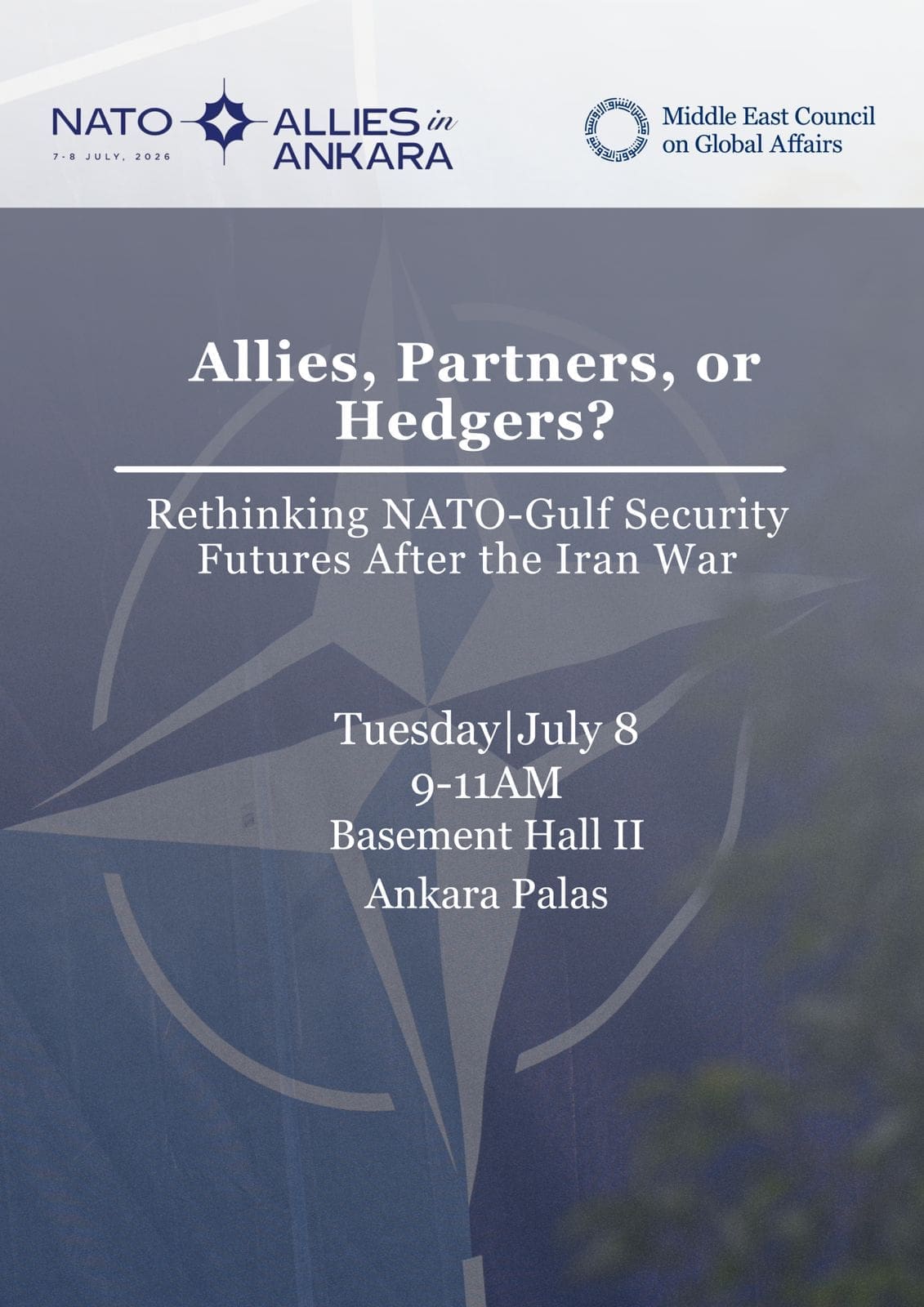
Two decades after the Istanbul Cooperation Initiative was launched, this side event examines how NATO–Gulf relations should evolve amid growing links between Gulf security and Euro-Atlantic stability. The discussion will explore practical cooperation on air and missile defense, maritime security, cybersecurity, counter-UAS, interoperability, training, and critical infrastructure protection, as well as Türkiye’s role in shaping future NATO–Gulf security cooperation.
Event Type: Closed Roundtable
Building Resilience and Comprehensive Security in the Gulf: Lessons from Transatlantic Cooperation and NATO-Gulf Partnerships

As Gulf states face a more complex security environment marked by geopolitical competition, cyber threats, disinformation, and risks to critical infrastructure and supply chains, resilience and comprehensive security have become increasingly important. This workshop brought together officials, diplomats, scholars, and security experts to discuss practical approaches to strengthening preparedness and advancing NATO-Gulf cooperation.
Qatar’s Economy and Energy Markets Amid Regional Conflict

The ongoing US-Israel-Iran conflict has introduced significant uncertainty into Gulf economies and global energy markets. While elevated energy prices may provide short-term fiscal benefits for hydrocarbon exporters, disruptions to trade routes, heightened geopolitical risk, supply chain challenges, and volatility in financial and commodity markets pose important risks to economic stability and growth. For Qatar, the… Continue reading Qatar’s Economy and Energy Markets Amid Regional Conflict
The Future of US-Gulf Relations: Regional Dynamics, Challenges, and Opportunities in the Era of a New US Administration

For decades, the United States and the Gulf Cooperation Council (GCC) states have shared a deeply rooted and multidimensional partnership shaped by strategic, economic, and cultural ties.
Beyond the Great Powers: The Rise of Middle Power Diplomacy in the Middle East

As middle powers from the Middle East and North Africa assume more prominent mediation roles, they are reshaping the global landscape of conflict resolution. This workshop—part of a joint UCLA Burkle Center and Middle East Council project—examined the motivations, scope, and impact of these emerging mediators, and how their efforts are influencing both regional dynamics and the approaches of traditional peace brokers. Hosted by the Gulf Research Center in Brussels, the discussion brought together experts to analyze country case studies and explore the evolving geopolitics of mediation in a rapidly shifting international order.
Regional Conflict Dynamics and Pathways to Peace in the Horn of Africa and the Middle East: The Doha Synthesis Dialogue

The Doha Synthesis Dialogue, co-organized by the Folke Bernadotte Academy and the Middle East Council on Global Affairs, brings together experts from the Horn of Africa and the Middle East to bridge perspectives, synthesize findings, and chart pathways toward sustainable peace. Building on workshops held in Beirut and Nairobi, the Dialogue aims to translate regional analysis into actionable steps for cooperation and stability across the Red Sea region.
Water Diplomacy and Governance in the MENA Region

Water resources across the Middle East and North Africa (MENA) are facing mounting pressures from both climate change and political instability. As droughts intensify and transboundary water tensions grow, regional cooperation has become indispensable. To address these challenges, the Middle East Council on Global Affairs (ME Council), in partnership with the Blue Peace Middle East Initiative and the Geneva Water Hub, and with support from the Embassy of Switzerland in Qatar, convened a roundtable to explore how water can serve as a vehicle for peacebuilding, diplomacy, and governance. The discussions aimed to identify shared policy priorities, strengthen regional collaboration, and lay the foundation for sustainable water security across the MENA region.