
After the War: Reorienting Gulf Economic Strategy
June 15, 2026
Summary
The U.S.-Israel Iran war has exposed a range of strategic and economic vulnerabilities for Qatar. As host to major U.S.–Qatari defense cooperation facilities at Al Udeid, the world’s largest LNG exporter, a state pursuing an ambitious economic diversification agenda under Qatar National Vision 2030, and one of the region’s leading diplomatic actors, Qatar has faced simultaneous pressures across the security, energy, economic, and diplomatic domains. The conflict has highlighted the extent to which regional instability can directly affect critical infrastructure, energy exports, investor confidence, trade routes, and broader economic planning assumptions across the Gulf.
While the ceasefire may reduce the immediate risks of escalation, it does not necessarily resolve the structural drivers of regional instability or fully restore the Gulf’s reputation as a stable destination for investment, trade, and global talent. Continued uncertainty surrounding the regional security environment may shape future perceptions of risk among investors, businesses, and expatriate communities, raising important questions about economic resilience and long-term strategic planning. In this context, the implications for Qatar’s economic model and diversification strategy extend beyond short-term crisis management and point toward broader structural considerations.
Against this backdrop, the Middle East Council on Global Affairs (ME Council), in partnership with the College of Public Policy at Hamad Bin Khalifa University (HBKU), convened a webinar to examine how the war may reshape Qatar’s long-term economic strategy and regional role. The discussion explored how policymakers can balance immediate stabilization priorities with longer-term efforts to strengthen economic resilience in an increasingly uncertain geopolitical environment. The panel addressed three interrelated questions: How should Qatar National Vision 2030 adapt to a more volatile regional environment while preserving its long-term diversification objectives? What does it mean to integrate geopolitical and security risks more systematically into economic planning, investment, and fiscal strategy? What role can Qatar play in strengthening regional economic coordination and resilience in the post-war Gulf?
Moderator

Associate Professor, College of Public Policy, HBKU
Speakers
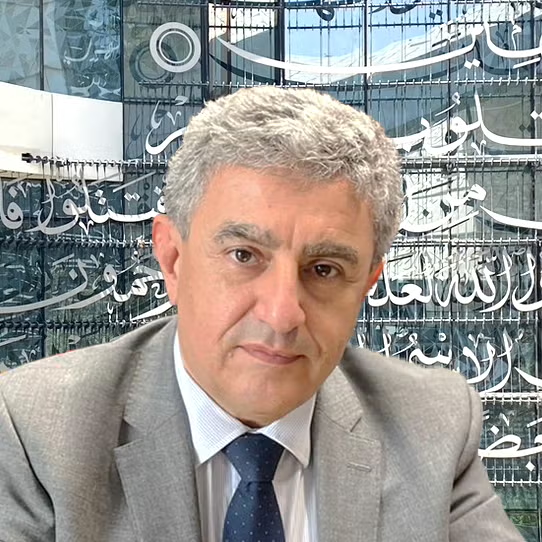
Sultan Barakat
Professor at the College of Public Policy, Hamad Bin Khalifa University.
Dr. Mohammed Al-Hashemi
Energy Expert, Qatar